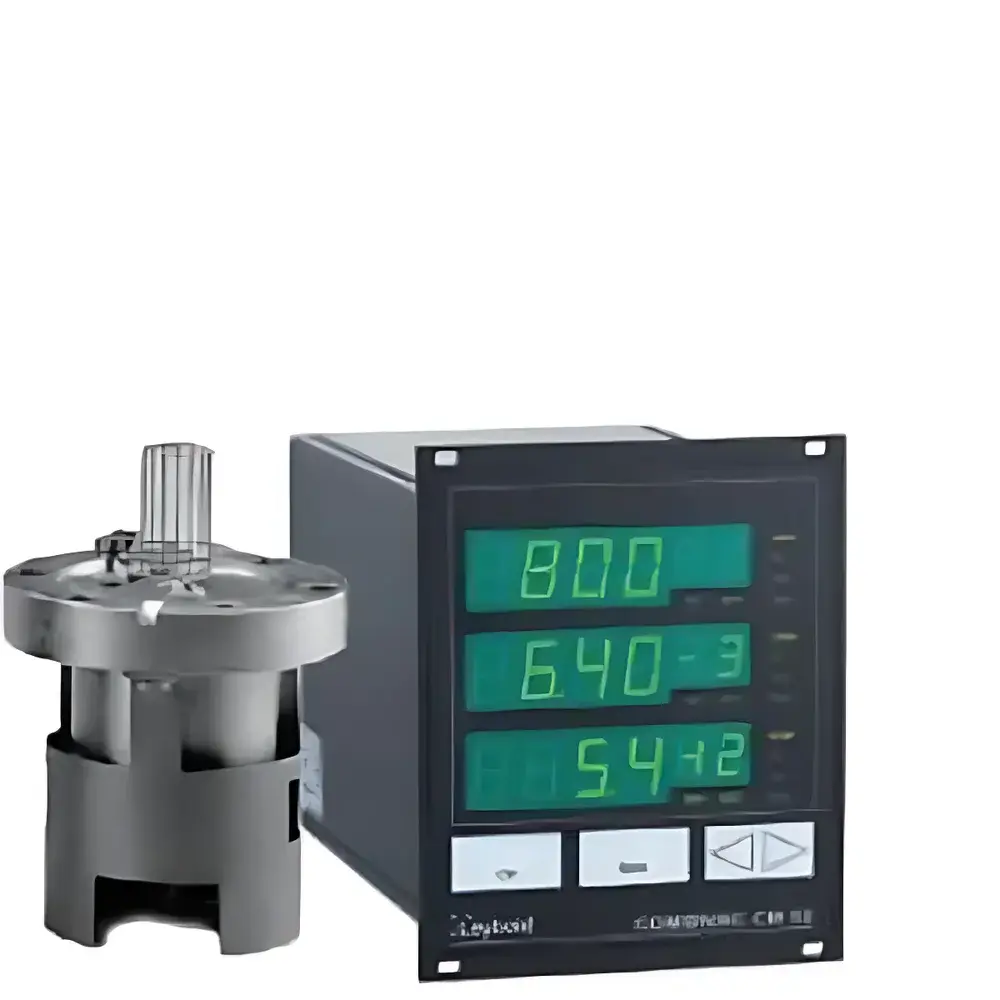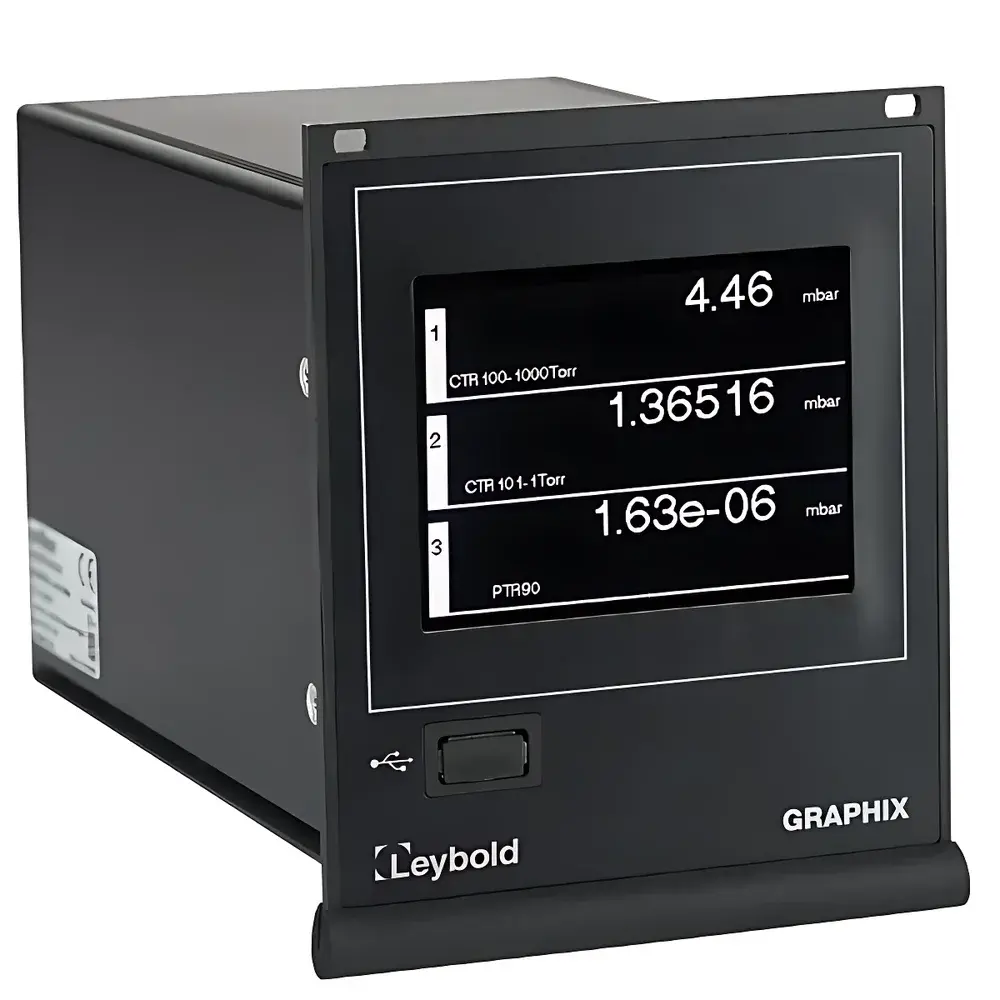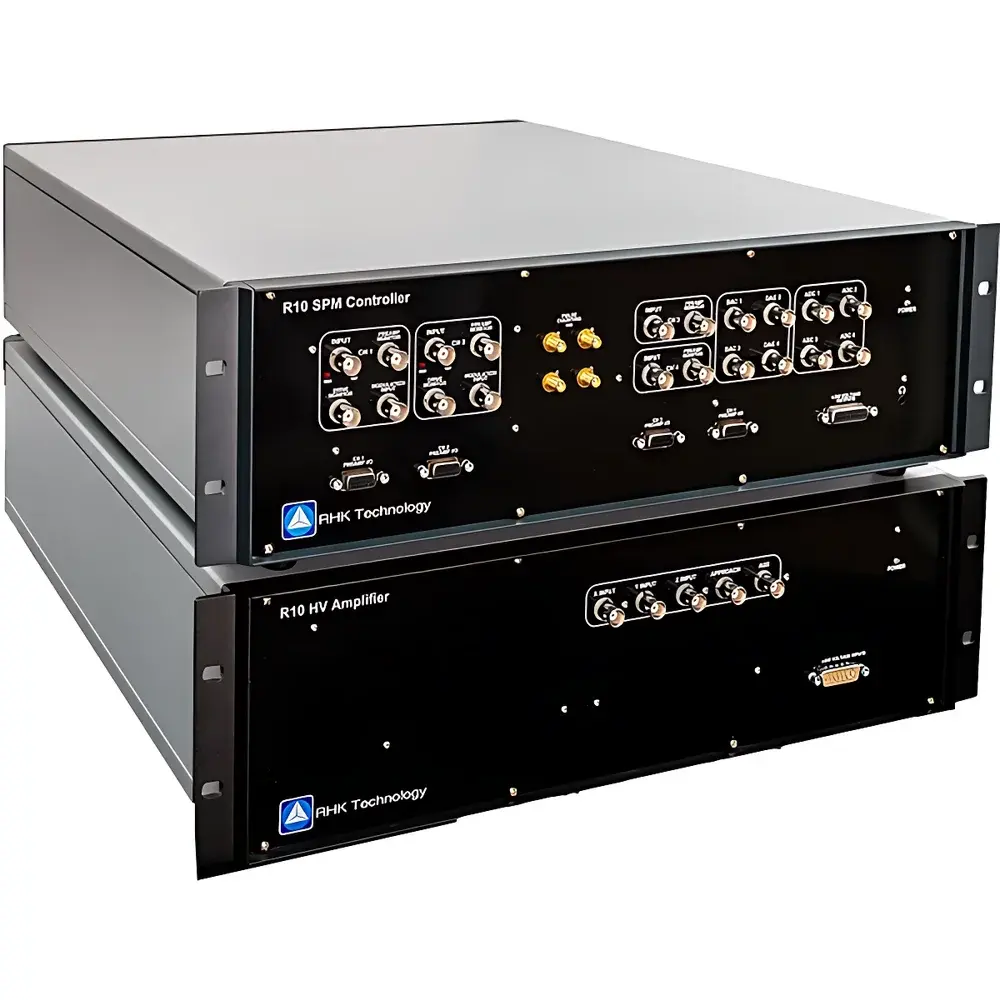
RHK Technology R10 Scanning Probe Microscope Controller
| Brand | RHK Technology |
|---|---|
| Origin | USA |
| Model | R10 |
| Type | Integrated Digital SPM Control Platform |
| FPGA Architecture | Reconfigurable Xilinx UltraScale+ |
| Data Channels | 64+ synchronized analog/digital I/O |
| Scan Speed | Up to 5× faster than R9 |
| HV Output Noise | ≤25% of R9 baseline |
| Dual SPM System Support | Yes |
| Position Resolution (Z modulation) | Down to 10 pm RMS |
| Bias Modulation | 10 µV–10 Vpp, DC–10 MHz |
| ADC/DAC Resolution | 16–24 bit, adaptive sampling up to 100 MS/s |
| Compliance | Fully compatible with ASTM E2531, ISO/IEC 17025 workflows, and GLP/GMP data integrity requirements (21 CFR Part 11 audit trail ready via optional software module) |
Overview
The RHK Technology R10 Scanning Probe Microscope Controller is a high-fidelity, field-programmable gate array (FPGA)-based digital control platform engineered for precision operation of scanning tunneling microscopy (STM), atomic force microscopy (AFM), and related scanning probe techniques. Unlike legacy analog controllers, the R10 implements all signal generation, demodulation, feedback computation, and data acquisition within a deterministic, low-latency digital domain—eliminating analog drift, crosstalk, and calibration dependency. Its core architecture leverages a Xilinx UltraScale+ FPGA, enabling real-time reconfiguration of control algorithms, filter coefficients, and I/O routing without system reboot. The controller supports both constant-current (STM) and constant-height (AFM) modes, as well as advanced variants including multi-frequency Kelvin probe force microscopy (KPFM), time-resolved spectroscopy, and lock-in detection across multiple harmonics. Designed for integration into ultra-high vacuum (UHV), cryogenic (≤4 K), and ambient laboratory environments, the R10 delivers sub-picometer Z-position resolution and microvolt-level bias modulation fidelity—critical for quantitative surface electronic structure mapping and nanoscale electrostatic characterization.
Key Features
- FPGA-Centric Architecture: All control loops—including feedback, modulation, demodulation, and synchronization—are executed in hardware logic with deterministic latency (<500 ns), ensuring phase coherence and reproducibility across long-duration scans.
- Dual Independent SPM Control: One R10 unit simultaneously manages two physically separate scanning systems—e.g., coarse/fine piezo stages or two independent probe heads—enabling correlated multimodal imaging or parallel sample characterization.
- Multi-Rate Synchronized Data Acquisition: Combines ultra-high-speed (16-bit @ 100 MS/s) and high-resolution (22-bit @ 25 kHz) digitization paths on shared timing references, preserving temporal alignment between topography, current, spectroscopic, and auxiliary sensor signals.
- Advanced Feedback Engine: Nine fully configurable PID/PI²D loops operating at up to 200 kHz bandwidth; supports cascaded, feedforward, and gain-scheduled configurations for nonlinear tip-sample interactions.
- Digital Lock-in Capability: Six independent lock-in amplifiers (each with dual-phase demodulation), plus two programmable PLLs—capable of tracking reference frequencies from 10 MHz and demodulating sidebands under rapid frequency sweeps.
- Hardware-Enforced Safety Protocols: Probe approach protection triggers within 5 µs upon threshold violation; automatic retraction and resumption upon parameter recovery; time-stamped event logging for failure root-cause analysis.
- Open Software Integration: Native support for LabVIEW, MATLAB, and Python via IHDL (Interactive Hardware Description Language) SDK; no proprietary runtime licenses required; full access to all 60+ I/O signals for custom experiment orchestration.
Sample Compatibility & Compliance
The R10 controller interfaces seamlessly with commercial and custom-built SPM hardware—including RHK’s own Omicron VT-STM and Cryo-SPM stages—as well as third-party scanners compliant with standard ±10 V deflection and ±100 V piezo drive interfaces. It meets electromagnetic compatibility (EMC) requirements per FCC Part 15 Class A and CE EN 61326-1. For regulated environments, optional firmware modules enable 21 CFR Part 11-compliant audit trails, electronic signatures, and data integrity validation—fully traceable to individual scan lines, parameter changes, and user actions. All acquired datasets embed ISO/IEC 17025-mandated metadata: timestamp (UTC), operator ID, instrument configuration hash, environmental logs (if connected sensors present), and calibration certificate references.
Software & Data Management
R10 operates with RHK’s cross-platform acquisition suite, which stores raw binary data in HDF5 format—preserving bit-identical fidelity, hierarchical metadata, and extensible attributes for future analysis pipelines. Each scan line is written directly to HDD upon completion, preventing data loss during power interruption. The system maintains an onboard buffer of the last 100 acquisitions (including spectra, FFTs, oscilloscope traces, and transient captures), accessible via network or USB. Time-based event logging records every parameter change—including scan speed, setpoint, bias voltage, and feedback gains—at sub-pixel temporal resolution, and overlays these annotations directly onto saved images. Diagnostic tools include a 100 MS/s transient recorder (1 s duration, 50 MHz bandwidth), 4-channel oscilloscope mode (50 kHz update), and a five-day continuous data logger—essential for stability benchmarking and noise source identification.
Applications
- Quantitative STM spectroscopy for bandgap mapping and quasiparticle interference imaging
- Multi-harmonic AFM in vacuum and liquid environments for viscoelastic property extraction
- Time-resolved KPFM with simultaneous topographic and contact potential difference (CPD) mapping
- In-situ electrochemical SPM during battery electrode cycling or catalyst surface reconstruction
- Low-temperature quantum material characterization (e.g., superconducting vortices, magnetic skyrmions)
- Correlative SPM–optical microscopy via synchronized trigger I/O and TTL-gated photon counting
FAQ
Does the R10 support third-party scanning probes and preamplifiers?
Yes—the R10 provides standardized ±10 V analog I/O, TTL/CMOS digital triggers, and configurable impedance matching (50 Ω / 1 MΩ) to interface with most commercially available SPM front-ends and external current/voltage preamps.
Can I run custom feedback algorithms on the R10 FPGA?
Yes—via the IHDL SDK, users can synthesize custom control logic directly into the FPGA fabric using VHDL or Verilog; compiled bitstreams are loaded dynamically without interrupting ongoing experiments.
Is real-time spectral visualization supported during acquisition?
Yes—the acquisition software displays up to 10 concurrent I(V) or dI/dV spectra in real time, with per-pixel spectral extraction, derivative calculation, and background subtraction—all computed on-the-fly from raw FPGA-streamed data.
What is the minimum detectable Z-modulation amplitude?
With optimized filtering and averaging, the R10 achieves 10 pm RMS Z-position modulation resolution when driving high-quality piezoelectric actuators with low intrinsic noise and mechanical hysteresis.
How is data provenance ensured for publication-grade research?
All datasets include embedded cryptographic hashes of acquisition parameters, firmware version, calibration history, and user-defined experimental notes—enabling full reproducibility and compliance with journal data deposition policies (e.g., Nature, Science, PRL).