
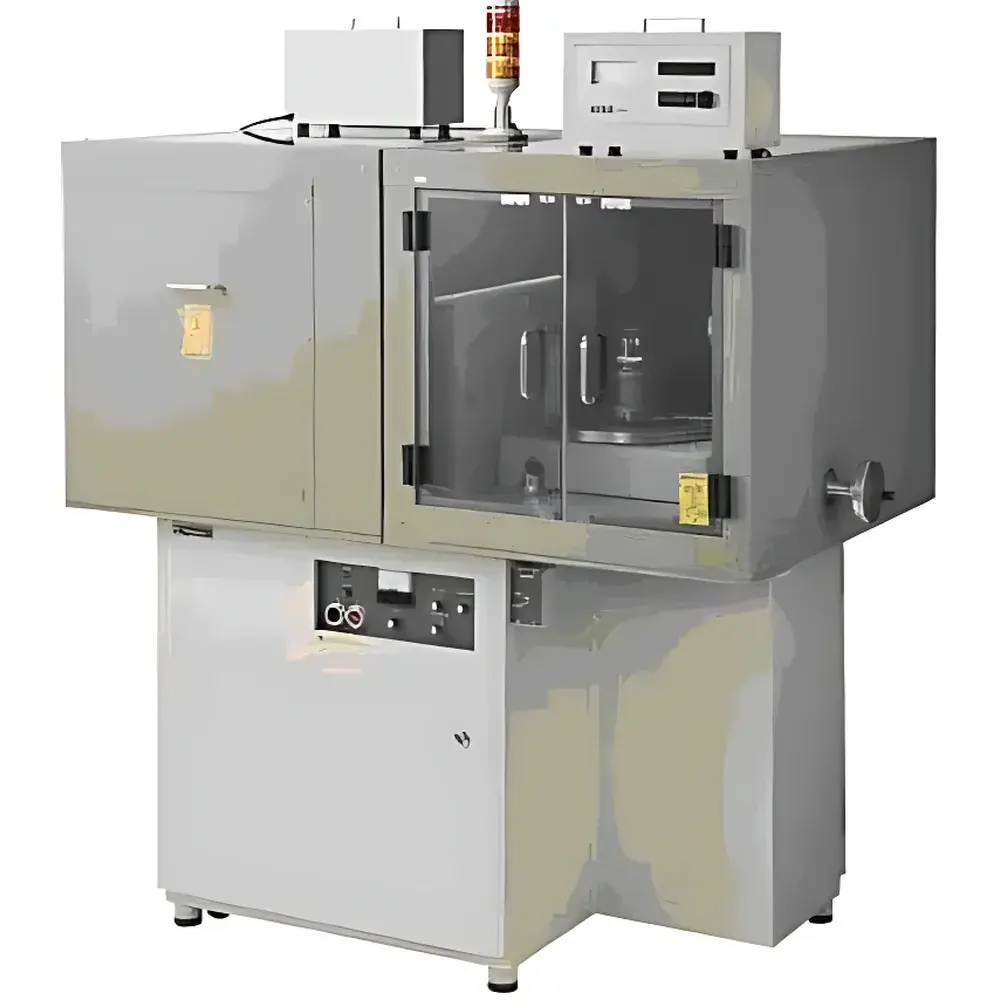
Rigaku 2991F2 Sapphire Single-Crystal X-ray Orientator
| Brand | Rigaku |
|---|---|
| Origin | Japan |
| Model | 2991F2 |
| Instrument Type | Single-Crystal X-ray Diffractometer |
| Configuration | Floor-Standing |
| X-ray Target | Cu |
| Max. Tube Voltage/Current | 30 kV / 5 mA |
| Cooling | Air-Cooled |
| Angular Range | 2θ = 0°–110°, θ = −10°–60° |
| Angular Resolution | 30 arcseconds (total system accuracy) |
| Detector | 2-inch Scintillation Counter |
| Output | Analog Signal |
| Time Constants | 0.1 s / 0.4 s (switchable) |
| Beam Shielding | 1 mm Pb-lined metal enclosure |
| Dimensions (per shield) | 580 mm (W) × 730 mm (D) × 530 mm (H) |
Overview
The Rigaku 2991F2 Sapphire Single-Crystal X-ray Orientator is a precision floor-standing instrument engineered for high-accuracy crystallographic orientation determination of sapphire (Al2O3) wafers, boules, and rods. Based on Bragg’s law and monochromatic Cu-Kα X-ray diffraction, the system enables rapid, repeatable identification of crystallographic planes—particularly the (0001) basal plane and common off-axis orientations such as A-, C-, R-, and M-planes—critical for epitaxial growth substrate preparation, LED/sapphire wafer slicing, and optoelectronic device manufacturing. Unlike polycrystalline or powder XRD systems, the 2991F2 employs a fixed-anode Cu X-ray tube and a mechanically coupled θ/2θ goniometer to deliver deterministic angular positioning with ≤30 arcsecond total measurement uncertainty. Its air-cooled tube architecture ensures stable operation in standard laboratory environments without external chiller infrastructure, while integrated safety interlocks and lead-lined shielding comply with IEC 61010-1 and national radiation safety regulations.
Key Features
- High-stability Cu-target X-ray source operating up to 30 kV / 5 mA, regulated via SCR-controlled tube current with ±0.5 mA stability at 3 mA under ±10% line voltage fluctuation
- Dual-axis goniometer with continuous θ rotation (−10° to +60°) and 2θ scanning (0° to 110°), equipped with digital angle readout and programmable step-angle setting
- Interchangeable divergence slits (0.05 mm, 0.1 mm, 0.2 mm) for optimized beam collimation and angular resolution trade-off based on sample size and mosaicity
- Rotating mechanical shutter synchronized with detector gating to minimize background and ensure precise exposure timing
- Dedicated manual shutter mounted directly on the X-ray tube housing for rapid beam interruption during alignment
- Integrated leakage current protection and visual X-ray status indicator (warning lamp) for real-time operational feedback
- Modular design supports dual-goniometer configuration for parallel sample evaluation—a capability frequently leveraged in high-throughput sapphire wafer QC workflows
Sample Compatibility & Compliance
The 2991F2 accommodates standard sapphire rods (up to Ø25 mm × 150 mm), rectangular wafers (up to 100 × 100 mm), and irregularly shaped crystals via optional motorized or manual sample stages (e.g., XYZ translation, tilt-adjustable holders). All configurations maintain alignment fidelity within the specified angular tolerance envelope. The instrument conforms to ISO 12718:2017 (X-ray equipment — Safety requirements) and incorporates fail-safe interlocks: opening either of the two full-metal radiation shields (each lined with 1 mm Pb) automatically terminates X-ray emission. The system is designed for use in ISO/IEC 17025-accredited laboratories and supports documentation traceability required for GLP-compliant crystallographic qualification reports.
Software & Data Management
While the base 2991F2 operates via hardware-based analog signal acquisition and manual angle control, it is fully compatible with Rigaku’s optional PC-based acquisition software (e.g., PDXL or CrystalClear Suite) for digitized scan logging, peak indexing, and orientation matrix export (Euler angles, Miller indices). Analog output permits integration with third-party DAQ systems supporting IEEE 488 (GPIB) or USB-ADC interfaces. Audit trails—including operator ID, timestamp, slit configuration, and applied voltage/current—are retained when used with compliant software modules satisfying FDA 21 CFR Part 11 requirements for electronic records and signatures.
Applications
- Orientation verification of sapphire substrates prior to GaN epitaxy in LED and power electronics fabrication
- Crystallographic axis alignment of sapphire rods for laser host material processing
- Quality assurance of off-cut angle consistency in sapphire wafers used in RF MEMS and optical windows
- Research-grade lattice parameter validation for doped or strained sapphire crystals
- Calibration reference setup for automated X-ray orienting systems in production environments
FAQ
Is the 2991F2 suitable for non-sapphire single crystals?
Yes—the instrument can determine orientations of any crystalline material with sufficient X-ray scattering power and known unit cell parameters; however, its optical and geometric calibration is optimized for sapphire’s hexagonal symmetry and typical lattice spacing.
Can the system be upgraded to automated data collection?
Yes—via integration with Rigaku’s motorized goniometer controllers and PDXL software, enabling programmable scans, automatic peak search, and batch reporting.
What safety certifications does the radiation enclosure meet?
Each shield meets IEC 61010-1:2010 (measurement/control laboratory equipment) and local regulatory limits for leakage radiation (<1 µSv/h at 5 cm from surface) when properly installed and interlocked.
Is remote diagnostics supported?
Hardware-level diagnostics are accessible via front-panel indicators and analog monitoring points; full remote troubleshooting requires optional Ethernet-enabled controller modules and Rigaku’s service portal access.
Does the system support USP or ASTM F2792 compliance for crystallographic testing?
While not a pharmacopoeial instrument per se, its angular accuracy, repeatability, and documentation capabilities enable method validation aligned with USP particulate matter guidance and ASTM F2792-18 (Standard Practice for X-ray Diffraction Analysis of Crystalline Materials) when operated under documented SOPs.





