
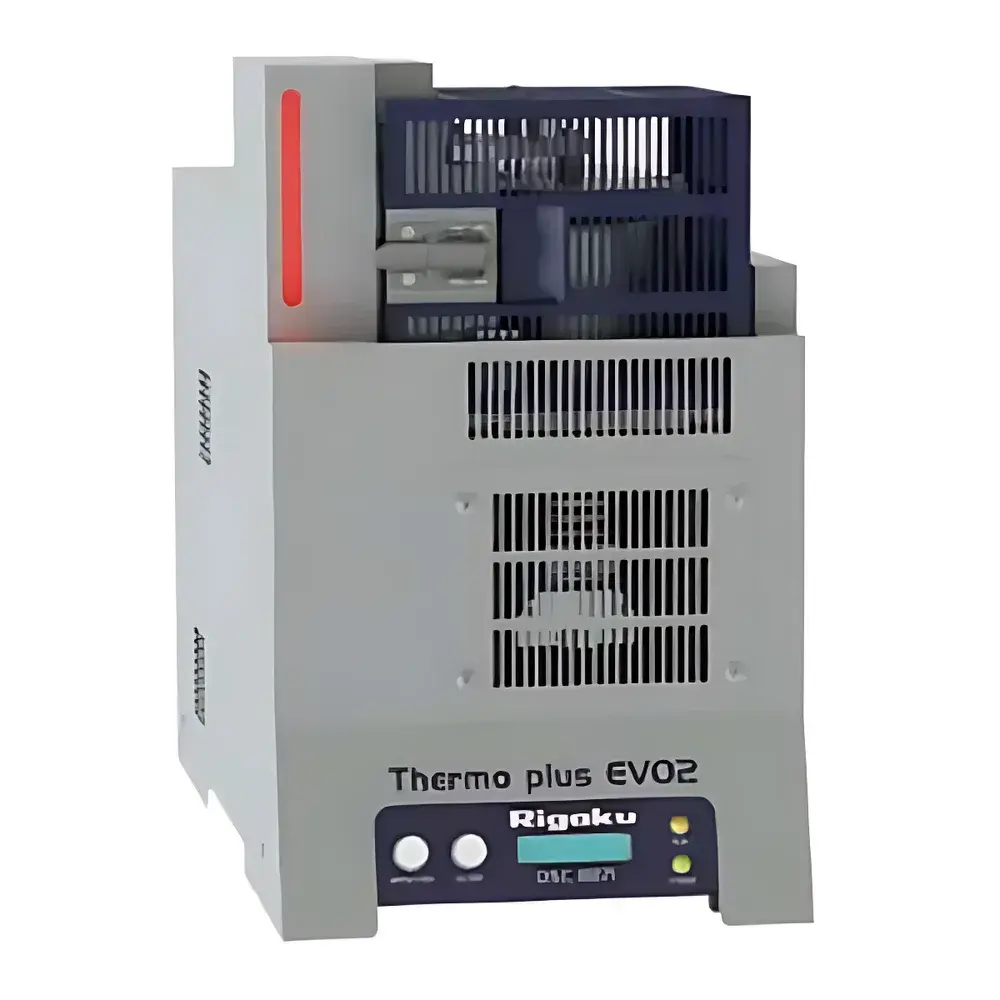
Rigaku DSC8271 Differential Scanning Calorimeter
| Brand | Rigaku |
|---|---|
| Origin | Japan |
| Instrument Type | DSC |
| Temperature Range | Ambient to 1500 °C |
| Manufacturer Status | Authorized Distributor (Non-OEM) |
| Origin Category | Imported Instrument |
| Model | DSC8271 |
Overview
The Rigaku DSC8271 Differential Scanning Calorimeter is a high-temperature, precision thermal analysis instrument engineered for quantitative measurement of heat flow differences between a sample and inert reference as a function of temperature or time. Based on the heat-flux DSC principle, it employs dual-sensor thermopile arrays mounted on a single ceramic sensor platform to deliver high sensitivity, baseline stability, and excellent signal-to-noise ratio across an extended operational range. Designed for rigorous materials research and industrial quality control, the DSC8271 supports dynamic and isothermal scanning protocols under controlled atmospheres (inert, oxidative, or reducing), enabling characterization of phase transitions, crystallization kinetics, glass transitions, decomposition behavior, and reaction enthalpies in advanced ceramics, refractory metals, high-performance polymers, and metallurgical alloys.
Key Features
- Extended temperature capability from ambient to 1500 °C, enabled by a high-stability platinum-rhodium furnace assembly and optimized thermal shielding architecture.
- Dual-sensor heat-flux detection system with integrated reference and sample thermopiles, ensuring reproducible baseline flatness (< ±0.5 µW over 100 °C at 10 °C/min) and high thermal resolution (≤ 0.01 °C).
- Modular atmosphere control interface supporting gas purging (N₂, Ar, O₂, He) with mass-flow regulation and optional vacuum compatibility (down to 10⁻² mbar).
- Robust crucible compatibility including standard alumina, platinum, and sapphire pans—rated for repeated use up to 1500 °C without degradation or cross-contamination.
- Integrated furnace calibration routine using high-purity reference standards (In, Sn, Zn, Al, Ag, Au) traceable to NIST SRMs, compliant with ASTM E794 and ISO 11357-1.
- Thermomechanical stability achieved via low-drift ceramic sensor substrate and active thermal symmetry compensation, minimizing positional and thermal gradient artifacts.
Sample Compatibility & Compliance
The DSC8271 accommodates solid, powdered, and thin-film specimens (typically 1–20 mg) with minimal geometric constraints. It is routinely deployed for regulatory-compliant testing in GMP environments where documentation integrity is critical: raw data files include embedded metadata (operator ID, timestamp, calibration status, gas flow rate, heating rate), and software supports audit trail generation per FDA 21 CFR Part 11 requirements. The instrument meets essential safety and electromagnetic compatibility criteria per IEC 61010-1 and CE marking directives. Its thermal performance aligns with ISO 11357 series standards for polymer characterization and ASTM C1039 for refractory material analysis.
Software & Data Management
Operation and analysis are managed through Rigaku’s ThermoAnalysis Suite v4.x—a Windows-based application supporting real-time data acquisition, multi-step temperature programming (ramp/hold/cool cycles), and advanced peak deconvolution algorithms. The software enables baseline correction using both tangent and sigmoidal fitting models, enthalpy integration with user-defined onset/endpoint criteria, and kinetic modeling (Ozawa-Flynn-Wall, Kissinger). All datasets are stored in vendor-neutral .tdf format; export options include CSV, ASCII, and PDF reports with customizable templates. For enterprise integration, the system supports OPC UA connectivity and can be configured for LIMS synchronization via secure API endpoints.
Applications
- Quantification of melting point, solidus/liquidus temperatures, and latent heat in superalloys and intermetallic compounds.
- Crystallization onset and exothermic peak analysis in amorphous metallic glasses and oxide glasses.
- Thermal stability assessment of battery cathode materials (e.g., NMC, LFP) under accelerated aging protocols.
- Decomposition kinetics and oxidative induction time (OIT) determination for high-temperature polymers (polyimides, PEEK, PEI).
- Phase diagram validation for ceramic systems such as Al₂O₃–ZrO₂ and SiC–Si₃N₄ composites.
- Reaction calorimetry of solid-state synthesis pathways, including mechanochemical and combustion-assisted processes.
FAQ
What is the maximum recommended heating rate for reliable data acquisition at 1500 °C?
For optimal signal fidelity and crucible longevity above 1200 °C, a maximum linear heating rate of 10 °C/min is recommended; rates up to 20 °C/min are supported but require pre-conditioned crucibles and extended equilibration periods.
Is the DSC8271 compatible with simultaneous TGA coupling?
No—the DSC8271 is a dedicated differential scanning calorimeter and does not support integrated thermogravimetric analysis; however, its mechanical and electrical interfaces are designed for synchronized operation with external TGA systems via shared temperature programming and data timestamp alignment.
Does the system support automated sample loading?
The DSC8271 operates with manual sample insertion; automated carousel accessories are not available for this model due to thermal inertia and sealing constraints inherent to high-temperature DSC design.
How often must the furnace be recalibrated?
Initial calibration is performed at factory acceptance; subsequent verification is recommended annually or after any major maintenance event, using certified reference materials and documented procedures aligned with ISO/IEC 17025 internal calibration guidelines.



