
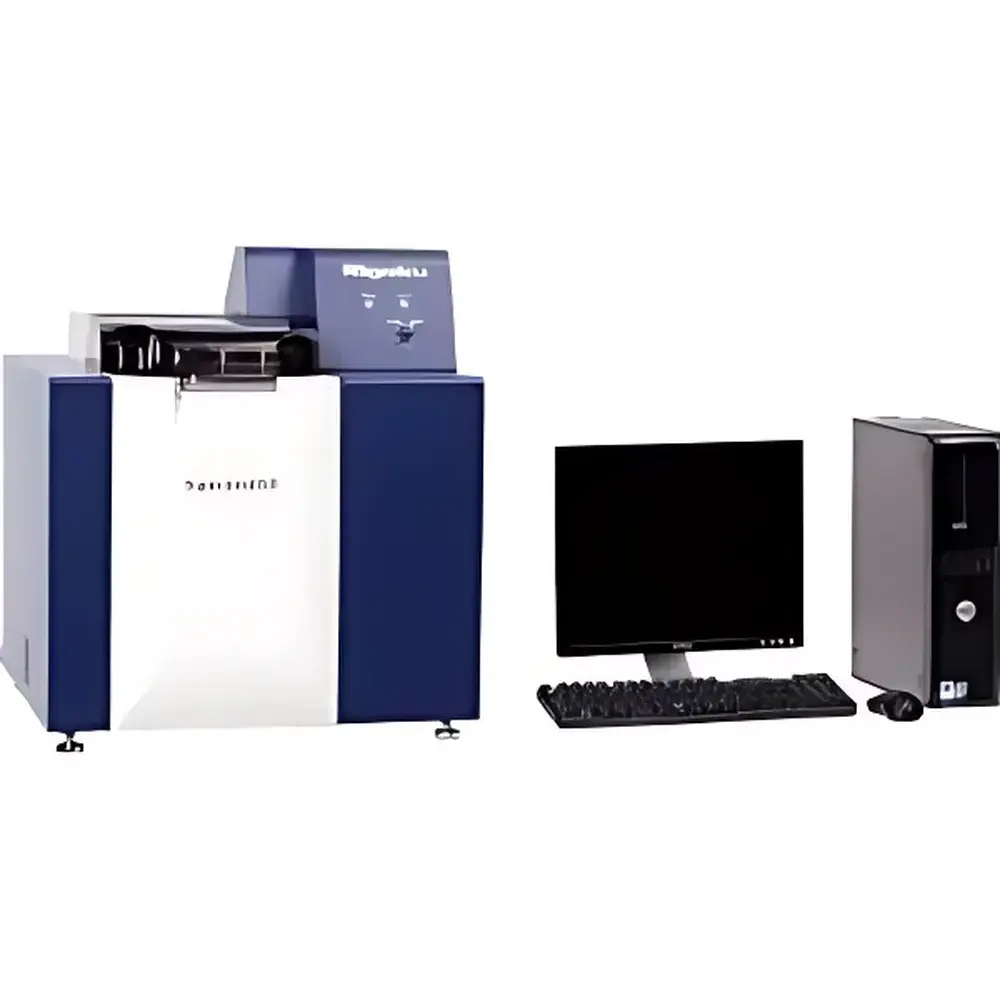
Rigaku NEX CG Benchtop Wavelength Dispersive X-Ray Fluorescence Spectrometer
| Brand | Rigaku |
|---|---|
| Origin | Japan |
| Configuration | Benchtop |
| Analytical Principle | Wavelength Dispersive X-Ray Fluorescence (WDXRF) |
| Elemental Range | F (Z=9) to U (Z=92) |
| Light Element Performance | Optimized for F, Na, Mg, Al, Si quantification |
| Detector Type | Scintillation + Flow Proportional Counters (no liquid nitrogen or water cooling required) |
| Diffracting Crystals | Triple-crystal auto-exchanger (PET, LiF, TAP) |
| Sample Handling | Single-position stage or 12-position rotating autosampler |
| Software Suite | Qualitative & quantitative analysis with Fundamental Parameters (FP) algorithm |
| Compliance | Designed for ISO 8258, ASTM E1361, and IEC 62321-5 workflows |
| Regulatory Support | Audit-trail enabled data management compliant with GLP/GMP documentation requirements |
Overview
The Rigaku NEX CG is a compact, benchtop wavelength dispersive X-ray fluorescence (WDXRF) spectrometer engineered for high-resolution elemental analysis across the full periodic table—from fluorine (Z = 9) to uranium (Z = 92). Unlike energy dispersive XRF (EDXRF) systems, the NEX CG employs Bragg diffraction from precisely aligned analyzing crystals to isolate characteristic X-ray wavelengths with exceptional spectral resolution. This physical separation mechanism enables unambiguous peak deconvolution—particularly critical for resolving overlapping Kα lines of adjacent light elements such as aluminum (Al Kα = 1.486 keV) and silicon (Si Kα = 1.740 keV), which remain unresolved in most EDXRF configurations. The instrument utilizes a high-stability palladium (Pd) anode X-ray tube rated at 200 W, delivering sufficient excitation power for trace-level detection while maintaining thermal stability without external cooling infrastructure. Its fully integrated optical path—including vacuum-purged sample chamber and helium-flushed light-element path—ensures reproducible sensitivity down to fluorine without cryogenic support.
Key Features
- Triple-crystal automatic changer (PET, LiF, TAP) enabling optimized diffraction conditions across soft and hard X-ray ranges
- Benchtop footprint (≈ 600 × 700 × 500 mm) with industrial-grade mechanical rigidity to minimize vibration-induced spectral drift
- Two sample handling options: fixed single-position stage for rapid QA/QC screening or 12-position programmable rotary autosampler for unattended batch analysis
- Zero-cryogen operation: scintillation and flow proportional detectors operate at ambient temperature with thermoelectric stabilization
- High-precision goniometer with <0.001° angular reproducibility ensures long-term calibration stability and inter-laboratory comparability
- Integrated vacuum and He-purge systems configurable per measurement sequence to optimize light-element transmission efficiency
Sample Compatibility & Compliance
The NEX CG accepts solid blocks, pressed pellets, fused beads, thin films, and coated substrates up to 50 mm in diameter and 30 mm in height. Its sealed sample chamber accommodates air-sensitive materials under inert gas purge. Method development adheres to internationally recognized protocols including ISO 22083 (XRF for cement), ASTM D7359 (halogen analysis in polymers), and IEC 62321-5 (restricted substance screening in electronics). All quantitative routines implement Fundamental Parameters (FP) modeling validated against NIST SRM reference materials (e.g., SRM 2710a, 2782, 610), ensuring traceability to SI units. Data acquisition and reporting modules support 21 CFR Part 11–compliant electronic signatures, audit trails, and role-based access control for regulated environments.
Software & Data Management
Rigaku’s proprietary PC-based software provides a unified interface for instrument control, spectrum acquisition, qualitative phase identification (via library matching against >500 certified spectra), and FP-based quantification with matrix correction. Calibration models are stored as encrypted binary files with versioned metadata. Raw spectral data (channel-intensity arrays), processed results (elemental concentrations, detection limits, uncertainty estimates), and acquisition logs are exported in ASTM E1301-compliant .csv and .trc formats. Optional integration with LIMS via OPC UA or HL7 interfaces enables automated result routing to enterprise quality databases.
Applications
- Quality assurance of raw materials in metallurgy (e.g., Al-Si alloy grade verification, Mg content in aerospace alloys)
- Regulatory compliance testing for RoHS, WEEE, and REACH restricted substances in consumer electronics and packaging
- Geochemical exploration—quantitative determination of major oxides (SiO₂, Al₂O₃, Fe₂O₃) and trace metals (Ni, Cr, V) in soil and sediment samples
- Catalyst characterization in petrochemical R&D, including promoter element distribution (e.g., P, S, Cl) and active metal loading (Pt, Pd, Ni)
- Forensic glass and paint chip analysis requiring sub-0.1 wt% precision for Na, Mg, Al, and Si differentiation
FAQ
Does the NEX CG require liquid nitrogen or chilled water for detector operation?
No. It uses ambient-temperature scintillation and flow proportional counters with thermoelectric cooling, eliminating dependency on cryogens or recirculating chillers.
Can the system analyze fluorine in solid polymer matrices?
Yes—when operated under helium purge with optimized crystal selection (TAP) and extended counting times, detection limits for F in polyethylene reach ≤80 ppm (k = 2, 100 s live time).
Is method transfer possible between different NEX CG units?
Yes. Standardized crystal alignment procedures, factory-calibrated goniometer offsets, and FP-based quantification ensure cross-instrument reproducibility within ±2% RSD for major elements across laboratories.
What regulatory documentation is supplied with the instrument?
Each unit ships with a Factory Calibration Certificate traceable to NIST standards, IQ/OQ documentation templates compliant with ISO/IEC 17025, and a complete 21 CFR Part 11 validation package for GxP environments.




