
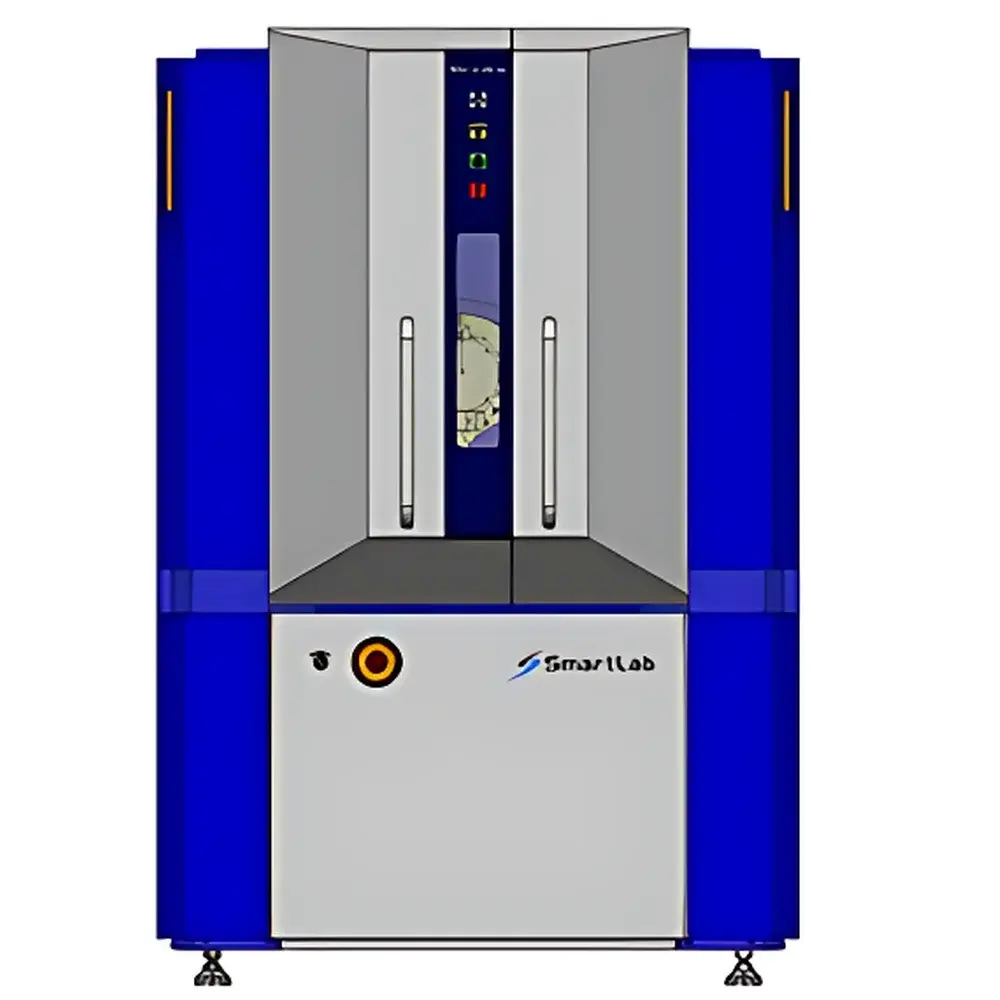
Rigaku SmartLab SE Smart X-ray Diffractometer
| Brand | Rigaku |
|---|---|
| Origin | Japan |
| Instrument Type | Powder X-ray Diffractometer |
| Configuration | Floor-standing |
| X-ray Generator Power | 3 kW |
| Goniometer Type | Horizontal |
| Goniometer Radius | 300 mm |
| Programmable Variable Slit | Yes |
| Minimum Step Size | 0.0001° |
| Optical System | CBO Cross-Beam Optics (Patented by Rigaku) |
| Detectors | D/teX Ultra250 (0D/1D mode), HyPix-400 Semiconductor Array Detector (0D/1D/2D mode) |
| Software | SmartLab Studio II |
| Sample Viewing | Integrated Video Observation System |
| Compliance | Designed for ASTM E975, ISO 17892-12, and JIS Z 8821 applications |
Overview
The Rigaku SmartLab SE Smart X-ray Diffractometer is a high-performance, floor-standing powder X-ray diffractometer engineered for precision structural characterization across academic, industrial, and regulatory laboratory environments. It operates on Bragg’s law-based X-ray diffraction (XRD) principles, utilizing monochromatic Cu Kα radiation generated by a sealed-tube 3 kW X-ray source. The system integrates Rigaku’s proprietary CBO (Cross-Beam Optics) architecture — a dual-path optical design enabling seamless switching between focused-beam geometry for high-intensity measurements and parallel-beam geometry with mirror optics for high-resolution, low-background analysis. This dual-mode capability ensures optimal signal-to-noise ratio and angular fidelity across diverse sample classes, from crystalline powders to thin films and nanoscale materials.
Key Features
- Horizontal goniometer with 300 mm radius and programmable variable slits for precise beam conditioning and background suppression
- Ultra-fine angular resolution with minimum step size of 0.0001°, supporting high-accuracy lattice parameter refinement and microstrain analysis
- Dual-detector configuration: D/teX Ultra250 (0D/1D mode) for rapid qualitative/quantitative phase analysis; HyPix-400 semiconductor array detector (0D/1D/2D mode) for simultaneous acquisition of full Debye–Scherrer rings, enabling texture, strain mapping, and small-angle X-ray scattering (SAXS) workflows
- Integrated real-time video observation system for precise sample positioning and alignment — critical for micro-diffraction and thin-film grazing-incidence measurements
- Modular accessory compatibility including incident-beam monochromators, anti-scatter slits, humidity chambers, heating/cooling stages, and capillary sample holders
Sample Compatibility & Compliance
The SmartLab SE accommodates a broad spectrum of physical sample forms without requiring reconfiguration: free-flowing powders, solid bulk specimens, epitaxial thin films (via GID and θ–2θ scans), micro-regional samples (down to ~100 µm spot size), and liquid suspensions in capillaries. Its mechanical stability and thermal management support GLP-compliant operation under ISO/IEC 17025-accredited testing protocols. The system meets foundational requirements for ASTM E975 (standard practice for XRD phase analysis), ISO 17892-12 (geotechnical investigation – XRD mineralogical analysis), and JIS Z 8821 (XRD terminology and measurement methods). While not inherently 21 CFR Part 11–compliant, SmartLab Studio II supports audit-trail-enabled user authentication, electronic signatures, and data integrity controls when deployed within validated IT infrastructure per FDA guidance.
Software & Data Management
SmartLab Studio II serves as the unified control, acquisition, and analysis platform — eliminating workflow fragmentation between instrument operation and data interpretation. It features guided measurement wizards for common applications (e.g., Rietveld refinement, crystallinity calculation, Scherrer-size estimation, thin-film thickness modeling), each with embedded method templates compliant with ISO 21367 and USP . Raw intensity vs. 2θ data are stored in vendor-neutral .raw/.xye formats, while processed reports export to PDF, CSV, and CIF for third-party validation or database ingestion. Batch processing, peak search with IUCr-recommended profile fitting algorithms, and automated phase identification against ICDD PDF-4+ databases ensure reproducible, traceable results across operators and shifts.
Applications
- Qualitative and quantitative phase analysis of polycrystalline materials using reference intensity ratio (RIR) and Rietveld full-pattern refinement
- Determination of crystallite size, microstrain, and dislocation density via Williamson–Hall and Warren–Averbach deconvolution
- Grazing-incidence XRD (GIXRD) for depth-resolved phase identification and layer-thickness modeling in multilayer stacks
- Small-angle X-ray scattering (SAXS) analysis of nanoparticle size distribution and polydispersity in colloidal systems
- Texture analysis and pole-figure mapping using 2D detector integration
- Pharmaceutical solid-form screening, polymorph identification, and stability-indicating assays per ICH Q5A and Q6A guidelines
FAQ
Is the SmartLab SE suitable for regulatory submissions in pharmaceutical or medical device QA/QC?
Yes — when operated under documented SOPs and integrated into a validated LIMS environment, its measurement repeatability (≤0.002° 2θ long-term drift) and software audit trail capabilities support data submission to FDA, EMA, and PMDA.
Can the system perform in situ or operando experiments?
Yes — optional environmental stages (heating up to 1200°C, cooling to −180°C, humidity control, electrochemical cells) enable time-resolved structural monitoring under dynamic conditions.
What detector modes are supported during Rietveld refinement?
Both D/teX Ultra250 (1D line scan) and HyPix-400 (2D frame integration) outputs are fully compatible with TOPAS, GSAS-II, and SmartLab Studio II’s native Rietveld engine.
Does the CBO optics require manual alignment between focal and parallel modes?
No — motorized optical switching enables automatic, software-controlled transition between geometries with sub-micron positional repeatability.
Is remote operation supported?
Yes — SmartLab Studio II includes secure remote desktop access and scheduled measurement queuing via TLS-encrypted client-server architecture.






