
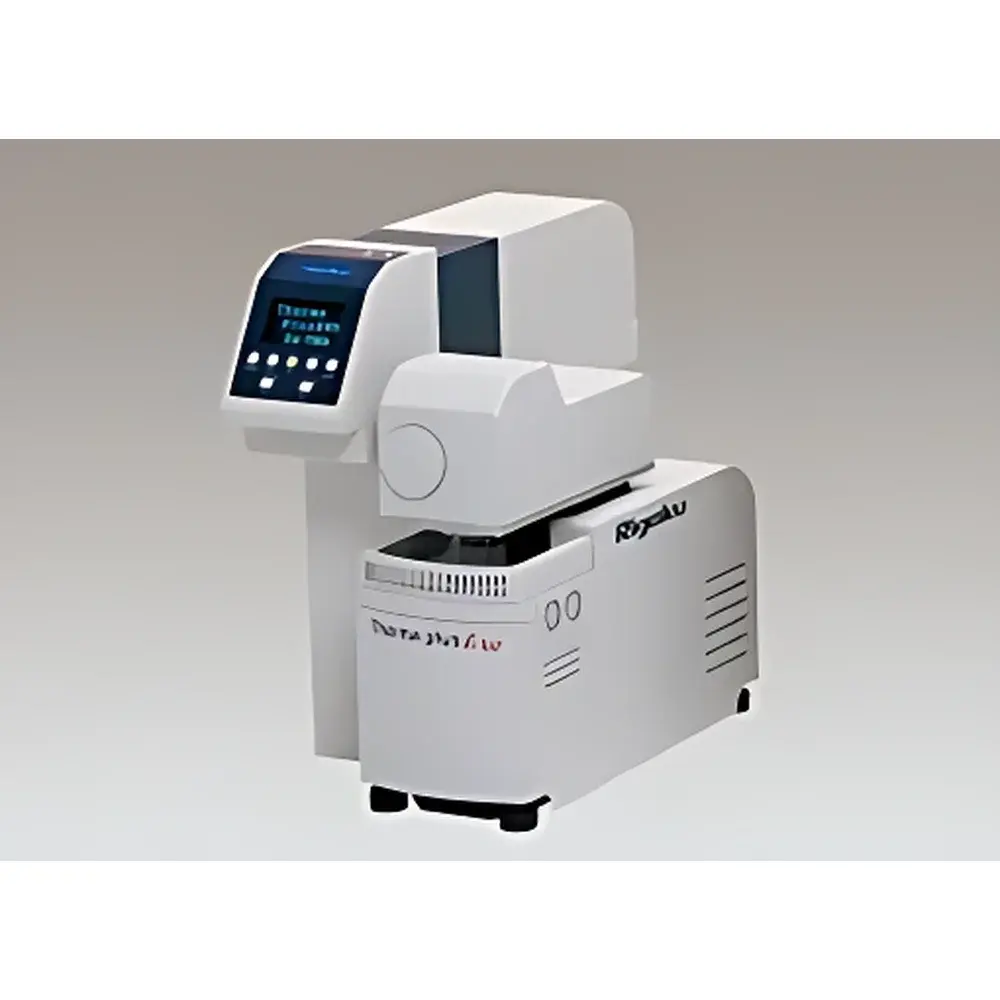
Rigaku Thermo Plus EVO TMA8310 Thermomechanical Analyzer
| Brand | Rigaku |
|---|---|
| Origin | Japan |
| Model | TMA8310 |
| Sample Capacity | Ø9 mm × 20 mm |
| Heating Rate | Up to 100 °C/min |
| Cooling Rate | From 1000 °C to 50 °C in ≤15 min |
| Temperature Control | Pre-emptive temperature regulation with hold-mode overshoot compensation |
| Calibration | Integrated temperature and dimensional calibration routines |
| Power Mode | ECO standby mode (30% energy reduction) |
| Multi-unit Control | Single PC controls up to 8 units |
| Safety | Dual-stage furnace safety alarm + emergency stop switch |
| Software | Fully integrated thermal analysis suite with auto-diagnosis, dual data backup, and remote firmware update capability |
| Compliance | Designed for GLP/GMP environments |
Overview
The Rigaku Thermo Plus EVO TMA8310 is a high-precision thermomechanical analyzer engineered for quantitative measurement of dimensional changes in solid materials as a function of temperature under controlled mechanical load. It operates on the principle of differential thermal expansion detection—utilizing Rigaku’s proprietary dual-sensor architecture to decouple sample deformation from instrumental thermal drift. This eliminates baseline artifacts caused by furnace or sensor housing expansion, enabling sub-micrometer resolution in length change detection even for ultra-low-expansion materials (e.g., fused silica, Invar alloys) and thin-film specimens (<50 µm thickness). The system conforms to ASTM E831, ISO 11359-2, and USP standards for thermal expansion coefficient (CTE) determination and transition temperature analysis.
Key Features
- Dual-compensated transduction system: Independent reference and sample arms with matched thermal mass minimize zero-drift during rapid thermal cycles.
- Modular probe interface: Interchangeable fixtures support tension, compression, penetration, and expansion modes without recalibration—enabling full ASTM D696 and ISO 11359-1 compliance across configurations.
- High-efficiency thermal management: Compact resistive furnace delivers linear heating rates up to 100 °C/min and achieves forced cooling from 1000 °C to 50 °C in ≤15 minutes via active gas purge and heat-sink coupling.
- Patented sample handling: Ergonomic rotating sample stage with wide-jaw clamps ensures reproducible positioning and minimizes thermal contact resistance—critical for accurate ΔL/L₀ calculation.
- Pre-emptive temperature control algorithm: Dynamically adjusts power input prior to temperature hold segments, eliminating overshoot and stabilizing setpoint within ±0.1 °C over 30-minute dwell periods.
- ECO operational mode: Automatically deactivates non-essential subsystems (e.g., auxiliary displays, peripheral I/O) during idle states—verified 30% reduction in standby power consumption per IEC 62301.
- Multi-station network architecture: One Windows-based host PC synchronously manages up to eight TMA8310 units via Gigabit Ethernet, supporting centralized method deployment and cross-instrument data harmonization.
Sample Compatibility & Compliance
The TMA8310 accommodates cylindrical specimens up to Ø9 mm × 20 mm in length, compatible with standard crucibles, quartz rods, and custom-fabricated holders for fiber or powder compacts. Its low-force loading range (0.01–5.00 N) and sub-µm displacement resolution make it suitable for fragile polymers, ceramic green bodies, pharmaceutical tablets, and composite laminates. All firmware and software modules are structured to support 21 CFR Part 11-compliant electronic records—including user authentication, immutable audit trails, and version-controlled method templates. Instrument design adheres to IEC 61010-1 safety standards, with redundant thermal cutoffs, real-time furnace temperature monitoring, and hardware-enforced emergency shutdown.
Software & Data Management
Thermo Plus EVO Control Suite v4.x provides a validated, role-based interface for method development, real-time monitoring, and post-run analysis. Key capabilities include automated CTE calculation with multi-segment linear regression, glass transition onset detection (Tg) via second-derivative analysis, and coefficient-of-thermal-expansion mapping across phase transitions. Data integrity safeguards include dual-location storage (local SSD + network-attached backup), checksum-verified export (CSV, TXT, ASTM E1358-compliant XML), and timestamped calibration logs. Remote diagnostics enable predictive maintenance alerts based on actuator cycle count, furnace resistance drift, and sensor signal-to-noise ratio degradation.
Applications
- Quantification of linear thermal expansion coefficients (α₁, α₂) for aerospace-grade composites and semiconductor packaging substrates.
- Characterization of cure shrinkage and post-cure relaxation in epoxy molding compounds used in IC encapsulation.
- Measurement of softening points and viscoelastic transitions in thermoplastic elastomers under constrained geometry.
- Validation of dimensional stability in battery electrode coatings during charge/discharge thermal cycling.
- Regulatory submission support for pharmaceutical solid dosage forms per ICH Q5E and Q1A(R2) guidelines.
FAQ
What is the maximum recommended sample mass for TMA8310 compression measurements?
For optimal force linearity and thermal equilibration, samples should not exceed 1.2 g in mass when using the standard 2-mm flat-ended probe.
Does the system support inert atmosphere purging during analysis?
Yes—integrated mass-flow controllers support continuous N₂, Ar, or He purge at 20–100 mL/min, with optional O₂ scrubber integration for oxidation-sensitive materials.
Can raw displacement data be exported in SI-units only?
All exported datasets default to SI units (meters, kelvin, newtons); unit conversion is disabled in audit-mode configurations to ensure regulatory traceability.
Is firmware upgrade capability available without vendor intervention?
Yes—secure over-the-air updates are delivered via HTTPS with SHA-256 signature verification; upgrade history is permanently logged in the system audit trail.
How is thermal lag corrected during fast heating ramps?
The instrument applies real-time correction using pre-characterized furnace time-constant models embedded in the temperature feedback loop—no post-processing required.



