
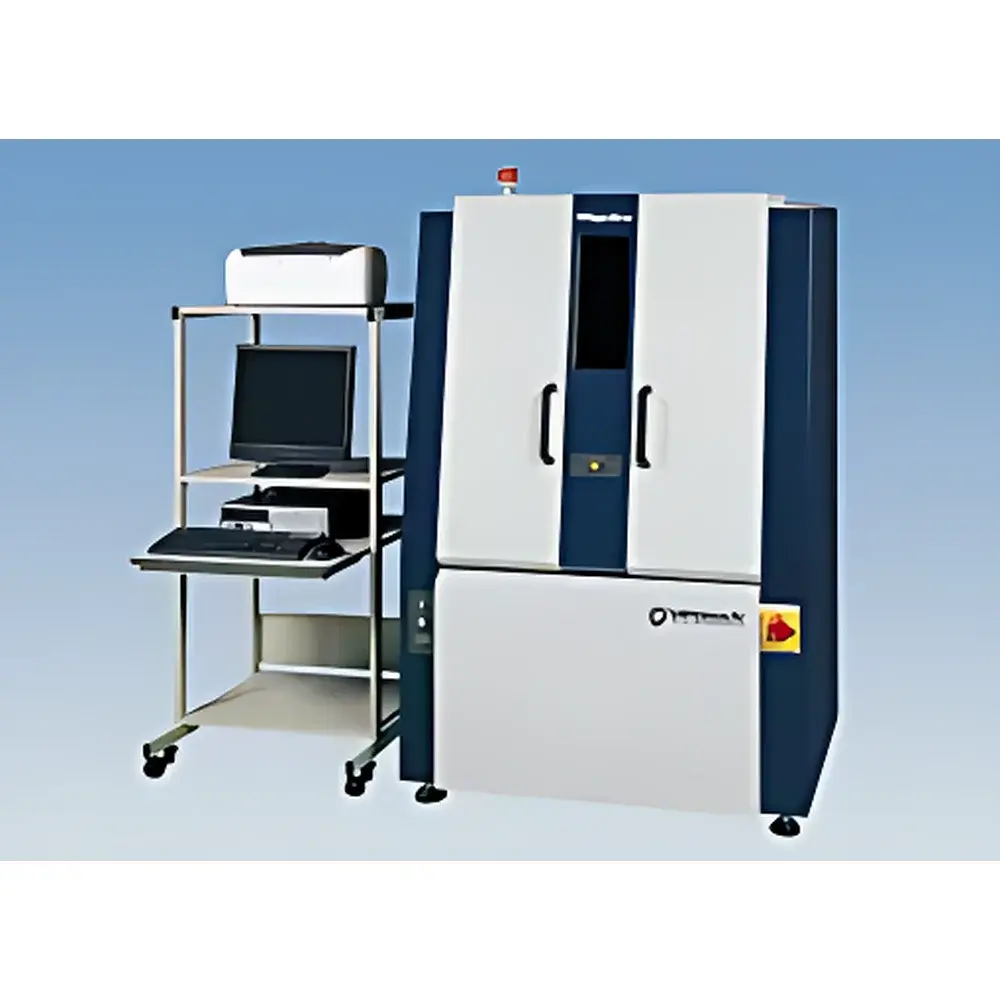
Rigaku Ultima IV Series Combined Multi-Function X-ray Diffractometer
| Brand | Rigaku |
|---|---|
| Origin | Japan |
| Model | Ultima IV Series |
| Instrument Type | Powder X-ray Diffractometer |
| X-ray Generator Power | 3 kW |
| Goniometer | Horizontal Type |
| Minimum Angular Step | 0.0001° |
| Optical System | CBO Cross-Beam Optics (Patented) |
| Detector | D/teX-Ultra High-Speed Energy-Dispersive Detector |
| Optional Modules | In-Plane Geometry Unit, Small-Angle X-ray Scattering (SAXS) Module, Thin-Film Analysis Module, Micro-Beam Mapping Unit, XRD-DSC Simultaneous Measurement System |
| Software Suite | PDXL (with Rietveld), NANO-Solver, GXRR, and XRD Analysis Package |
Overview
The Rigaku Ultima IV Series is a high-performance, modular powder X-ray diffractometer engineered for comprehensive structural characterization across diverse material classes. Based on Bragg’s law and X-ray diffraction physics, it delivers precise lattice parameter determination, phase identification, quantitative phase analysis, crystallite size and microstrain evaluation, and advanced thin-film metrology. Its defining innovation—the patented CBO (Cross-Beam Optics) system—enables seamless switching between high-intensity focused-beam geometry for conventional powder analysis and parallel-beam geometry with mirror optics for high-resolution thin-film and grazing-incidence measurements. This dual-optical architecture eliminates the need for manual optical realignment, ensuring measurement consistency and reducing setup time between sample types. Designed and manufactured in Japan, the Ultima IV meets stringent international engineering standards for thermal stability, mechanical rigidity, and angular reproducibility—critical for long-duration scans and automated batch analysis in regulated environments.
Key Features
- 3 kW sealed-tube X-ray generator with high-stability anode cooling and voltage regulation for consistent intensity output over extended operation.
- Horizontal goniometer with ultra-fine angular resolution (0.0001° minimum step) and programmable variable divergence slits for optimized beam conditioning per application.
- CBO cross-beam optics: integrates both parabolic Göbel mirror (for high-flux focused geometry) and collimating mirror (for parallel-beam SAXS/GISAXS and thin-film analysis) within a single, motorized optical path.
- D/teX-Ultra silicon strip detector: energy-dispersive, 1D linear array with >95% quantum efficiency at Cu Kα, enabling rapid data acquisition without mechanical scanning.
- Modular add-on capabilities: In-Plane geometry unit (Rigaku-exclusive) for simultaneous in-plane and out-of-plane reciprocal space mapping; SAXS module for nanostructure analysis (1–100 nm range); micro-beam unit (spot size down to 100 µm) for spatially resolved phase mapping; XRD-DSC hybrid stage for real-time structural evolution during thermal cycling.
- Robust mechanical architecture with temperature-controlled enclosure and vibration-damped base, supporting GLP-compliant operation in shared laboratory facilities.
Sample Compatibility & Compliance
The Ultima IV accommodates a broad spectrum of sample forms—including free-flowing powders, pressed pellets, bulk solids, epitaxial and polycrystalline thin films (single-layer and multilayer), nanocomposites, and micro-regions on heterogeneous substrates. Its modular design supports ASTM E975 (phase analysis of metallic materials), ISO 17889 (crystallinity determination in polymers), and USP (pharmaceutical solid-state characterization). When configured with audit-trail-enabled software and electronic signature modules, the system complies with FDA 21 CFR Part 11 requirements for regulated pharmaceutical and biotech QA/QC laboratories. All hardware components conform to IEC 61000-6-3 (EMC) and IEC 61010-1 (safety) standards.
Software & Data Management
Data acquisition and analysis are managed via Rigaku’s integrated PDXL platform, which includes full Rietveld refinement (using GSAS-II or TOPAS engines), whole-pattern fitting, and crystal structure visualization. The NANO-Solver package enables quantitative SAXS data reduction (Guinier, Porod, and model-based fitting), while GXRR provides rigorous modeling of X-ray reflectivity profiles for film thickness, density, and interfacial roughness. All software modules support automated report generation with embedded metadata (instrument parameters, calibration history, operator ID), timestamped audit logs, and export to standardized formats (CIF, XYE, HDF5). Raw data files are stored in vendor-neutral binary format with checksum validation to ensure long-term integrity.
Applications
- Quantitative phase analysis (QPA) of multi-component ceramics, battery cathodes, and geological samples using internal standard or reference intensity ratio (RIR) methods.
- Rietveld refinement for lattice parameter optimization, site occupancy modeling, and anisotropic displacement parameter (ADP) extraction in complex oxides and MOFs.
- Grazing-incidence XRD (GIXRD) and X-ray reflectivity (XRR) for non-destructive depth profiling of thin-film crystallinity, layer stacking order, and interface diffusion.
- In-Plane geometry measurements to resolve in-plane lattice distortions (e.g., strain relaxation in strained SiGe layers) alongside conventional θ–2θ scans—enabling complete reciprocal-space reconstruction.
- SAXS analysis of nanoparticle size distribution, shape anisotropy, and aggregation state in colloidal dispersions and polymer nanocomposites.
- Micro-XRD mapping of phase segregation, oxidation gradients, or grain boundary chemistry in metallurgical cross-sections or sintered ceramics.
FAQ
What sample geometries does the Ultima IV support without hardware modification?
Standard configurations accommodate flat-plate powder, reflection-mode thin films, and transmission-mode bulk samples. In-Plane, SAXS, and micro-beam analyses require dedicated optional modules.
Is the CBO optical system user-switchable during routine operation?
Yes—the CBO mechanism is fully motorized and software-controlled; switching between focused and parallel beam modes is executed via the PDXL interface with automatic recalibration.
Can the XRD-DSC module perform simultaneous data collection under controlled atmosphere?
Yes—the module integrates with Rigaku’s environmental chamber options (N₂, air, vacuum, or reactive gas) and supports synchronized thermal ramping (up to 30 °C/min) with XRD pattern acquisition at user-defined temperature intervals.
Does the system support automated sample changers for unattended operation?
Yes—compatible with the SC-70 robotic sample changer (70 positions) and optional barcode reader for traceable, high-throughput screening in industrial QA workflows.
What level of technical support and calibration services are available globally?
Rigaku offers factory-certified installation, annual performance verification (per ISO 17873), and remote diagnostics via secure TLS-encrypted connection; service contracts include on-site engineer response within 48 hours in major markets.




