
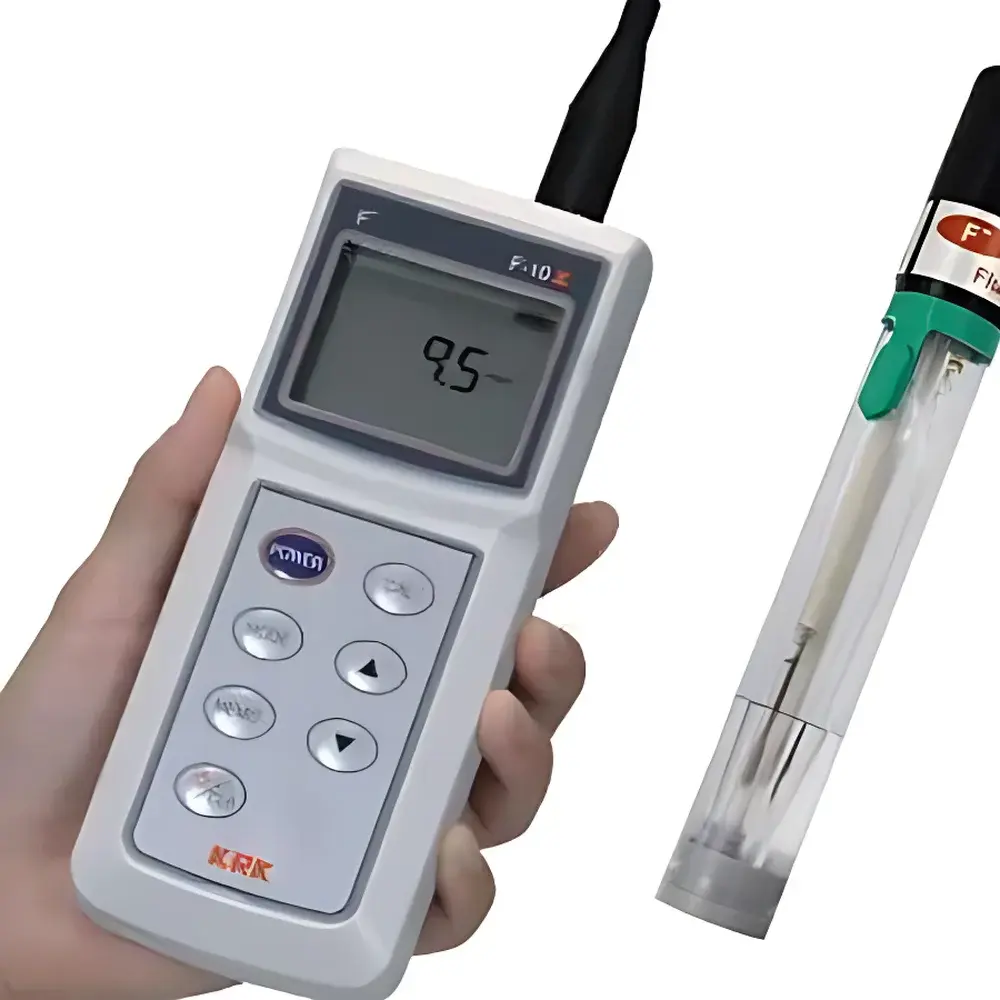
Riken Keiki F-10Z Portable Fluoride Ion Analyzer
| Brand | Riken Keiki |
|---|---|
| Model | F-10Z |
| Type | Portable Fluoride-Specific Ion Analyzer |
| Measurement Principle | Solid-State Lanthanum Fluoride (LaF₃) Single-Crystal Membrane Electrode |
| Measuring Range | 0–2000 mg/L F⁻ |
| Detection Limit | 1 mg/L F⁻ |
| Resolution | 0.1 mg/L (0.1–99.9 mg/L), 1 mg/L (100–2000 mg/L) |
| Accuracy | ±1% of reading |
| Response Time | ≤10 s (t₉₀) |
| Temperature Compensation | Automatic, semiconductor-based (0–45 °C) |
| Display | 4-digit LCD (F⁻: mg/L |
| mV | −1000 to +1000 mV) |
| Reproducibility | ±2 mg/L (≤99.9 mg/L), ±5 mg/L (100–2000 mg/L) |
| Calibration | Two-point using certified F⁻ standards (2 mg/L and 200 mg/L) |
| Memory Capacity | 30 measurement records |
| Ingress Protection | IP67 |
| Power Supply | DC 4.5 V (3 × AAA LR03 batteries) |
| Auto-Power-Off | After 30 min idle |
| Dimensions | 70 × 36 × 170 mm (W × H × D) |
| Weight | ~290 g (incl. batteries) |
| Housing Material | ABS plastic |
| Compliance | RoHS-compliant, lead-free soldering |
Overview
The Riken Keiki F-10Z is a portable, field-deployable fluoride ion analyzer engineered for precise, on-site quantification of free aqueous fluoride ions (F⁻) in environmental and industrial water matrices. It operates on the potentiometric principle using a solid-state lanthanum fluoride (LaF₃) single-crystal membrane electrode—a Nernstian sensor with well-documented selectivity for F⁻ over common anions such as Cl⁻, NO₃⁻, and SO₄²⁻. The instrument measures the electrode potential (in mV) generated at the LaF₃/solution interface and converts it to concentration (mg/L) via built-in calibration curves. Crucially, the F-10Z detects only *free*, uncomplexed fluoride ions; it does not measure total fluorine or organofluorine compounds (e.g., fluoropolymers, fluorinated surfactants) nor hydrolyzable complexes (e.g., AlF₆³⁻, FeF₆³⁻). This specificity aligns with regulatory monitoring requirements where bioavailable or corrosive F⁻ poses operational or ecological risk—particularly in semiconductor rinse waters, glass etching effluents, and fluoropolymer production wastewater.
Key Features
- Solid-state LaF₃ crystal membrane electrode with high chemical stability and long-term drift resistance—no internal filling solution required for routine operation.
- Automatic temperature compensation (ATC) using integrated semiconductor thermistor (0–45 °C), ensuring accurate readings across variable field conditions without manual correction.
- Wide linear dynamic range: 0.1–2000 mg/L F⁻, supporting both low-level compliance checks (e.g., drinking water standards ≤1.5 mg/L) and high-concentration process stream monitoring.
- IP67-rated enclosure provides full protection against dust ingress and temporary immersion (up to 1 m for 30 min), enabling reliable use in humid, outdoor, or splash-prone environments.
- Lead-free construction compliant with RoHS Directive 2011/65/EU, including certified lead-free soldering and halogen-free PCB substrates.
- Dual-mode operation: direct F⁻ concentration readout (mg/L) and reference mV mode for troubleshooting electrode health or verifying calibration integrity.
- Battery-powered (3 × AAA LR03) with 30-minute auto-shutdown, delivering >200 hours of typical field operation per set.
Sample Compatibility & Compliance
The F-10Z is validated for use with clarified, low-turbidity aqueous samples—including municipal drinking water, cooling tower blowdown, semiconductor ultrapure rinse water, and neutral-to-moderately alkaline industrial effluents (pH 5–8). For optimal accuracy, samples must be free of suspended solids that could foul the crystal surface, and ionic strength must be stabilized using the included Ionic Strength Adjustment Buffer (ISAB). While the instrument itself does not perform full method validation, its measurement protocol conforms to the foundational principles of ASTM D4192–22 (“Standard Test Method for Fluoride Ion Concentration in Water by Ion-Selective Electrode”) and ISO 10304-1:2012 (water quality — determination of dissolved anions by liquid chromatography). It supports GLP-aligned data integrity through timestamped memory storage (30 entries) and traceable two-point calibration using NIST-traceable fluoride standards.
Software & Data Management
The F-10Z operates as a standalone, embedded-system analyzer with no external software dependency. All calibration coefficients, temperature compensation parameters, and measurement logs are stored in non-volatile memory. The 4-digit LCD displays real-time F⁻ concentration, mV potential, temperature, and battery status simultaneously. Calibration history (date, standard values used, slope/mV/decade) is retained in memory and accessible via the menu system. Though USB or Bluetooth connectivity is not integrated, the device meets FDA 21 CFR Part 11 readiness prerequisites: all measurements include immutable timestamps, operator-identifiable calibration events, and no editable raw mV data—ensuring auditability during GMP or environmental compliance inspections.
Applications
- Real-time monitoring of fluoride discharge limits at semiconductor fabrication facilities (e.g., wet etch station effluent, CMP slurry waste).
- Process control in fluorosilicic acid dosing systems for municipal water fluoridation programs.
- Compliance verification for EPA Method 300.0 and WHO guideline values (1.5 mg/L) in groundwater and surface water sampling campaigns.
- Quality assurance testing of deionized water used in optical lens cleaning or photomask rinsing.
- Field assessment of fluoride leaching from landfill leachate or phosphate fertilizer runoff in agricultural watersheds.
FAQ
Does the F-10Z measure total fluorine or only free fluoride ions?
It measures only free, hydrated F⁻ ions in solution. Complexed, colloidal, or organically bound fluorine species are not detected.
Can the electrode be used in acidic or highly alkaline samples?
Optimal performance occurs between pH 5 and 8. Below pH 5, H⁺ interferes with the LaF₃ membrane; above pH 8, OH⁻ competition reduces sensitivity. Use ISAB and pH adjustment per ASTM D4192 guidance.
How often must the electrode be recalibrated?
Calibration is recommended before each measurement session and after exposure to high-F⁻ samples (>500 mg/L) or extreme temperatures. Two-point calibration ensures linearity verification across the working range.
Is the internal reference element replaceable or serviceable?
The F-10Z uses a sealed, maintenance-free solid-state reference system. No user-serviceable parts exist; electrode replacement is required upon signal drift exceeding ±5 mV/decade or slow response (>30 s t₉₀).
What is the expected lifetime of the LaF₃ crystal membrane under routine use?
With proper storage (dry, protected from light and mechanical abrasion) and avoidance of HF exposure or abrasive cleaning, the crystal typically maintains Nernstian response for 12–18 months in continuous field deployment.
Related Products







