
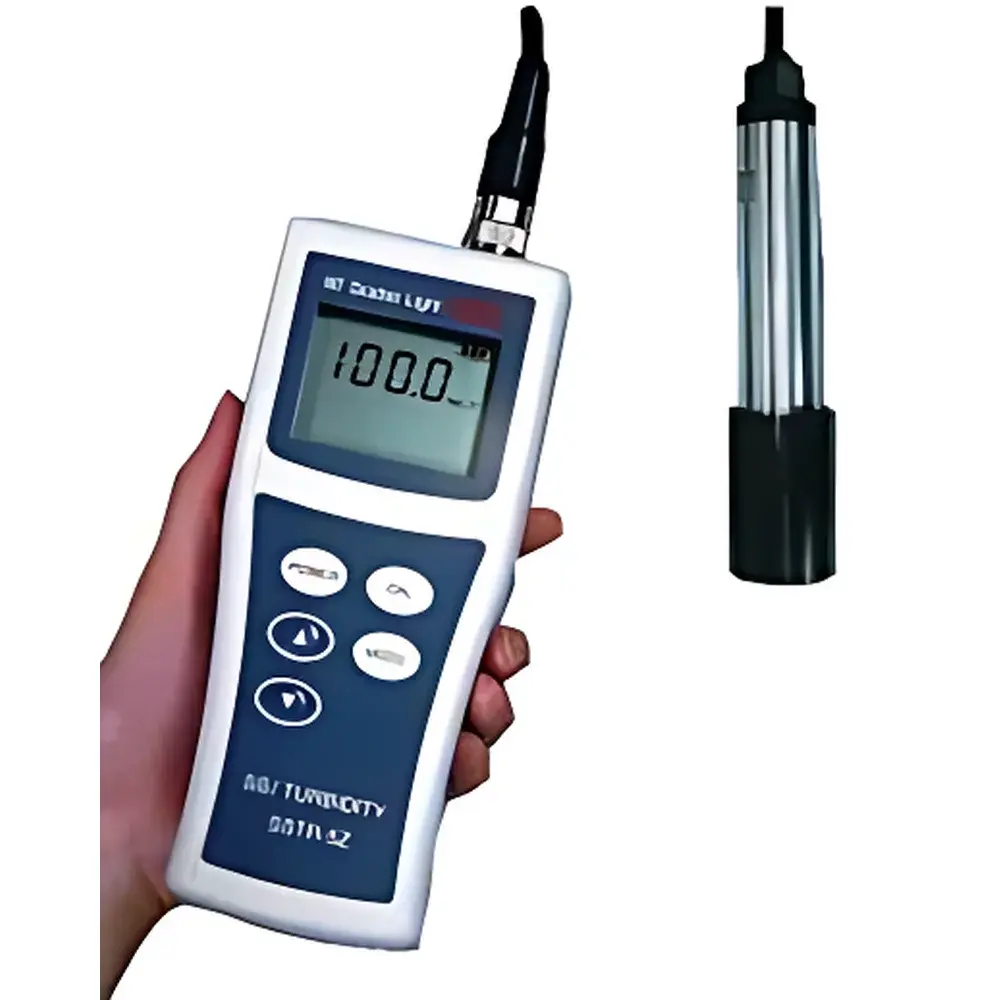
Rikorika SSTR-5Z Portable Turbidity & Suspended Solids (SS) Analyzer
| Brand | Rikorika |
|---|---|
| Origin | Japan |
| Model | SSTR-5Z |
| Instrument Type | Portable/HANDHELD Water Quality Analyzer |
| Measured Parameters | Turbidity (NTU), Suspended Solids (SS, mg/L) |
| Measurement Principle | Near-Infrared 90° Scattered Light Detection |
| Light Source | LED with Auto-Brightness Compensation |
| Detection Method | Ratio-metric dual-beam (sample + reference channel) |
| Display | 4-digit LCD |
| Turbidity Range | 0–500 NTU |
| SS Range | 0–500 mg/L (extendable to 1000 mg/L via range switching) |
| Resolution | 0.1 NTU/mg/L (0–199.9), 1 NTU/mg/L (200–500), 0.01 NTU/mg/L (full scale 1000) |
| Repeatability | ≤ ±2% FS (under specified conditions) |
| Zero Calibration | Deionized water or dedicated zero calibration plate |
| Span Calibration | Hydrazine-based turbidity standard (Formazin) or direct SS calibration using lab-analyzed sample |
| SS Conversion Function | Linear regression y = a + bx (user-configurable coefficients) |
| Operating Temperature | 0–40°C |
| Sample Temp. Range | 5–40°C |
| Immersion Materials | PVC, Borosilicate Glass, SUS-304 Stainless Steel |
| Probe Dimensions | Ø53 × 270 mm |
| Cable Length | 6 m |
| Weight | ~500 g (probe only, excluding cable) |
| Power Supply | 3 × AAA alkaline (LR03), auto-power-off enabled |
| Self-Diagnostic Functions | Battery voltage monitoring, calibration error detection, photodetector fault alert |
| IP Rating | IP67 (probe body) |
Overview
The Rikorika SSTR-5Z is a field-deployable, dual-parameter optical analyzer engineered for simultaneous, real-time measurement of turbidity and suspended solids (SS) concentration in natural waters, wastewater effluents, and process streams. It employs a near-infrared (NIR) 90° scattered light detection principle—compliant with ISO 7027-1:2016 and EPA Method 180.1—minimizing interference from color, fluorescence, and ambient light. Unlike conventional white-light turbidimeters, the NIR wavelength (typically 850 nm) reduces spectral absorption by organic chromophores and eliminates scattering bias from fine colloidal particles smaller than 1 µm. The instrument implements a ratio-metric dual-beam architecture: one channel measures scattered intensity at 90°, while the second monitors incident LED output in real time, enabling automatic source drift compensation and long-term photometric stability without frequent recalibration.
Key Features
- True dual-parameter capability: Independent yet correlated turbidity (NTU) and SS (mg/L) readouts with configurable linear conversion (y = a + bx)
- NIR 90° scatter optics with integrated reference photodiode for LED intensity normalization and thermal drift mitigation
- High-sensitivity TRD-120Z-series probe featuring borosilicate glass optical windows and SUS-304 wetted parts for corrosion resistance in municipal and industrial wastewater
- Zero calibration support via deionized water or factory-traceable zero plate—eliminating need for dark-room conditions
- Two-point calibration flexibility: Formazin-based turbidity standard for primary traceability, or direct SS calibration using laboratory-determined gravimetric or filtration-based reference values
- Robust mechanical design: IP67-rated probe housing, 6-meter submersible cable, and compact Ø53 × 270 mm form factor optimized for grab sampling and pipe insertion
- Low-power operation on three AAA alkaline cells with intelligent auto-shutdown and real-time battery diagnostics
Sample Compatibility & Compliance
The SSTR-5Z is validated for use with aqueous samples within 5–40°C and pH 4–10. It is incompatible with strong oxidizers (e.g., undiluted chlorine solutions >5 ppm), organic solvents, or slurries containing abrasive particulates >200 µm. Its optical path design inherently suppresses air bubble artifacts through hydrodynamic probe geometry and surface tension management—critical for reliable field measurements in aerated or pumped systems. Regulatory alignment includes conformance with ISO 7027-1 (turbidity), ASTM D3730 (SS estimation via turbidity correlation), and JIS K 0101 (Japanese industrial standards for water analysis). While not intrinsically certified for hazardous locations, its non-sparking construction and low-voltage operation meet general safety requirements for Class I, Division 2 environments per NEC Article 500.
Software & Data Management
The SSTR-5Z operates as a standalone instrument with no embedded firmware update capability; however, all calibration coefficients (zero offset, span gain, SS conversion parameters a/b), diagnostic logs (battery status, detector saturation events), and measurement timestamps are retained in non-volatile memory across power cycles. Raw data export is not supported via USB or Bluetooth; instead, users manually record readings alongside contextual metadata (location ID, sampling time, operator ID) for GLP-compliant field notebooks. For integration into centralized SCADA or LIMS platforms, third-party analog output modules (4–20 mA, 0–5 V) may be interfaced externally—requiring separate configuration and validation per FDA 21 CFR Part 11 Annex 11 guidelines if used in regulated pharmaceutical or drinking water applications.
Applications
- Wastewater treatment plant monitoring: Influent/effluent turbidity screening, secondary clarifier performance assessment, and sludge blanket depth estimation
- Drinking water distribution: Real-time verification of coagulation-flocculation efficiency and filter breakthrough detection
- Environmental field surveys: River and reservoir sediment load tracking, stormwater runoff characterization, and dredging plume dispersion studies
- Industrial process control: Cooling tower blowdown optimization, food & beverage rinse water clarity verification, and semiconductor fab ultrapure water pre-checks
- Educational laboratories: Teaching optical scattering theory, calibration traceability, and empirical SS-turbidity modeling under controlled experimental conditions
FAQ
Is the SSTR-5Z compliant with US EPA Method 180.1?
Yes—the NIR 90° scatter geometry, Formazin-compatible calibration protocol, and documented repeatability (≤±2% FS) satisfy the instrumental requirements of EPA Method 180.1 for field turbidity measurement.
Can the SS conversion coefficient (a and b) be modified in the field?
Yes—users may enter custom linear regression parameters via the front-panel keypad after performing gravimetric SS analysis on representative samples.
What is the maximum allowable suspended particle size for accurate measurement?
Particles larger than 200 µm may settle or obstruct the optical path; for highly heterogeneous samples, inline filtration (e.g., 100 µm mesh) prior to measurement is recommended.
Does the probe require periodic cleaning or maintenance?
Yes—optical windows should be wiped with lint-free tissue and isopropyl alcohol after each use in high-SS environments; annual inspection of O-ring integrity and cable strain relief is advised.
Is temperature compensation applied automatically during measurement?
No—the instrument does not include built-in temperature sensing; users must record ambient and sample temperatures separately and apply empirical correction factors per ISO 7027-1 Annex B if operating outside 20±2°C reference conditions.
Related Products







