
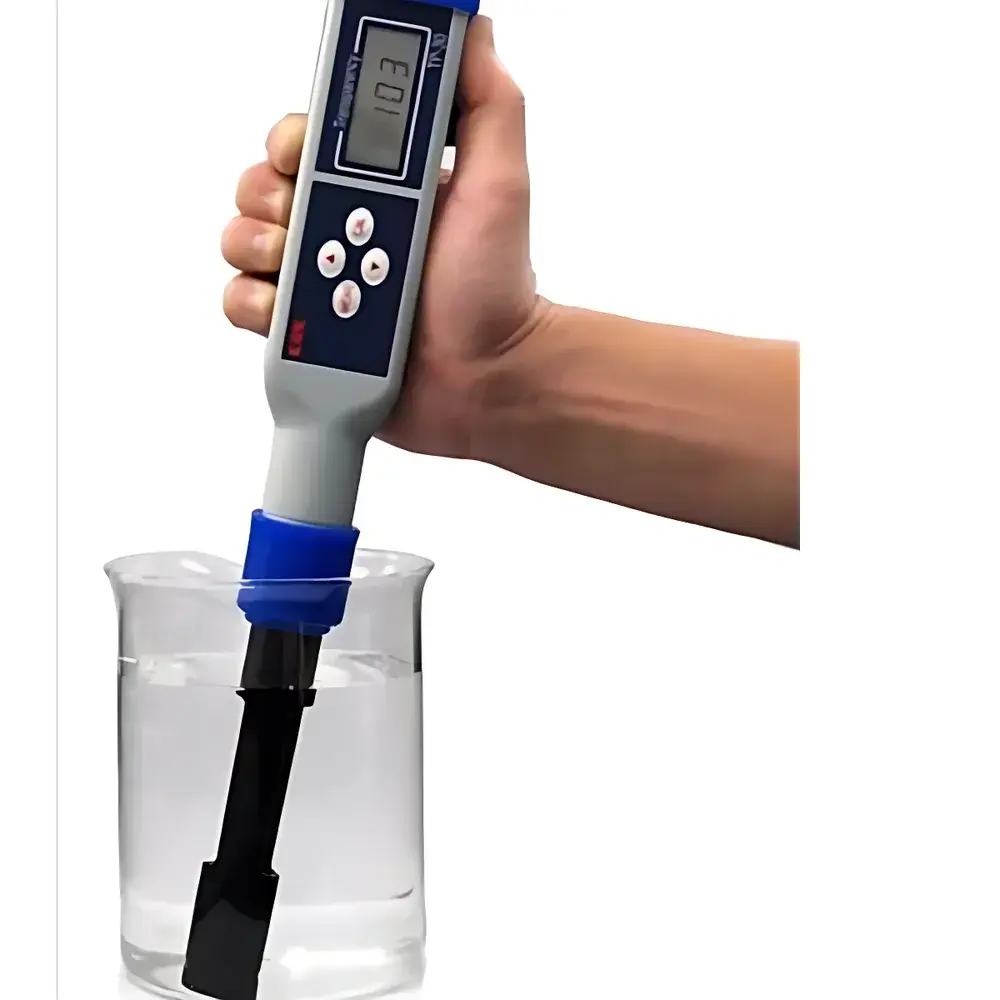
Rikorika TP-30 Submersible Turbidity & Transparency Meter
| Brand | Rikorika |
|---|---|
| Model | TP-30 |
| Origin | Japan |
| Measurement Principle | Near-infrared transmittance (880 nm) |
| Optical Path Length | 60 mm |
| Measurement Range | 2.0–200 cm |
| Resolution | 0.1 cm (2.0–99.9 cm), 1 cm (100–200 cm) |
| Accuracy | ±3% FS or better |
| Repeatability | ±3% FS |
| Operating Temperature | 2–40 °C (water), 0–40 °C (ambient) |
| Humidity Limit | ≤95% RH |
| Ingress Protection | IP63 (dust-resistant and splash-proof) |
| Power Supply | 4 × AA alkaline batteries (DC 6 V) |
| Auto Power-off | Yes |
| Housing Material | POM + rubberized impact-absorbing casing |
| Dimensions | 48 × 32 × 320 mm |
| Weight | ~300 g |
| Standard Accessories | Fluoride ion sensor module, shock-absorbing protective cap, PVC sample cell, calibration filter, user manual, batteries |
Overview
The Rikorika TP-30 Submersible Turbidity & Transparency Meter is a field-deployable, optical transmission-based instrument engineered for rapid, in-situ assessment of water column clarity. Unlike traditional Secchi disk methods or scattered-light turbidimeters, the TP-30 employs a fixed-path, near-infrared (NIR) transmittance measurement at 880 nm — a wavelength selected to minimize interference from ambient visible light, chlorophyll-a absorption, and dissolved organic matter (DOM) spectral overlap. The device operates on the principle that attenuation of collimated NIR radiation through a defined 60 mm optical path correlates directly with suspended particle concentration and aggregate size distribution in natural waters. Its submersible design enables direct immersion into lakes, rivers, reservoirs, and wastewater channels without requiring sample extraction, thereby eliminating errors associated with container-induced settling or aeration artifacts. The integrated lens-focusing optical system ensures stable beam alignment and high signal-to-noise ratio under variable lighting conditions, making it suitable for both diurnal monitoring and low-light deployment.
Key Features
- Fixed 60 mm optical path length with precision NIR (880 nm) LED source and photodiode detector — optimized for reduced solar interference and enhanced stability in outdoor environments
- Dual-range digital LCD display (3-digit) with automatic resolution switching: 0.1 cm resolution for transparency values between 2.0–99.9 cm; 1 cm resolution above 100 cm
- IP63-rated housing constructed from polyoxymethylene (POM) polymer and elastomeric impact-absorbing rubber — resistant to dust ingress and water splashes during field handling
- Integrated fluoride ion sensor module (standard) enabling concurrent measurement of F⁻ concentration alongside transparency — useful for groundwater and industrial effluent screening
- Two-point calibration capability: primary calibration via supplied neutral-density filter; secondary verification using traceable standard solutions (sold separately, 250 mL volume)
- Auto power-off after 5 minutes of inactivity — extends battery life and supports unattended short-term deployments
Sample Compatibility & Compliance
The TP-30 is validated for use with freshwater, brackish water, and treated wastewater matrices within a temperature range of 2–40 °C. It is not intended for highly viscous, aerated, or strongly colored samples (e.g., peat-stained waters with absorbance >0.5 AU at 880 nm), as these may exceed the linear dynamic range of the transmittance detector. While not certified to ISO 7027 or ASTM D1889, its measurement methodology aligns with the physical principles outlined in ISO 10212 (water quality — determination of transparency by Secchi disk and photometric methods) and supports data comparability in GLP-compliant environmental monitoring programs. The device’s construction materials comply with RoHS Directive 2011/65/EU, and its battery-powered operation eliminates electrical safety concerns in wet-field applications.
Software & Data Management
The TP-30 operates as a standalone, non-data-logging instrument. All measurements are displayed in real time on the integrated LCD screen and must be manually recorded. No proprietary software, USB interface, or Bluetooth connectivity is provided. However, the standardized output format (centimeter-scale transparency value, optional F⁻ concentration in ppm) facilitates seamless integration into third-party environmental data management systems (e.g., EQuIS, Aquarius, or custom Excel-based QA/QC templates). For regulatory reporting, users are advised to document calibration dates, ambient conditions, operator ID, and instrument serial number per site visit — consistent with EPA Method 180.1 documentation requirements for transparency-related field parameters.
Applications
- Long-term limnological monitoring of lake stratification and epilimnetic clarity trends
- Rapid assessment of sediment resuspension events following stormwater runoff or dredging operations
- Effluent compliance checks at municipal wastewater treatment plant outfalls
- Groundwater quality screening in fluoride-endemic regions where F⁻ co-occurs with turbidity-inducing colloids
- Educational fieldwork for university hydrology and environmental science courses
FAQ
Can the TP-30 measure turbidity in NTU units?
No. The TP-30 reports transparency depth in centimeters (cm), not nephelometric turbidity units (NTU). Conversion to approximate NTU requires empirical correlation with local water type and is not supported by the instrument firmware.
Is the fluoride sensor interchangeable or replaceable?
Yes. The fluoride ion sensor is modular and can be replaced independently; replacement modules are available under part number F-SNSR-TP30.
Does the device require annual factory recalibration?
No formal annual recalibration is mandated. Users should verify performance quarterly using the included calibration filter and maintain a log of verification results per ISO/IEC 17025 Clause 7.7.
Can the TP-30 be used in seawater?
It is not recommended for full-strength seawater (≥35 ppt salinity) due to potential chloride-induced drift in the fluoride sensor and refractive index effects on NIR transmittance interpretation.
Related Products







