
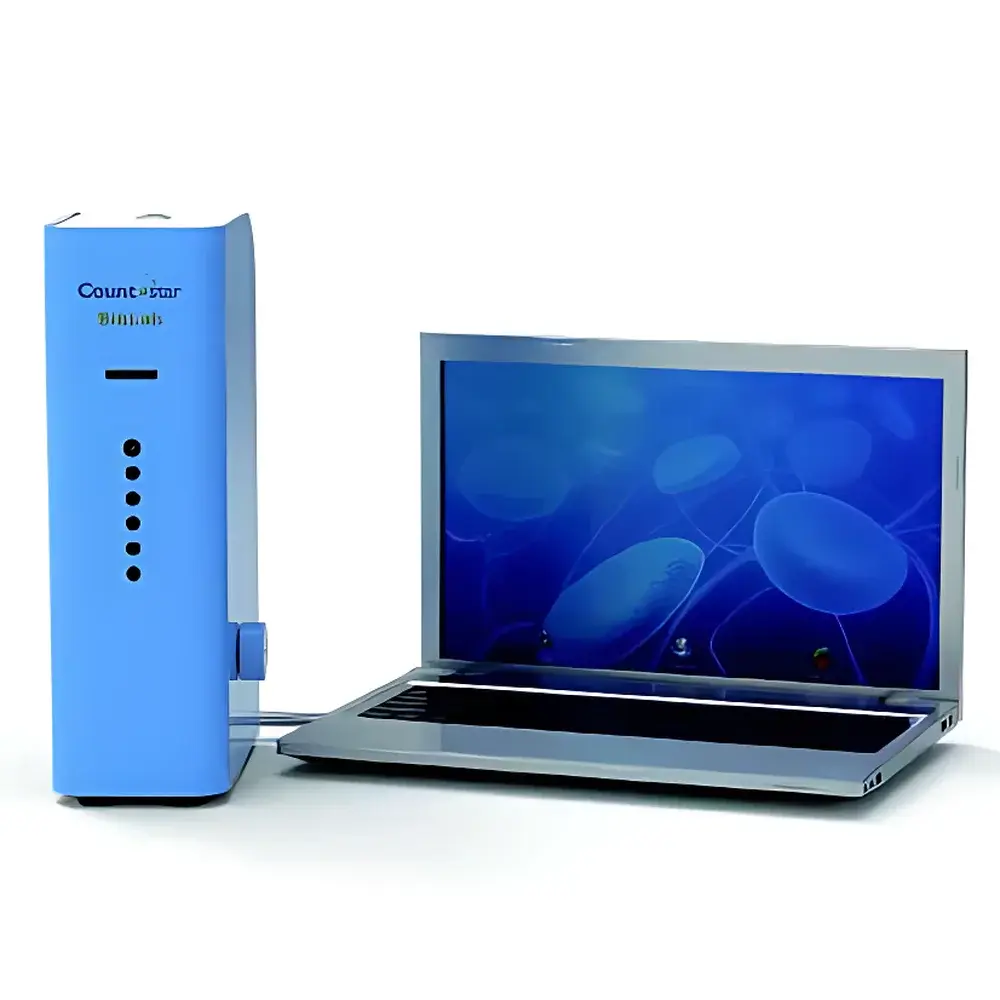
Countstar BioLab IE1000 Automated Cell Counter
| Brand | Countstar |
|---|---|
| Origin | Shanghai, China |
| Model | IE1000 |
| Measurement Time | <20 s |
| Cell Concentration Range | 1×10⁴–3×10⁷ cells/mL |
| Sample Volume | 20 µL |
| Throughput | 5 samples per slide |
| Detectable Cell Diameter | 5–180 µm |
Overview
The Countstar BioLab IE1000 Automated Cell Counter is an optical image-based cell analysis instrument engineered for precision, reproducibility, and workflow efficiency in academic and industrial life science laboratories. It employs high-resolution brightfield microscopy coupled with proprietary fixed-focus imaging technology—eliminating manual focusing and reducing operator-dependent variability. The system captures digital micrographs of unstained or trypan blue-stained cells loaded onto a disposable counting chamber, then applies adaptive segmentation algorithms to distinguish individual cells from debris and aggregates. Designed specifically for suspension cultures, the IE1000 delivers rapid quantification of total cell concentration, viable cell concentration, and viability percentage—calculated via membrane integrity discrimination using standard trypan blue exclusion methodology. Its compact footprint and intuitive software interface support benchtop deployment in core facilities, teaching labs, and R&D environments where throughput, consistency, and ease of validation are critical.
Key Features
- Fixed-focus optical architecture ensures consistent image acquisition across users and instruments—no calibration or focus adjustment required between samples.
- Validated performance: inter-instrument and intra-instrument coefficient of variation (CV) <5% for concentration and viability measurements under standardized conditions.
- High-throughput operation: five independent samples analyzed simultaneously on a single counting slide, each requiring only 20 µL of suspension.
- Wide dynamic detection range: supports cells from 5 µm (e.g., small lymphocytes, yeast) up to 180 µm (e.g., large adherent-derived spheroids, microalgae), accommodating diverse model systems including mammalian, insect, and aquatic eukaryotic cells.
- Aggregate-aware analysis engine: quantifies aggregate incidence, size distribution, and effective disaggregation ratio—providing objective metrics for culture health assessment beyond simple viability reporting.
- Low consumable cost: uses standardized, sterile, single-use counting slides compatible with ISO-certified manufacturing practices; no reagent kits or proprietary dyes required beyond standard trypan blue solution.
Sample Compatibility & Compliance
The IE1000 is validated for use with suspension-phase biological samples including primary mammalian cells, immortalized lines (e.g., HEK293, CHO, Jurkat), insect cells (Sf9, Sf21), tumor spheroids, microalgae, and selected planktonic protists. It complies with standard laboratory quality frameworks: measurement traceability aligns with ISO 21542 (Biotechnology — General requirements for cell counting methods), and data integrity features—including user-defined audit trails, password-protected method templates, and exportable CSV/PDF reports—support GLP-compliant documentation. While not intended for clinical diagnostics or regulatory submission under FDA 21 CFR Part 866.2140, the system meets technical requirements for research-grade cell enumeration as referenced in ASTM E2877-21 (Standard Guide for Characterization of Cell Populations in Suspension).
Software & Data Management
The embedded Countstar Analysis Suite provides a Windows-based graphical interface with role-based access control, customizable report templates, and automated data logging. All images and raw pixel matrices are stored locally with timestamped metadata (user ID, date/time, sample ID, dilution factor). Export options include structured CSV files for integration into LIMS or statistical platforms (e.g., GraphPad Prism, R), as well as PDF summary reports containing histograms of cell size distribution, viability trends over serial passages, and aggregate morphology heatmaps. Software updates are delivered via secure HTTPS channel and require digital signature verification—ensuring version control and compliance with internal IT security policies.
Applications
- Routine passage monitoring: rapid pre- and post-thaw viability assessment, seeding density optimization, and bioreactor inoculation calculations.
- Transfection and infection efficiency studies: correlation of viability loss with vector dose or MOI, supported by side-by-side comparison of treated vs. control populations.
- Spheroid and organoid dissociation QC: evaluation of single-cell yield and residual clump burden following enzymatic or mechanical dissociation protocols.
- Algal and microbial culture management: quantification of non-mammalian eukaryotes in biofuel, aquaculture, or ecotoxicology workflows.
- Training and education: visual demonstration of cell morphology, staining kinetics, and population heterogeneity in undergraduate and graduate laboratory curricula.
FAQ
Is the IE1000 suitable for adherent cell counting without trypsinization?
No—the instrument requires single-cell suspensions. Adherent cells must be fully dissociated into monodisperse suspensions prior to loading.
Does the system support fluorescent staining or dual-channel analysis?
No—this model operates exclusively in brightfield mode and does not integrate fluorescence excitation or emission filters.
Can data be exported in machine-readable format for automated pipeline integration?
Yes—CSV exports contain all calculated parameters (total count, viable count, % viability, average diameter, CV of size, aggregate index) with column headers compliant with MIAME and MIAPE metadata standards.
What regulatory documentation is provided for laboratory validation?
A Factory Acceptance Test (FAT) report, Certificate of Conformance, and IQ/OQ protocol templates are supplied with each unit to facilitate installation and operational qualification under ISO/IEC 17025 or CAP-accredited environments.
Is remote software support or firmware update capability available?
Yes—secure remote desktop assistance is offered during business hours (CST), and firmware updates are distributed via encrypted download portal with SHA-256 hash verification.
Related Products



