
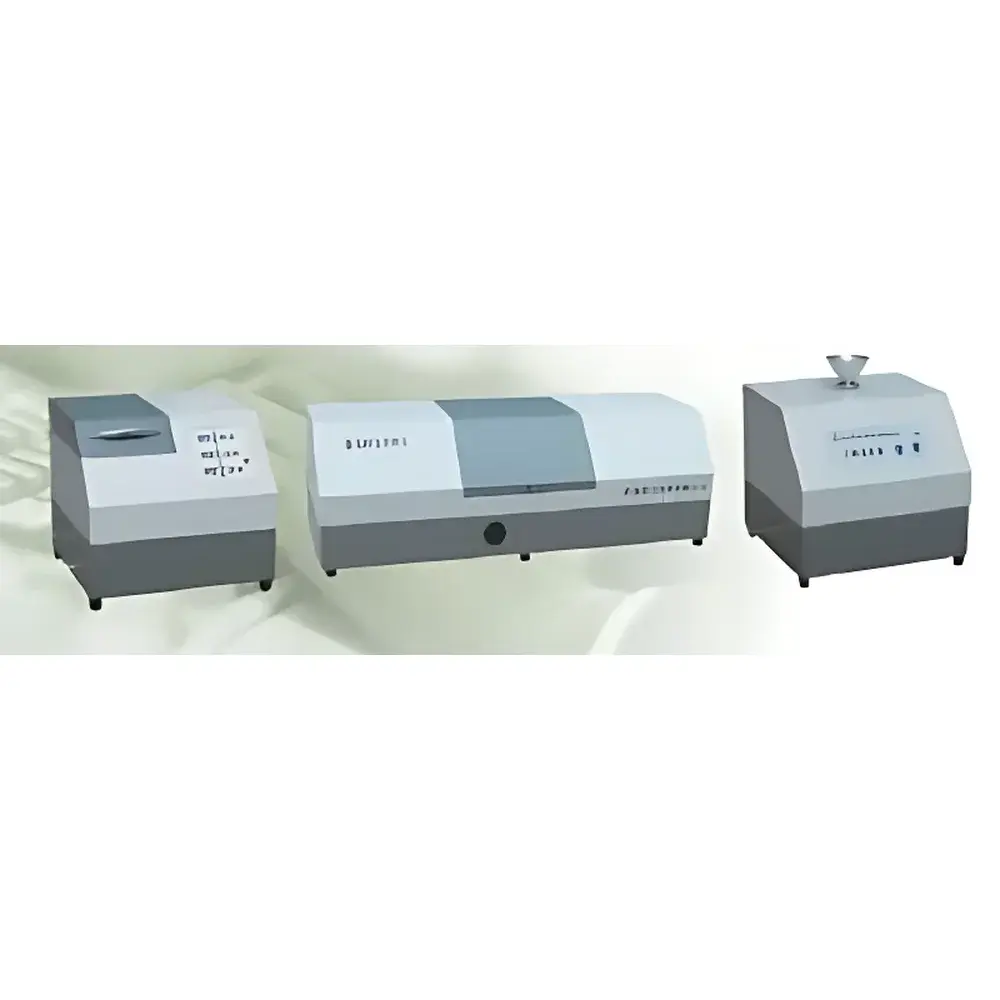
Rise RISE-2026 Dual-Mode Dry/Wet Laser Particle Size Analyzer
| Origin | Beijing, China |
|---|---|
| Manufacturer Type | Authorized Distributor |
| Regional Origin | Domestic (China) |
| Model | RISE-2026 |
| Pricing | Upon Request |
| Measurement Range (Wet) | 0.05–800 µm |
| Measurement Range (Dry) | 0.1–800 µm |
| Accuracy Error | < ±1% (D50, NIST-traceable standard reference materials) |
| Repeatability | < ±1% (D50, same sample, repeated measurements) |
| Electrical Supply | AC 220 V ±10%, 50 Hz, 200 W |
| Dimensions (L×W×H) | 950 × 330 × 300 mm |
| Weight | 50 kg |
| Laser Source | He–Ne gas laser, λ = 632.8 nm, lifetime >25,000 h |
| Maximum Detection Angle | 105° |
| Detector Array | Non-uniform cross-three-dimensional扇-shaped matrix (translated as “non-uniform crossed 3D sectoral matrix”) |
| Optical Design | Single-range convergent optical path, Fourier lens-free alignment |
| Standard Grading | 130 size classes default (0.02–2000 µm), fully customizable from Class 1 to 130 |
| Software | PADMAS v5.x (Particle Diameter Measure & Analysis System) |
| Data Export | CSV, Excel (.xlsx), PDF, PNG/JPEG images |
| Compliance | Designed per Q/01RZ01–2004 enterprise standard |
Overview
The Rise RISE-2026 Dual-Mode Dry/Wet Laser Particle Size Analyzer is an engineered solution for high-fidelity particle size distribution (PSD) characterization across diverse industrial and research environments. It operates on first-principles Mie scattering theory—fully accounting for particle refractive index, dispersion medium optical properties, and angular intensity distribution—to deliver physically grounded, model-independent PSD reconstruction. Unlike constrained inversion algorithms that assume predefined distribution shapes (e.g., log-normal or Rosin-Rammler), the RISE-2026 implements true non-parametric, unconstrained inverse scattering computation. This approach eliminates systematic bias introduced by a priori distribution assumptions and ensures fidelity to actual sample morphology—critical for QC release testing, formulation development, and regulatory submissions. Its dual operational mode enables seamless transition between dry powder aerosolization and liquid-phase suspension analysis without hardware reconfiguration, supporting method transfer validation under ISO 13320 and ASTM E2979 guidelines.
Key Features
- Single-optical-path convergent design with no Fourier lens assembly—eliminates alignment drift and enables long-term measurement stability.
- He–Ne laser source (632.8 nm) delivering narrow linewidth (25,000-hour service life—ensuring consistent coherence and signal-to-noise ratio over extended operation.
- Non-uniform crossed 3D sectoral matrix photodetector array covering up to 105° scattering angle—optimized for high-resolution detection of fine submicron particles and coarse aggregates within one measurement cycle.
- Integrated dry dispersion module featuring oil-free silent air compressor + refrigerated dryer—generating contaminant-free carrier gas compliant with ISO 8573–1 Class 2 purity requirements.
- Wet dispersion system with 100 W programmable ultrasonic generator (0–9 min 50 s, 1-s resolution), 400 mL stainless steel circular dispersion cell, and simultaneous ultrasonication–measurement capability—minimizing re-agglomeration artifacts in cohesive or high-surface-energy samples.
- Fully motorized, touch-interactive control panel for independent adjustment of stirrer speed (0–3000 rpm), circulation pump rate (0–5000 rpm), and ultrasonic duty cycle—enabling empirical optimization of dispersion kinetics per material class.
Sample Compatibility & Compliance
The RISE-2026 accommodates a broad spectrum of particulate materials—including metal powders, pharmaceutical actives, catalysts, pigments, ceramics, battery electrode slurries, and nanocomposites—without requiring solvent-specific calibration or optical parameter re-entry. Dry-mode operation eliminates need for surfactants, dispersants, or volatile organic carriers; wet-mode compatibility extends to aqueous, alcoholic, and low-dielectric media (e.g., isopropanol, ethylene glycol). All hardware conforms to Q/01RZ01–2004 manufacturing specifications for metrological traceability and mechanical robustness. The system supports documentation workflows aligned with GLP, GMP, and FDA 21 CFR Part 11 when configured with optional role-based access control, electronic signatures, and immutable audit logs. Instrument performance verification follows ISO 22412 and USP protocols using NIST-traceable silica and polystyrene latex standards.
Software & Data Management
PADMAS v5.x serves as the analytical engine and data governance interface. It computes D10, D50, D90, span, specific surface area (volume- and mass-weighted), and moment-ratio descriptors (e.g., skewness, kurtosis). Distribution formats include differential, cumulative, Rosin–Rammler, custom binning (1–130 classes), mesh-based reporting (US Sieve Series), and number-weighted histograms. Raw scattering intensity profiles are stored alongside processed results, enabling retrospective re-analysis with updated optical models. Export options include Excel-compatible .xlsx files with embedded metadata (operator ID, timestamp, instrument serial, dispersion parameters), publication-ready vector/PNG graphics, and searchable PDF reports with configurable headers/footers. Batch processing, statistical comparison (t-test, ANOVA), and trend monitoring dashboards support multi-lot stability studies and supplier qualification programs.
Applications
- Pharmaceutical solid dosage development: API crystallinity assessment, excipient blend uniformity, inhalation powder aerodynamic diameter profiling (in conjunction with cascade impaction data).
- Advanced materials R&D: Sintering behavior prediction via PSD–density correlation, catalyst pore-size inference from primary particle distribution, graphene oxide flake lateral dimension mapping.
- Quality control in chemical manufacturing: Batch-to-batch consistency verification of precipitated calcium carbonate, titanium dioxide pigment grading, polymer latex emulsion stability monitoring.
- Geotechnical and environmental analysis: Soil particle classification per USDA texture triangle, sediment transport modeling input, microplastic identification in wastewater effluents.
- Academic research: Validation of computational fluid dynamics (CFD) granular flow simulations, benchmarking of machine-learning–based PSD prediction models, interlaboratory round-robin studies under ISO/IEC 17043 accreditation frameworks.
FAQ
Does the RISE-2026 require periodic optical recalibration?
No—its single-range convergent optical architecture and thermally stabilized He–Ne laser eliminate routine alignment. Annual verification using NIST SRM 1963 or equivalent is recommended for ISO/IEC 17025 compliance.
Can the system measure particles below 50 nm?
While the specified lower limit is 0.05 µm (50 nm) in wet mode, detection sensitivity depends on refractive index contrast and signal averaging duration. Sub-50 nm verification requires orthogonal techniques (e.g., TEM, DLS) per ISO 22412 Annex C.
Is method transfer between dry and wet modes scientifically justified?
Yes—provided dispersion energy input, particle–medium interaction time, and shear history are documented and controlled. The RISE-2026’s parametric logging enables full method equivalence assessment per ICH Q5A(R2).
How does the system handle highly magnetic or electrostatic powders?
Dry dispersion incorporates grounded stainless steel pathways and ionized air purge nozzles to mitigate charge accumulation. Optional ferromagnetic separator accessories are available for Fe/Ni/Co-rich samples.
What level of software validation support is provided for regulated environments?
IQ/OQ documentation templates, installation checklists, and 21 CFR Part 11 readiness guidance are included. Full validation services (including PQ protocol development) are available through Rise-certified partners.



