
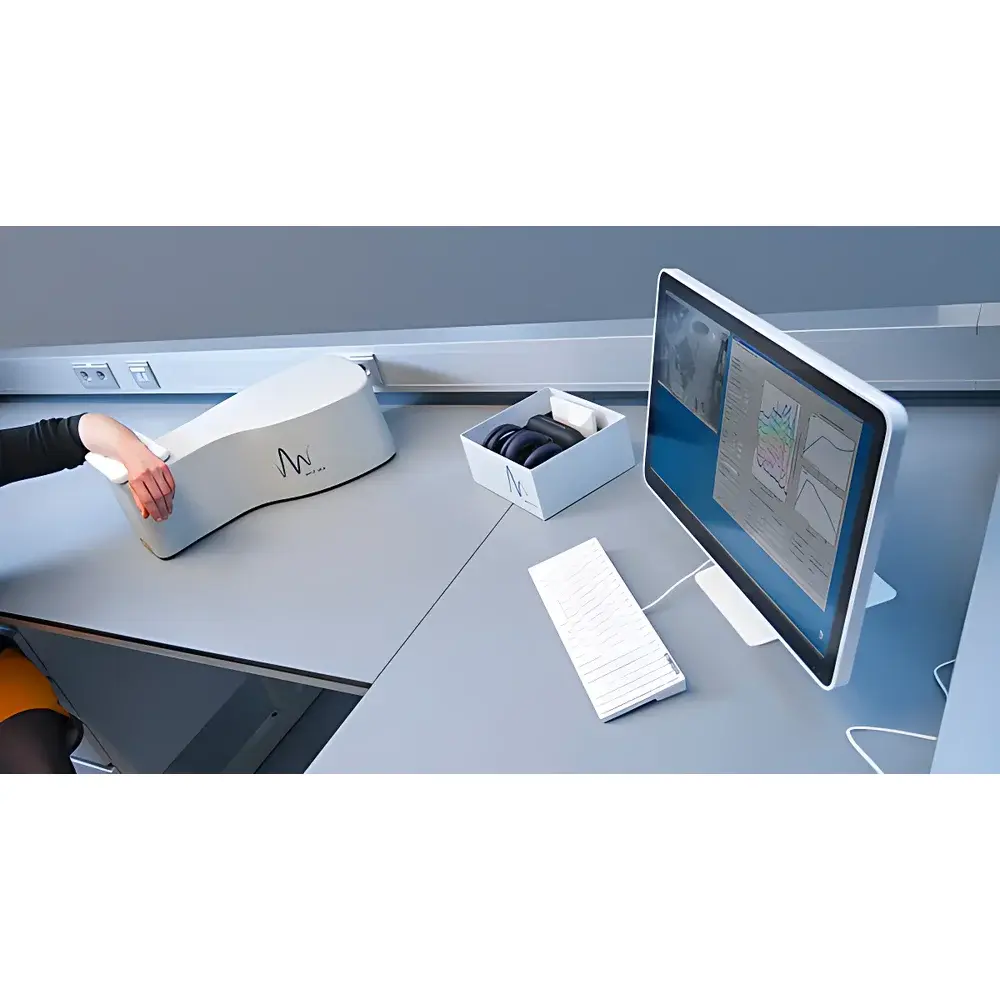
RIVERD gen2-SCA Confocal Raman Spectroscopy Skin Composition Analyzer
| Brand | RIVERD |
|---|---|
| Origin | Netherlands |
| Manufacturer Type | Authorized Distributor |
| Origin Category | Imported |
| Model | gen2-SCA |
| Pricing | Available Upon Request |
Overview
The RIVERD gen2-SCA Confocal Raman Spectroscopy Skin Composition Analyzer is a non-invasive, label-free optical instrumentation platform engineered for depth-resolved molecular characterization of human skin in vivo. It operates on the physical principle of confocal Raman spectroscopy—where monochromatic laser light interacts with molecular vibrational modes in skin tissue, generating inelastically scattered photons whose frequency shifts (Raman shifts) serve as unique spectral fingerprints of endogenous and exogenous chemical species. Unlike conventional bulk spectroscopic methods, the confocal optical architecture enables axial sectioning with micron-scale spatial resolution (typically 5–10 µm axial, 1–2 µm lateral), permitting quantitative profiling of molecular concentrations across discrete skin layers—from stratum corneum to viable epidermis—without biopsy or contrast agents.
Key Features
- Confocal optical design with motorized z-axis stage for precise depth scanning (0–500 µm range, step resolution ≤ 1 µm)
- High-throughput Raman acquisition using a cooled CCD detector and optimized grating configuration (spectral range: 400–3200 cm−1, spectral resolution ≤ 4 cm−1)
- Dual-wavelength excitation capability (typically 785 nm and 633 nm) to balance signal-to-noise ratio and minimize fluorescence interference from melanin and keratin
- Integrated real-time skin surface topography mapping via co-aligned low-coherence interferometry
- Thermally stabilized sample interface with adjustable contact pressure control to ensure consistent optical coupling and minimize motion artifacts
- CE-marked medical device (Class I, compliant with MDR 2017/745) and ISO 13485-certified manufacturing and distribution processes
Sample Compatibility & Compliance
The gen2-SCA is validated for use on human volar forearm, cheek, and dorsal hand sites under controlled ambient conditions (temperature 20–25°C, relative humidity 40–60%). It accommodates subjects aged 18–75 years with Fitzpatrick skin types I–IV. The system complies with ISO 10993-5 (cytotoxicity), ISO 10993-10 (irritation/sensitization), and IEC 62304 (medical device software lifecycle). All measurement protocols align with ASTM E2534 (standard guide for Raman spectroscopy in biomedical applications) and support GLP-compliant study execution, including full audit trail logging per FDA 21 CFR Part 11 requirements when paired with optional secure software licensing.
Software & Data Management
The proprietary SCA-Studio v3.2 software suite provides end-to-end workflow management: from automated spectral acquisition and background subtraction to multivariate curve resolution (MCR) and principal component regression (PCR) modeling. Spectral libraries include reference signatures for water, urea, lactate, ceramides, cholesterol, squalene, hyaluronic acid, and common cosmetic actives (e.g., niacinamide, retinol, salicylic acid). Raw data are stored in HDF5 format with embedded metadata (subject ID, anatomical site, depth coordinate, laser power, integration time). Export options include CSV, MATLAB .mat, and Bruker OPUS-compatible formats. Role-based user access control, electronic signature support, and encrypted database backups ensure data integrity and regulatory readiness.
Applications
- Quantitative depth profiling of stratum corneum hydration gradients and transepidermal water loss (TEWL)-correlated moisture distribution
- Spatial mapping of natural moisturizing factor (NMF) components—including amino acids, pyrrolidone carboxylic acid (PCA), and inorganic ions—across epidermal layers
- Pharmacokinetic assessment of topical drug penetration kinetics (e.g., corticosteroids, antifungals) and formulation-dependent reservoir formation
- Evaluation of cosmetic ingredient bioavailability and barrier interaction mechanisms (e.g., occlusives vs. humectants vs. emollients)
- Longitudinal monitoring of skin barrier recovery following tape-stripping, UV exposure, or irritant challenge in clinical trials
- Support for dermatological research into atopic dermatitis, psoriasis, and xerosis pathophysiology through molecular phenotype correlation
FAQ
What is the typical measurement time per depth point?
Acquisition time ranges from 0.5 to 5 seconds per spectrum, depending on laser power, integration time, and required signal-to-noise ratio; full depth profiles (20–50 points) require 1–4 minutes.
Can the gen2-SCA distinguish between bound and free water in skin?
Yes—via peak deconvolution of the O–H stretching band (3000–3600 cm−1), enabling quantification of tightly bound, loosely bound, and bulk-like water fractions.
Is calibration required before each session?
A daily wavelength calibration using a silicon standard (520.7 cm−1) is recommended; intensity calibration is performed semi-annually using NIST-traceable polystyrene standards.
Does the system support multi-site comparative studies?
Yes—SCA-Studio includes batch processing tools for inter-subject and inter-site normalization using internal water reference peaks and spatial registration algorithms.
How is subject motion compensated during depth scanning?
Real-time surface tracking via integrated interferometry adjusts the confocal focus position dynamically, maintaining optical sectioning accuracy even during minor physiological movement.






