
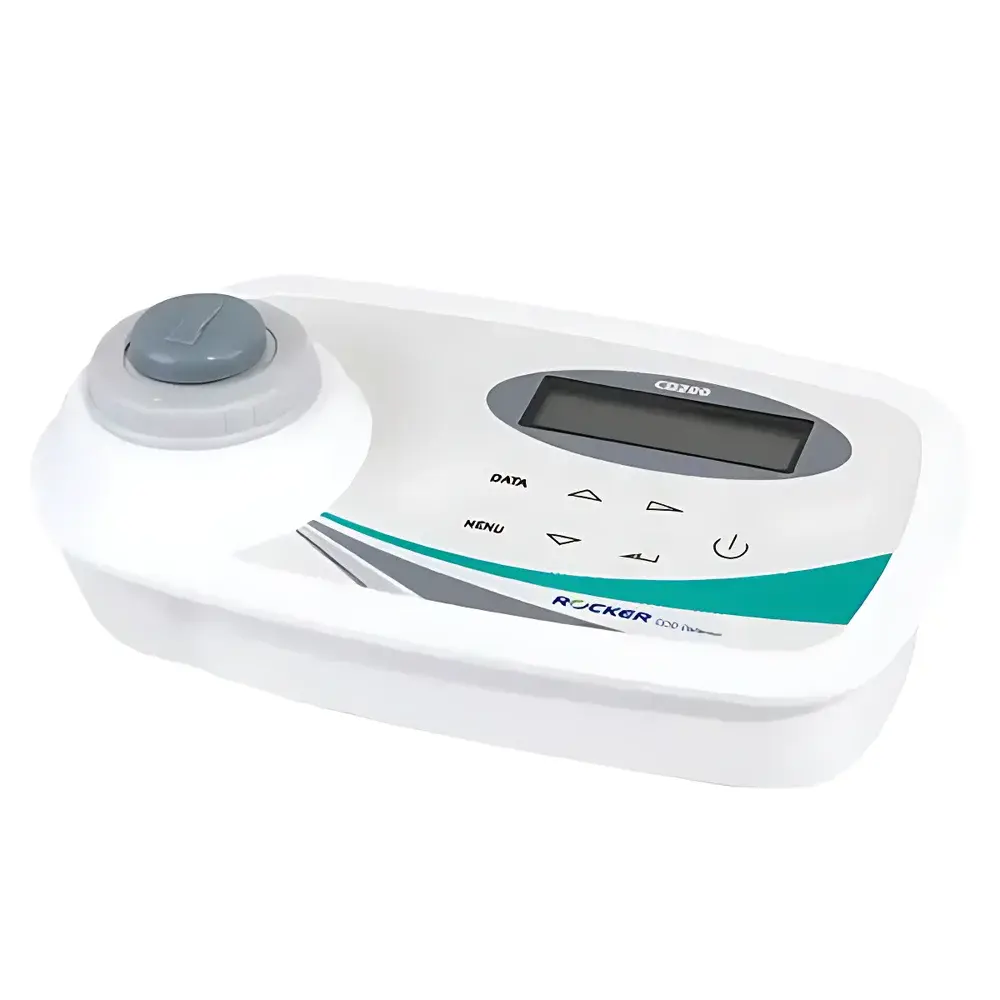
ROCKER CD200 Portable Chemical Oxygen Demand (COD) Analyzer
| Brand | ROCKER |
|---|---|
| Origin | Taiwan |
| Model | CD200 |
| Instrument Type | Portable |
| Measurement Principle | UV Absorption Spectrophotometry |
| Measurement Ranges | 10–150 mg/L, 100–1500 mg/L, 1000–15000 mg/L |
| Display | Backlit LCD |
| Light Source | LED |
| Measurement Time | 3 seconds |
| Data Storage Capacity | 100 records |
| Power Supply | DC 9 V battery or external AC adapter |
| Weight | 0.5 kg |
| Dimensions | 23 × 13 × 9 cm |
| Regulatory Compliance | CE Marked |
| Compatible Reagents | Hach, Lovibond, CHEMetrics, Hanna, Merck |
Overview
The ROCKER CD200 is a portable, microprocessor-controlled Chemical Oxygen Demand (COD) analyzer engineered for rapid, field-deployable water quality assessment using UV absorption spectrophotometry. Unlike traditional dichromate-based wet chemistry methods—which require hazardous reagents, high-temperature digestion, and laboratory infrastructure—the CD200 leverages optical absorbance at specific ultraviolet wavelengths to quantify the concentration of oxidizable organic matter in aqueous samples. This principle enables direct, non-destructive measurement post-digestion, eliminating the need for blank corrections or calibration drift compensation during routine operation. Designed for compliance with standard method frameworks—including ASTM D1252 (Method B, UV-based alternatives) and ISO 15705:2002 (for spectrophotometric COD estimation)—the instrument supports environmental monitoring workflows where speed, portability, and reagent interoperability are critical. Its compact form factor and battery-powered operation make it suitable for on-site sampling at wastewater outfalls, riverbanks, industrial effluent points, and municipal treatment facilities.
Key Features
- Triple-range optical quantification: Pre-programmed and user-configurable calibration curves for three distinct COD ranges—10–150 mg/L (low), 100–1500 mg/L (medium), and 1000–15000 mg/L (high)—ensuring optimal signal-to-noise ratio across diverse sample matrices.
- Zero warm-up requirement: LED-based optical system achieves stable photometric output immediately upon power-on; measurement completes within 3 seconds after sample insertion.
- Multi-reagent compatibility: Embedded assay protocols for five globally recognized reagent systems—Hach, Lovibond, CHEMetrics, Hanna, and Merck—enabling seamless integration into existing lab-standardized workflows without protocol redesign.
- User-definable curve editor: Engineers and QA/QC personnel may input custom calibration coefficients (slope/intercept) to support proprietary or modified digestion chemistries, ensuring traceability under GLP-compliant documentation practices.
- Onboard data management: Internal memory stores up to 100 test records with timestamp, range selection, and operator ID (if configured via external software), supporting audit-ready data capture per ISO/IEC 17025 documentation requirements.
- Ruggedized portable architecture: Housing meets IP54 ingress protection standards; weight (0.5 kg) and dimensions (23 × 13 × 9 cm) comply with IEC 61010-1 for handheld field instrumentation safety.
Sample Compatibility & Compliance
The CD200 accepts standard 16 mm round glass or quartz cuvettes following ASTM D5848 and ISO 7027 geometrical specifications. It is validated for use with commercially available closed-vial digestion kits requiring no post-digestion dilution or filtration—provided turbidity remains below 5 NTU to avoid scattering interference. The device bears CE marking per Directive 2014/30/EU (EMC) and 2014/35/EU (LVD), confirming conformity with essential health and safety requirements for electrical equipment operating within the European Economic Area. While not a standalone regulatory testing platform, its optical methodology aligns with EPA Method 410.4 (UV-VIS adaptation) and supports data generation acceptable for internal QC reporting, pre-screening, and trend analysis in accordance with ISO 5667-3:2018 (water sampling guidance).
Software & Data Management
Data export is supported via optional USB-to-serial interface (not included), enabling transfer of stored records to PC-based spreadsheet or LIMS environments. Raw absorbance values and applied calibration parameters are retained in non-volatile memory. Firmware supports firmware version logging and operator-defined metadata tagging (e.g., site code, batch ID), facilitating alignment with FDA 21 CFR Part 11 requirements when paired with validated third-party data acquisition software. No cloud connectivity or proprietary cloud service is embedded—ensuring full data sovereignty and simplifying IT security validation in regulated environments.
Applications
- Real-time effluent monitoring at municipal wastewater treatment plants (WWTPs) and industrial discharge points.
- Rapid screening of surface water bodies (rivers, lakes, reservoirs) during environmental impact assessments or seasonal pollution surveys.
- Groundwater quality verification in remediation sites and landfill leachate collection systems.
- Process control in food & beverage, pharmaceutical, and textile manufacturing where COD serves as a key surrogate for organic loading.
- Educational laboratories requiring safe, repeatable COD instruction without chromium(VI) handling protocols.
FAQ
Does the CD200 perform digestion internally?
No. The CD200 is a photometric reader only; sample digestion must be conducted externally using certified reagent kits and heating blocks or digesters compliant with ISO 6060 or EPA 410.4.
Can calibration curves be exported or backed up?
Calibration parameters are stored in-device and editable via front-panel interface; full curve export requires connection to ROCKER’s optional configuration utility (v2.1+).
Is the instrument compatible with ASTM D1252-compliant digestion protocols?
Yes—when used with digestion reagents and procedures meeting ASTM D1252 Section 11.2 (UV-based alternatives), the CD200 delivers measurement results consistent with the method’s performance criteria.
What maintenance is required for long-term accuracy?
Annual verification using NIST-traceable COD reference standards (e.g., potassium hydrogen phthalate solutions) is recommended; optical path cleaning with lint-free wipes and isopropyl alcohol every 200 measurements ensures repeatability.
Does the CD200 meet GLP data integrity requirements?
It supports core GLP elements—audit trail-capable memory, operator identification fields, and immutable timestamping—but full GLP compliance depends on organizational SOPs governing instrument qualification, calibration, and data review processes.
Related Products







