
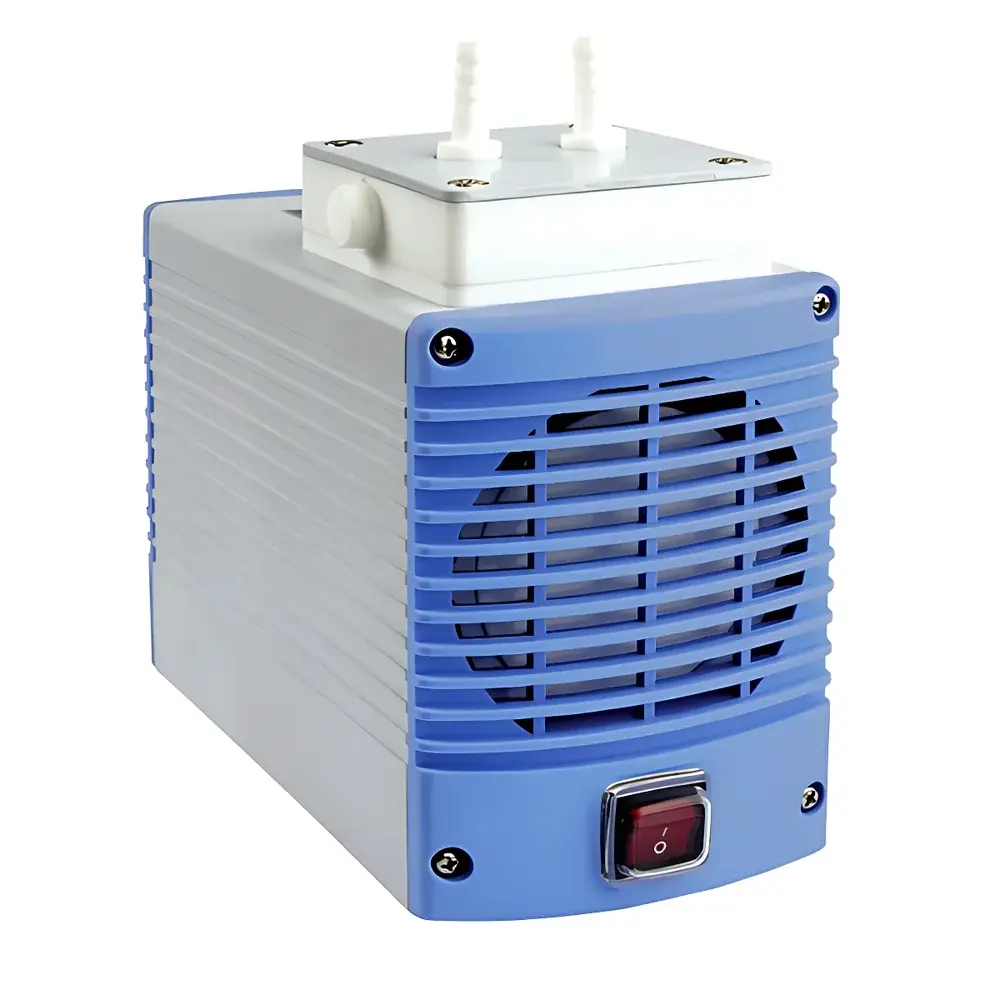
Rocker Chemker 300 Corrosion-Resistant Laboratory Diaphragm Vacuum Pump
| Brand | Rocker |
|---|---|
| Origin | Taiwan |
| Model | Chemker 300 |
| Pump Type | Diaphragm Vacuum Pump |
| Ultimate Vacuum | –670 mmHg (89.3 kPa, 120 mbar) |
| Flow Rate | 18 L/min |
| Noise Level | ≤50 dB(A) |
| Motor Speed | 1450 rpm |
| Power Consumption | 60 W |
| Input Voltage | 220–240 VAC, 50 Hz |
| Weight | 5.0 kg |
| Dimensions (L×W×H) | 20.3 × 11.2 × 20.9 cm |
| Hose ID | 8 mm (5/16″) |
| Motor Rating | 1/8 HP |
| Thermal Protection | Built-in motor temperature cut-off switch |
| Certification | CE compliant |
Overview
The Rocker Chemker 300 is an oil-free, corrosion-resistant diaphragm vacuum pump engineered for demanding laboratory environments where exposure to aggressive vapors—such as organic solvents, acidic fumes, and alkaline gases—is routine. Unlike rotary vane or piston pumps, the Chemker 300 operates on a positive displacement principle using a PTFE-coated elastomeric diaphragm actuated by an eccentric cam. This design eliminates the need for lubricating oil, thereby preventing cross-contamination of samples, avoiding oil backstreaming into vacuum lines, and eliminating oil mist emissions—a critical requirement in analytical, pharmaceutical, and environmental laboratories. Its ultimate vacuum performance of –670 mmHg (89.3 kPa, 120 mbar) and continuous flow rate of 18 L/min support stable operation across a wide range of low-to-medium vacuum applications, including filtration, solvent removal, and sample preparation workflows requiring chemically inert vacuum sources.
Key Features
- Chemically inert wetted parts: All gas-contact surfaces—including diaphragm, valves, and internal chamber—are constructed with PTFE or PTFE-coated materials, ensuring compatibility with HCl, HF, acetic acid, acetone, chloroform, and other corrosive or volatile media.
- Oil-free operation: No lubrication required; eliminates maintenance intervals associated with oil changes, filter replacements, or vapor trap servicing—reducing total cost of ownership and downtime.
- Low-noise, low-vibration architecture: Direct-drive motor coupling and optimized diaphragm stroke dynamics maintain sound pressure levels at ≤50 dB(A) at 1 m distance, enabling placement on shared benchtops without acoustic interference.
- Integrated thermal protection: A bimetallic temperature switch embedded in the motor windings automatically interrupts power when internal temperature exceeds safe operating thresholds, then resets autonomously upon cooling—enhancing long-term reliability under intermittent or extended duty cycles.
- CE-marked safety compliance: Conforms to EU Machinery Directive 2006/42/EC and Low Voltage Directive 2014/35/EU, validating electrical insulation integrity, mechanical stability, and fault-condition response.
Sample Compatibility & Compliance
The Chemker 300 is validated for use with aqueous, polar, and non-polar solvents commonly employed in solid-phase extraction (SPE), vacuum-assisted filtration (e.g., Büchner or membrane filtration), electrophoretic transfer (Western/Northern blotting), and solvent purification systems. Its PTFE-wetted path meets material compatibility requirements specified in ASTM D471 (rubber property testing) and ISO 15203 (chemical resistance of elastomers). While not intrinsically rated for hazardous area use (ATEX/IECEx), its sealed motor housing and absence of sparking components make it suitable for general-purpose Class I, Division 2 environments per NEC 500 when installed per local electrical codes. The pump does not require GLP/GMP-specific audit trails but supports traceable vacuum process documentation when integrated with external pressure loggers or PLC-controlled systems.
Software & Data Management
As a standalone benchtop vacuum source, the Chemker 300 operates without proprietary software or digital interfaces. It features a simple on/off rocker switch with LED status indication. For integration into automated workflows, optional analog pressure transducers (0–10 V or 4–20 mA output) may be connected externally to record vacuum level trends via LabVIEW, MATLAB, or SCADA platforms. No firmware updates, cybersecurity protocols, or FDA 21 CFR Part 11-compliant electronic records are provided—consistent with its role as a utility-grade instrument rather than a regulated analytical endpoint device.
Applications
- Vacuum filtration of aggressive filtrates in environmental water analysis (e.g., EPA Method 1664B lipid extraction).
- Solvent degassing prior to HPLC mobile phase preparation involving TFA or trifluoroethanol.
- Electrophoretic transfer of proteins from SDS-PAGE gels under acidic or basic buffer conditions.
- Concentration of acid-labile compounds during natural product isolation using rotary evaporation backup.
- Gas sampling systems requiring chemically stable vacuum generation for FTIR or GC-MS inlet conditioning.
FAQ
Is the Chemker 300 suitable for continuous 24/7 operation?
It is rated for intermittent duty; sustained operation beyond 6–8 hours/day requires periodic cooldown intervals to prevent thermal accumulation. The built-in thermal cutoff provides safeguarding but does not extend duty cycle ratings.
Can it handle hydrogen chloride (HCl) gas directly?
Yes—provided gas stream moisture content is minimized (<30% RH) and flow rates remain within rated capacity. Condensed acid formation must be prevented via inline desiccant or chilled traps upstream.
Does it meet ISO 8573-1 Class 0 air purity requirements?
Not applicable—the Chemker 300 is a vacuum pump, not a compressed air source. Its exhaust is non-oiled and particle-free per ISO 8573-1 Annex B methodology, but no formal certification is issued.
What hose fittings are compatible with the 8 mm inlet port?
Standard silicone or Viton tubing with 8 mm inner diameter (5/16″ ID) and appropriate barbed or compression fittings—no proprietary connectors required.
Is replacement PTFE diaphragm available as a service part?
Yes—Rocker supplies OEM diaphragm kits (Part No. CK300-DIA) with full installation instructions; typical service life exceeds 10,000 hours under nominal load conditions.
Related Products



