
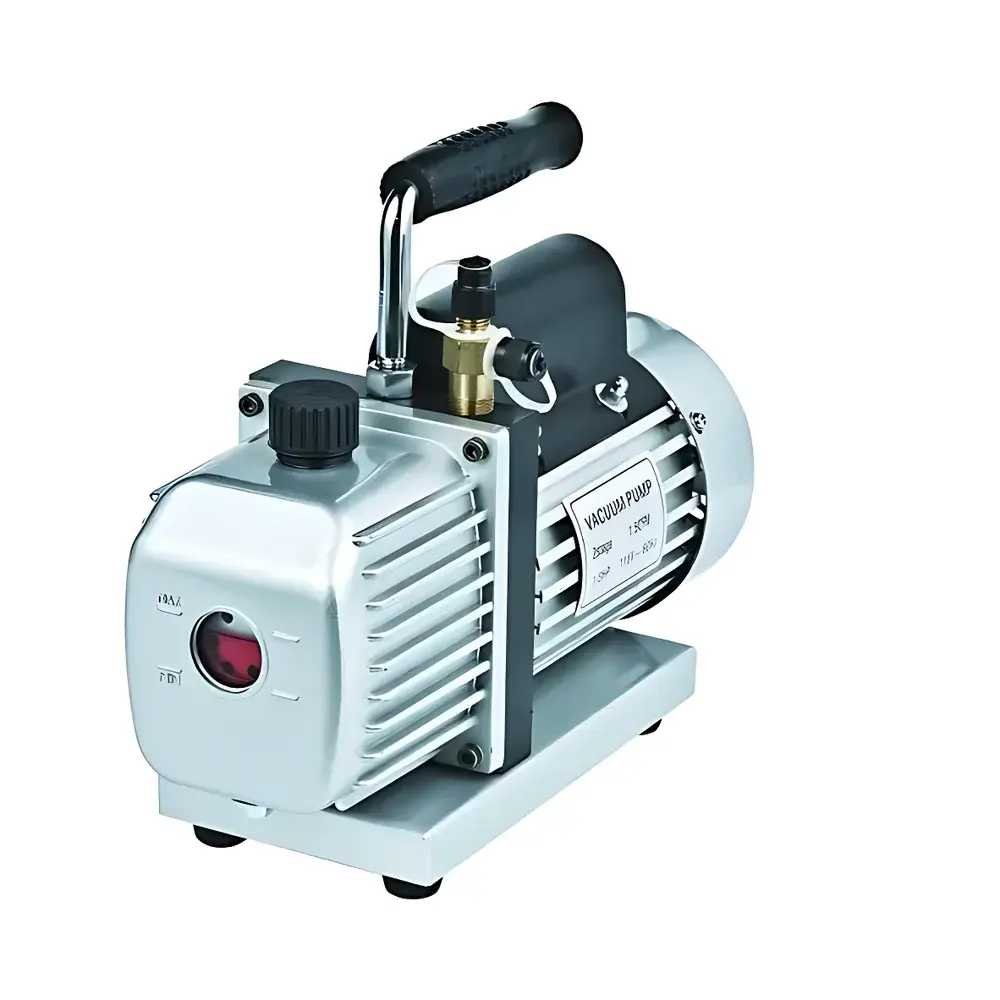
ROCKER Tanker 150 Rotary Vane Vacuum Pump
| Brand | ROCKER |
|---|---|
| Origin | Taiwan |
| Model | Tanker 150 |
| Pump Type | Oil-Lubricated Rotary Vane |
| Ultimate Vacuum | 0.133 mbar |
| Flow Rate | 140 L/min |
| Noise Level | 52 dB(A) |
| Power Consumption | 372.9 W |
| Weight | 12 kg |
| Voltage | 100–120 V / 60 Hz (optional 200–240 V / 50 Hz) |
| Certifications | CE compliant |
| Protection | Built-in thermal cut-off switch |
| Optional Accessory | Oil mist filter |
Overview
The ROCKER Tanker 150 is an oil-lubricated rotary vane vacuum pump engineered for reliable, continuous operation in demanding laboratory environments requiring medium-to-high vacuum levels and high volumetric flow rates. Based on the well-established Couette-type rotary vane principle, the pump utilizes precision-machined vanes rotating eccentrically within a cylindrical stator chamber to generate vacuum through sequential compression and expulsion of gas volumes. Its ultimate vacuum performance of ≤0.133 mbar (≤0.1 Torr) and free-air displacement rate of 140 L/min make it suitable for applications where rapid evacuation and stable base pressure are critical—such as vacuum drying ovens, centrifugal concentrators, solvent removal systems, and multi-port filtration manifolds. Designed with industrial-grade cast aluminum housing and dynamically balanced rotor assembly, the Tanker 150 delivers mechanical stability and long-term repeatability under sustained load conditions.
Key Features
- Oil-lubricated rotary vane architecture ensures consistent sealing and low ultimate pressure without requiring frequent maintenance intervals.
- Integrated thermal protection circuit automatically de-energizes the motor when internal temperature exceeds safe operational thresholds; self-resets upon cooling to prevent coil damage and extend service life.
- Acoustically optimized housing and vibration-dampened mounting reduce radiated noise to 52 dB(A) at 1 m distance—enabling placement in shared lab spaces without acoustic interference.
- Standard configuration includes a dedicated oil mist filter port; optional high-efficiency coalescing filter minimizes hydrocarbon vapor emission, supporting ISO 8573-1 Class 3 air purity compliance for sensitive downstream instrumentation.
- CE-marked per Directive 2014/35/EU (Low Voltage Directive) and 2014/30/EU (EMC Directive), indicating conformity with essential health, safety, and electromagnetic compatibility requirements for use across EEA member states.
- Configurable power input options: factory-set for 100–120 V / 60 Hz (North America/Japan) or optionally supplied for 200–240 V / 50 Hz (EU/UK/Asia), with UL-listed cord sets available upon request.
Sample Compatibility & Compliance
The Tanker 150 is compatible with standard NPT 1/4″ or BSP 1/4″ vacuum inlet connections and interfaces seamlessly with common laboratory vacuum accessories—including Büchner funnels, desiccators, vacuum-jacketed glassware, and lyophilizer condensers. It is not intended for use with corrosive, polymerizing, or highly particulate-laden gases unless paired with appropriate upstream traps or scrubbers. As an oil-sealed mechanical pump, it complies with general-purpose vacuum system guidelines outlined in ASTM D3924 (Standard Practice for Laboratory Vacuum Systems) and supports GLP-compliant workflows when operated within defined environmental parameters (ambient temperature: 15–35°C; relative humidity: ≤80%, non-condensing). Routine oil change intervals (every 500 operating hours or 6 months, whichever occurs first) are recommended to maintain specified ultimate vacuum and flow performance.
Software & Data Management
The Tanker 150 operates as a standalone analog device with no embedded firmware or digital interface. However, its electrical characteristics—including nominal current draw (≈3.1 A @ 120 V), steady-state power consumption (372.9 W), and thermal response profile—are fully documented in the IEC 61000-3-2 Class D harmonic emission report included in the technical dossier. For integration into automated vacuum control systems, users may pair the pump with external pressure transducers (e.g., capacitance manometers traceable to NIST standards) and programmable logic controllers (PLCs) supporting Modbus RTU or 4–20 mA analog feedback loops. All calibration certificates, CE Declaration of Conformity, and RoHS compliance documentation are provided digitally upon shipment and archived for audit readiness under ISO/IEC 17025-aligned quality management protocols.
Applications
- Vacuum-assisted filtration of aqueous and organic suspensions using sintered glass or membrane filter assemblies.
- Controlled dehydration of heat-sensitive biological samples in vacuum drying chambers (operating range: 25–80°C).
- Rotary evaporation support for solvent recovery in synthetic chemistry workflows.
- Pre-evacuation and hold-pressure maintenance in freeze-drying cycles prior to primary drying phase initiation.
- Gas blanketing and inert atmosphere preparation in glovebox antechambers and Schlenk line manifolds.
- Supporting vacuum integrity testing of sealed packaging or microfluidic device enclosures per ASTM F2338.
FAQ
Is the Tanker 150 suitable for continuous 24/7 operation?
Yes—when installed in a well-ventilated area with ambient temperature maintained between 15°C and 35°C and serviced per the recommended oil replacement schedule, the Tanker 150 is rated for uninterrupted duty cycle operation.
Can this pump be used with aggressive solvents such as chloroform or acetone?
Direct exposure to halogenated or highly volatile solvents is not recommended without upstream cold traps or chemical scrubbers, as these may degrade pump oil integrity and accelerate vane wear.
Does the unit include vacuum oil and an oil mist filter?
Factory-shipped units contain one liter of ISO VG 100 mineral-based vacuum pump oil; the oil mist filter is optional and must be ordered separately.
What is the expected service life under normal laboratory usage?
With adherence to maintenance protocols—including oil changes every 500 hours and periodic inspection of inlet filters—the typical service life exceeds 10,000 operating hours.
Is remote monitoring or IoT integration possible?
No native digital interface exists; however, third-party current sensors, temperature probes, and pressure transmitters can be integrated via external control systems for logging and alarm triggering.
Related Products



