
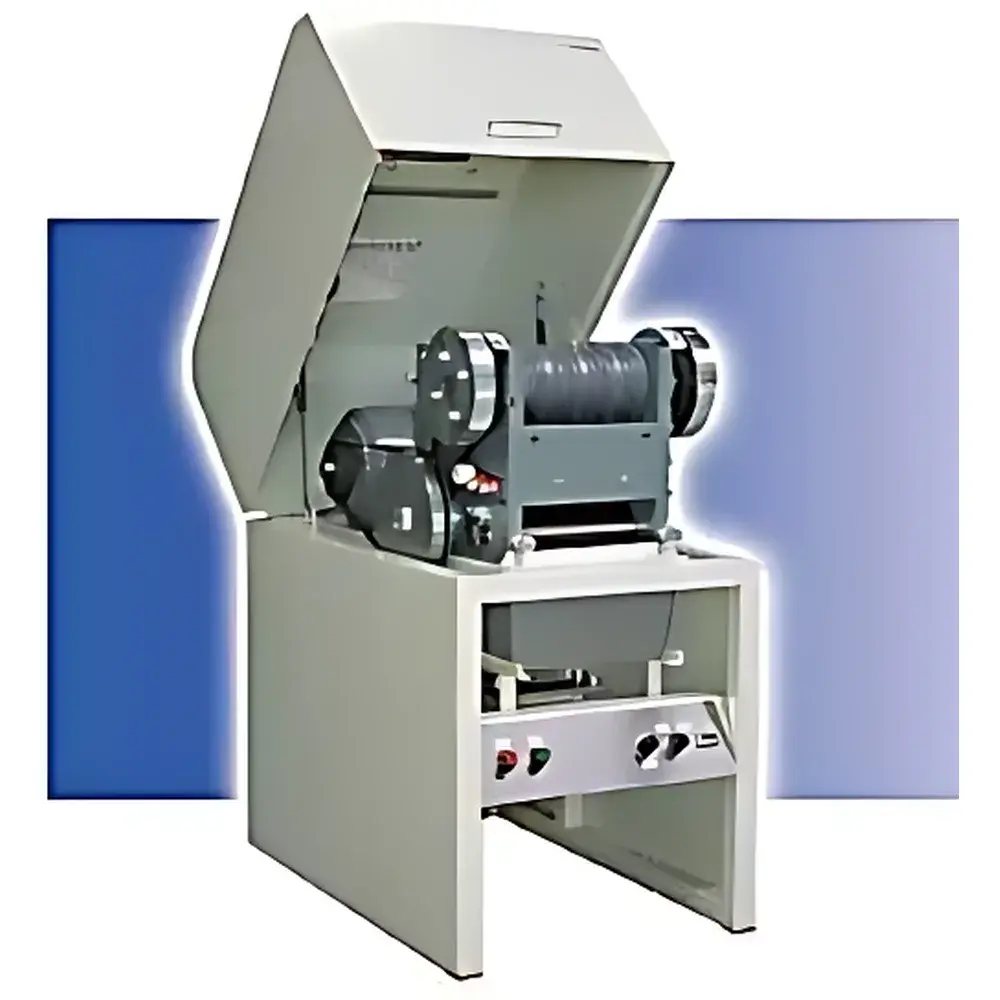
ROCKLABS Boyd Dual-Action Jaw Crusher
| Brand | CHINYEE |
|---|---|
| Origin | Imported (New Zealand) |
| Manufacturer Type | Authorized Distributor |
| Model | ROCKLABS Boyd Crusher |
| Dimensions (H×W×D) | 1320 mm × 680 mm × 1160 mm |
| Weight | 560 kg |
| Max Feed Size | 50 mm |
| Output Particle Size | ≤2 mm |
| Reduction Ratio | Up to 25:1 |
| Max Batch Capacity | 5 kg |
| Feed Opening Width | 300 mm |
| Safety | Integrated Interlock Switches |
| Dust Control | Internal Air Duct System |
| Compliance | Designed for ISO/IEC 17025-compliant sample preparation environments |
Overview
The ROCKLABS Boyd Dual-Action Jaw Crusher is a precision-engineered primary crushing instrument developed in New Zealand for high-integrity geological, metallurgical, and geochemical sample preparation. Unlike conventional single-motion jaw crushers, the Boyd employs a patented dual-action mechanism—featuring two independently driven jaw plates (top and bottom)—that subjects feed material to sequential compressive shearing cycles as it descends through the crushing chamber. This kinematic architecture ensures uniform particle size reduction with minimal overgrinding, low heat generation, and exceptional reproducibility across batch operations. Designed specifically for laboratories requiring trace-element integrity and representative subsampling, the Boyd crusher meets the mechanical and operational demands of ASTM D2974, ISO 13320, and USP for comminution consistency in heterogeneous solid matrices.
Key Features
- Dual-action jaw motion: Synchronized top and bottom jaw plate movement delivers up to 25:1 size reduction in a single pass—unmatched among standard jaw crushers.
- High-capacity feed geometry: 300 mm wide horizontal feed opening enables rapid loading of irregularly shaped rocks, drill cores, or coarse aggregates without pre-sizing.
- Extended service life design: Interchangeable top and bottom jaw plates double usable wear surface area, reducing long-term maintenance cost and downtime.
- Integrated safety interlocks: Mechanical and electrical interlock switches automatically halt operation when access doors are opened, complying with IEC 61000-6-2 and EN 60204-1 requirements.
- Onboard dust mitigation: Internal air duct system connects directly to laboratory exhaust or optional cyclonic filtration units, minimizing airborne particulate exposure during operation.
- Rugged cast-iron frame and hardened manganese steel jaws ensure structural stability and resistance to abrasive wear under continuous 8-hour shifts.
Sample Compatibility & Compliance
The Boyd Crusher accepts feed materials with maximum dimensions of 50 mm and hardness up to Mohs 7 (e.g., quartzite, basalt, iron ore, slag, ceramics). It is routinely deployed in accredited mineral assay labs preparing samples for XRF, ICP-MS, and fire assay workflows where contamination control and particle size homogeneity are critical. The unit conforms to GLP documentation standards when paired with optional audit-trail-enabled operation logs. Its closed-cabinet configuration supports compliance with OSHA 1910.94 (ventilation) and EU Directive 2009/104/EC (machinery safety). All structural welds meet AWS D1.1 specifications; electrical components are CE-marked and RoHS-compliant.
Software & Data Management
While the Boyd Crusher operates as a standalone mechanical system, its integration into digital lab ecosystems is supported via optional I/O modules (4–20 mA analog output, Modbus RTU RS-485) for connection to LIMS or MES platforms. Optional RFID-tagged jaw plate kits enable automated wear tracking and predictive replacement scheduling. All operational parameters—including cycle count, total runtime, and emergency stop events—are logged locally on non-volatile memory and exportable via USB-C interface in CSV format. These records satisfy FDA 21 CFR Part 11 requirements when used with validated electronic signature protocols.
Applications
- Geochemical exploration labs preparing pulverized rock samples for multi-element analysis (ICP-OES, ICP-MS).
- Mining QA/QC facilities performing run-of-mine (ROM) ore characterization prior to milling and leaching trials.
- Cement and aggregate testing laboratories conducting gradation analysis per ASTM C136 and EN 933-1.
- Environmental soil labs reducing field-collected contaminated soils to <2 mm for TCLP extraction and heavy metal speciation.
- Academic research groups studying comminution energy efficiency and fracture mechanics in brittle solids.
- Reference material producers requiring certified homogeneity across large-batch reference standards (e.g., NIST SRMs, CANMET CRM series).
FAQ
What is the maximum feed size the Boyd Crusher can accept?
The unit accepts feed particles up to 50 mm in largest dimension.
Does the crusher require external dust extraction?
It includes an integrated air duct system compatible with standard lab exhaust manifolds or optional cyclone separators.
Can jaw plates be reversed for extended service life?
Yes—the top and bottom jaw plates are fully interchangeable, effectively doubling their usable wear surface.
Is the Boyd Crusher suitable for hazardous or reactive materials?
It is not intrinsically safe; use with pyrophoric, explosive, or highly toxic materials requires additional engineering controls and risk assessment per NFPA 484 and ATEX directives.
How is calibration and performance verification performed?
Performance is verified using certified reference aggregates (e.g., ASTM E11 test sieves) and documented per ISO/IEC 17025 clause 6.5.2; no routine recalibration is required due to mechanical-only actuation.
Related Products



