
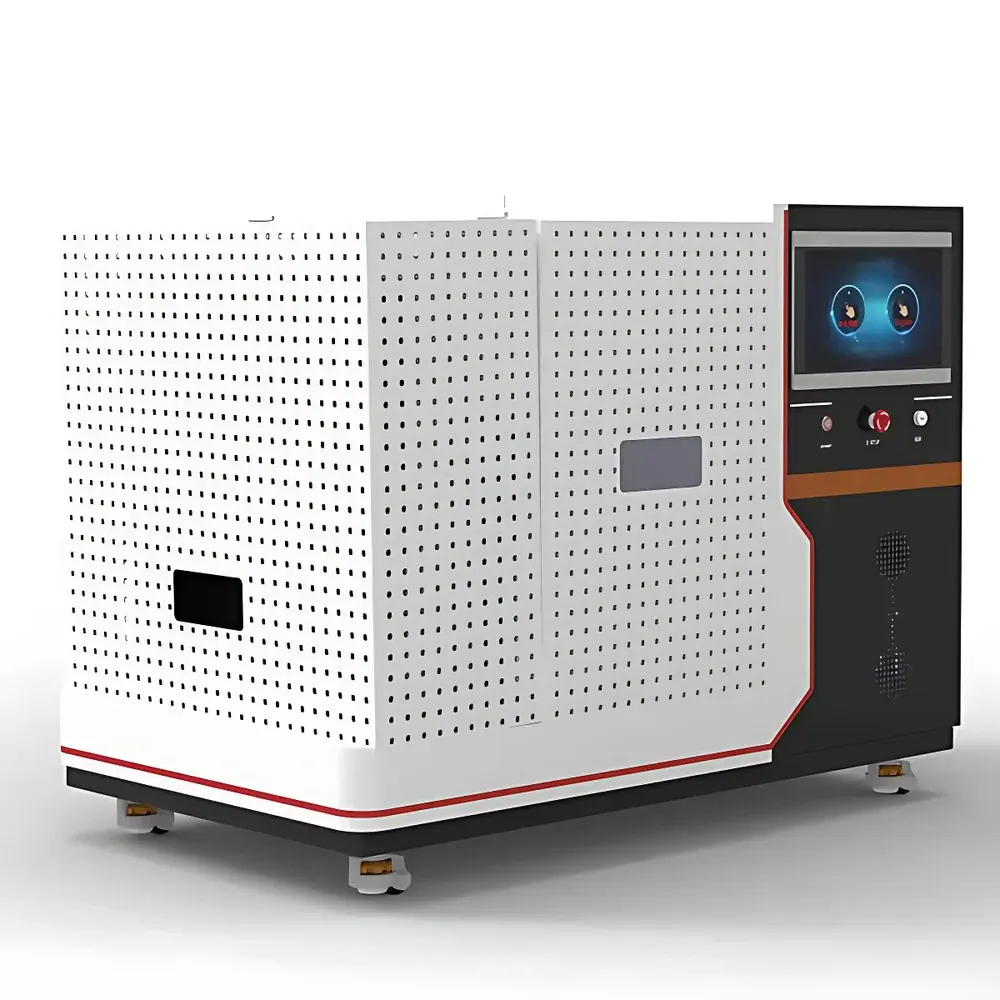
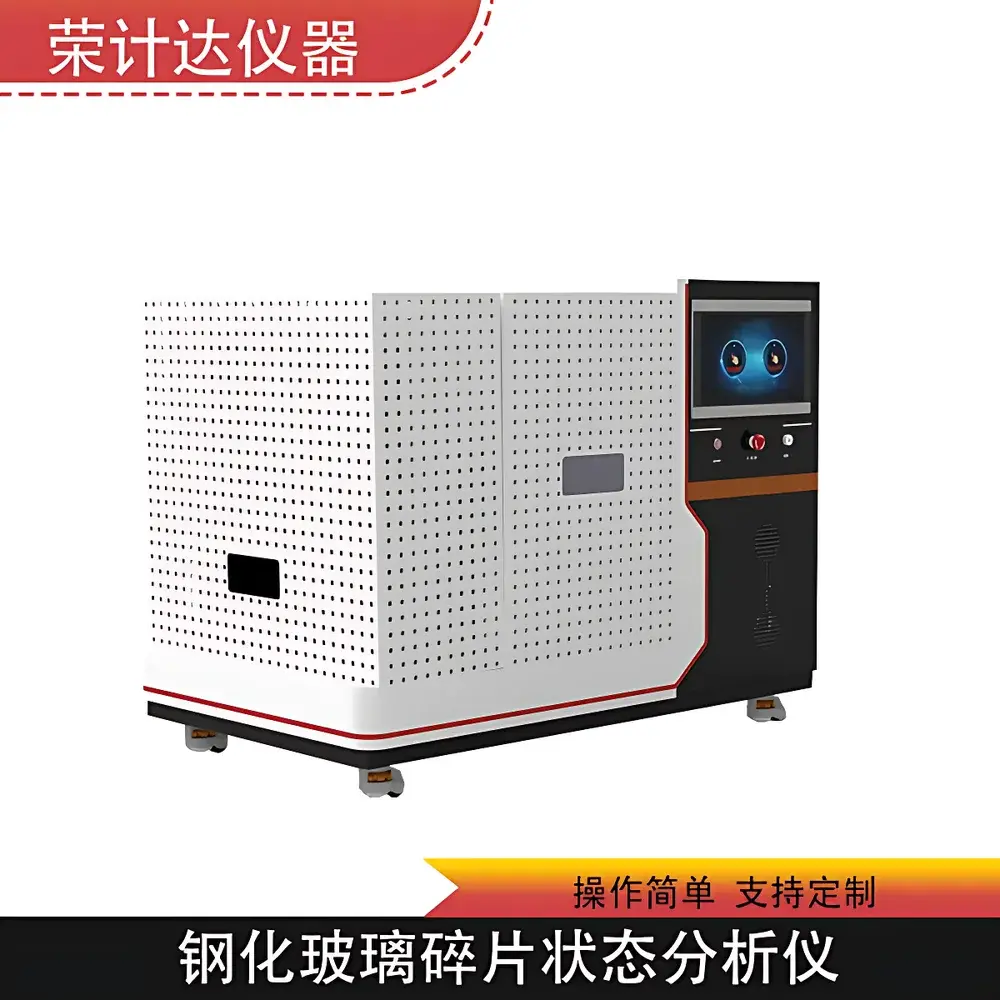
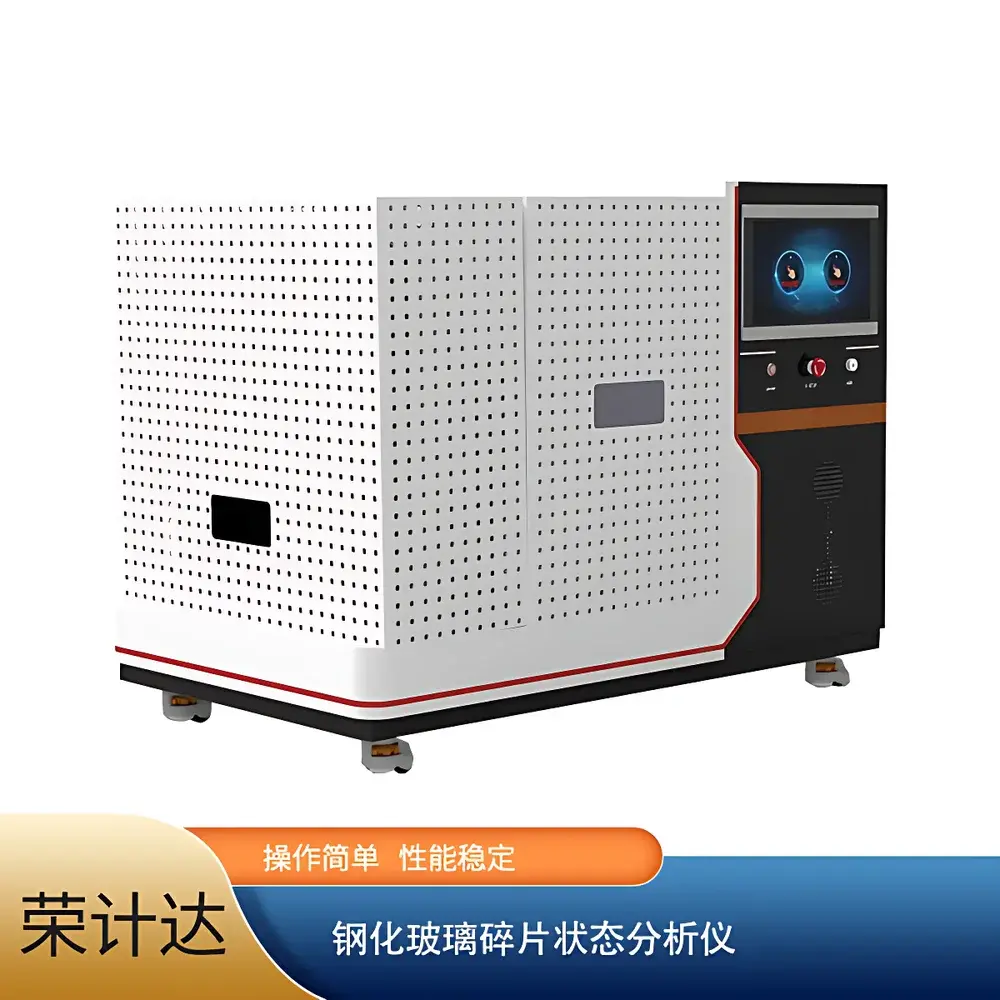
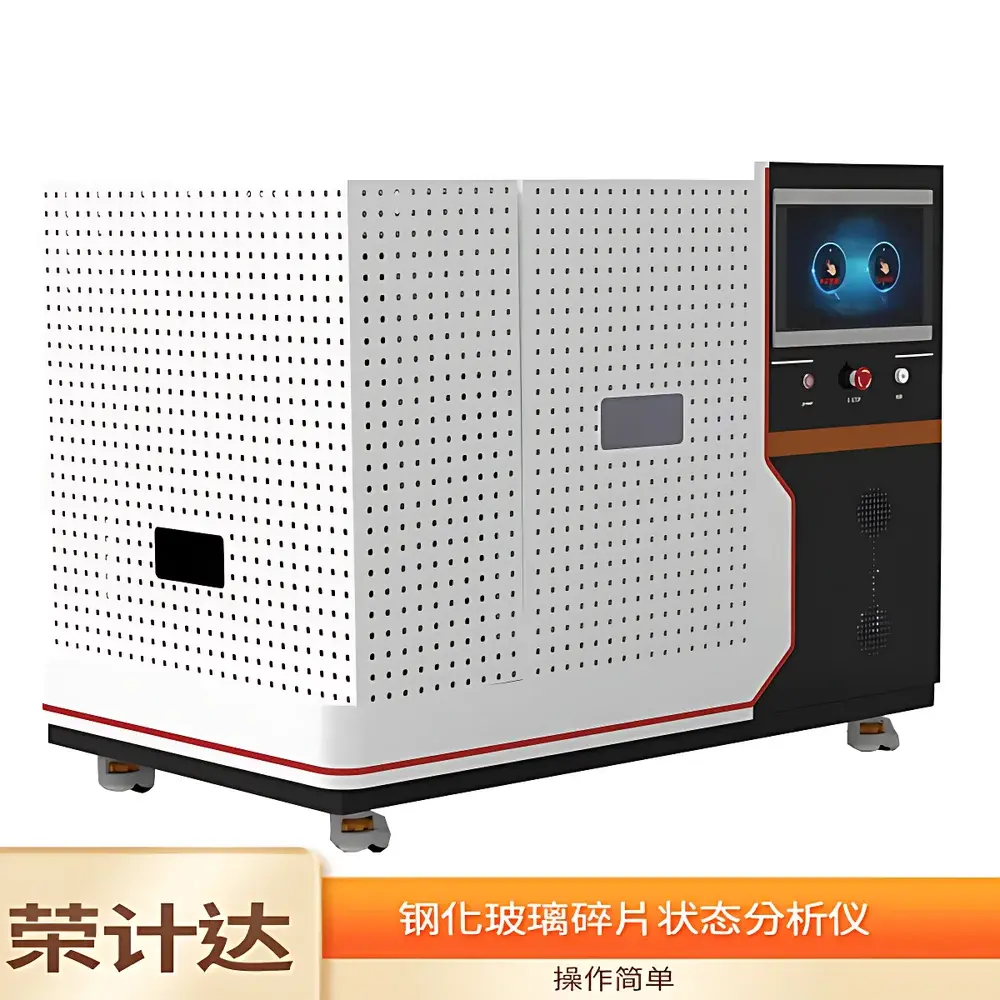
Rongjida GBSF-2023 Tempered Glass Fragmentation Analyzer
| Brand | Rongjida |
|---|---|
| Origin | Shanghai, China |
| Manufacturer Type | Direct Manufacturer |
| Country of Origin | China |
| Model | GBSF-2023 |
| Hammer Tip Radius | 0.2 mm |
| Max Sample Size | 1800 × 900 mm |
| Max Imaging Area | 1200 × 900 mm |
| Overall Dimensions | 2060 × 1100 × 1580 mm |
| Power Supply | 220 V AC, 1200 W |
Overview
The Rongjida GBSF-2023 Tempered Glass Fragmentation Analyzer is a dedicated optical-mechanical testing system engineered for standardized assessment of fragmentation patterns in thermally tempered glass, laminated safety glass, and fire-resistant glazing. It operates on the principle of controlled mechanical impact followed by high-resolution digital imaging and algorithm-assisted fragment quantification—directly aligned with international fragmentation evaluation protocols defined in ISO 12543-6, EN 12600, and ASTM C1048. Unlike manual counting methods, the GBSF-2023 integrates a precision-tuned hammer strike mechanism (with certified 0.2 mm radius tungsten carbide tip) and a calibrated overhead imaging station to capture full-surface fragment distribution immediately post-fracture. The system is designed for compliance-driven environments—including construction material certification labs, automotive glass QC facilities, and rail vehicle component validation centers—where reproducible, auditable fragmentation data is required for regulatory submissions.
Key Features
- Adjustable pendulum-type impact mechanism with traceable 0.2 mm radius striking tip, compliant with GB 15763.2–2005 and ISO 12543-6 requirements for consistent energy delivery.
- Automated image acquisition and fragment segmentation using industrial-grade CMOS sensor (≥5 MP resolution) with uniform LED backlighting, enabling clear contrast for edge detection of fragments as small as 2 mm².
- Integrated analysis software that computes key metrics: fragment count per 50 mm × 50 mm zone, average fragment size distribution, and percentage area coverage of fragments exceeding specified thresholds (e.g., >30 mm length).
- Full audit trail functionality: timestamped test records include raw images, impact parameters, operator ID, and calibration status—supporting GLP and ISO/IEC 17025 documentation workflows.
- Modular sample stage accommodates flat specimens up to 1800 mm × 900 mm and thicknesses from 3 mm to 19 mm, with vacuum-assisted fixation to prevent displacement during impact.
Sample Compatibility & Compliance
The GBSF-2023 is validated for use with monolithic tempered soda-lime silicate glass, heat-strengthened glass, and coated or laminated variants meeting dimensional and surface quality criteria per GB/T 2828.1 sampling plans. It supports testing under ambient conditions (15–25 °C, 40–60% RH), with environmental monitoring logs exportable alongside test reports. The instrument meets mechanical safety requirements per GB/T 5226.1 and electromagnetic compatibility per GB/T 18268.1. All test outputs are structured to satisfy reporting obligations under GB 9656–2021 (automotive glazing), GB 15763.1–2009 (fire-rated glazing), GB 15763.2–2005 (tempered architectural glass), and EN 12150-1 for European CE-marking pathways.
Software & Data Management
The embedded Windows-based application provides role-based access control (administrator, technician, reviewer), configurable report templates (PDF/CSV/XLSX), and native support for electronic signatures per FDA 21 CFR Part 11 Annex 11 requirements. Image metadata—including EXIF timestamps, lens focal length, and illumination intensity—is embedded in each acquired frame. Data integrity is ensured via SHA-256 hashing of raw image files at time of capture, with optional integration into LIMS via OPC UA or RESTful API endpoints. All measurement history is stored in an encrypted local SQL database with automatic daily backups and retention policies configurable up to 10 years.
Applications
- Verification of fragmentation performance for automotive side/rear windows per GB 9656–2021 and UN Regulation No. 43.
- Pre-certification testing of architectural façade panels prior to third-party inspection under GB 50210 and JGJ/T 139.
- Quality conformance checks for rail vehicle glazing per GB 18045–2000 and EN 12663-1.
- R&D validation of new tempering furnace parameters, quenching air pressure profiles, or coating-induced stress gradients.
- Root cause analysis of premature fracture incidents through comparative fragment morphology mapping across production batches.
FAQ
Does the GBSF-2023 comply with ISO/IEC 17025 calibration requirements?
Yes—the system includes built-in verification routines for impact energy repeatability (±1.5% CV over 10 strikes) and imaging scale accuracy (certified reference grid traceable to NIM standards). Calibration certificates are issued annually by accredited metrology labs.
Can the analyzer process curved or bent tempered glass samples?
No—it is configured exclusively for flat specimens. Curved glazing requires specialized fixtures not included in the standard configuration; custom engineering support is available upon request.
Is remote software update capability supported?
Yes—firmware and application updates can be deployed over secure HTTPS with version rollback and integrity checksum verification.
What is the minimum fragment size resolvable by the imaging system?
Under optimal lighting and contrast conditions, the system reliably detects and segments fragments ≥2 mm in longest dimension, with sub-pixel centroid localization enabled by bicubic interpolation algorithms.
How is operator training delivered for this instrument?
Rongjida provides on-site commissioning, SOP development assistance, and ISO 17025-aligned competency assessments—including hands-on practice with reference glass sets and inter-laboratory comparison exercises.






