
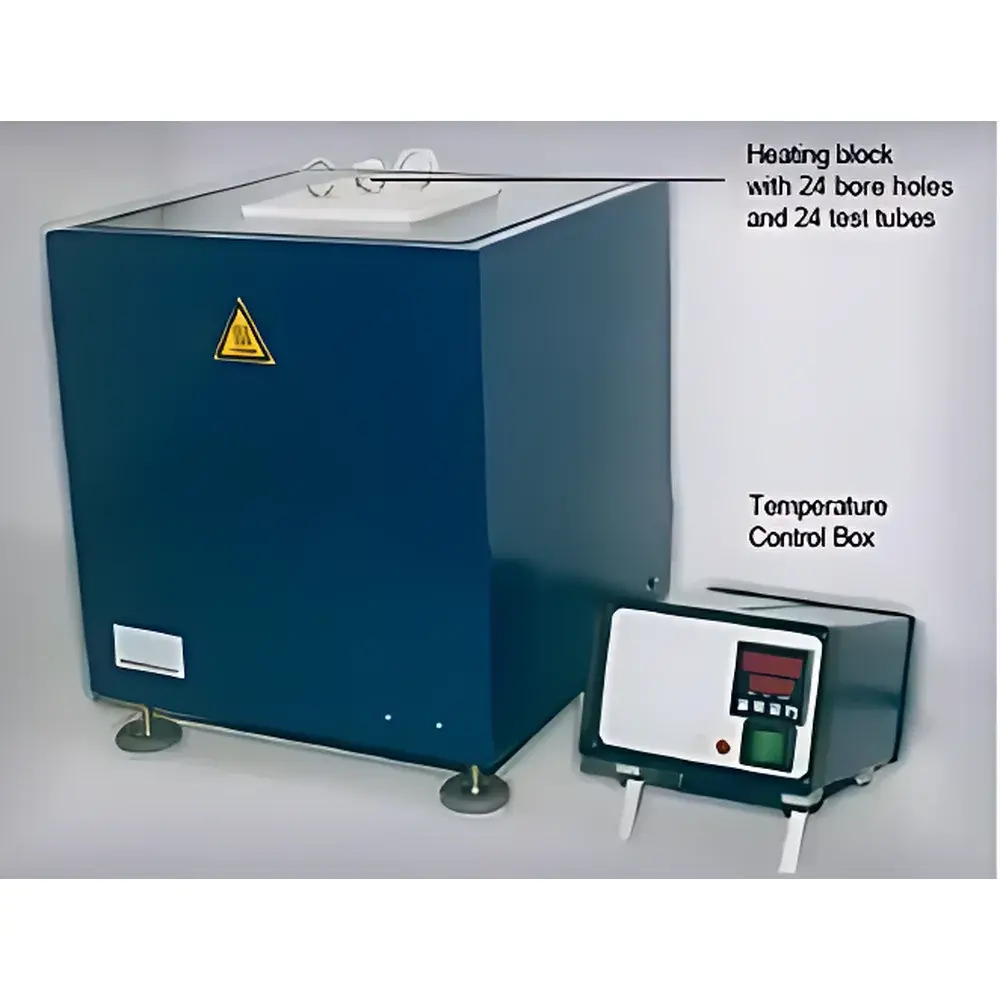
R&P Methyl Violet Stability Analyzer for Nitrocellulose
| Brand | R&P |
|---|---|
| Origin | Germany |
| Model | Methyl Violet Method |
| Temperature Range | 60–140 °C |
| Control Accuracy | ±0.1 °C |
| Sample Capacity | 24 positions (20.5 mm diameter × 280 mm depth) |
| Heating Block | Anodized aluminum with PID controller |
| Temperature Sensor | PT100 probe |
| Safety Features | Over-temperature cut-off, ISO-insulated housing |
| Power Supply | 230 V / 50 Hz, 1500 VA |
| Compliance | MIL-STD-286C (Sections 120 & 134.5), ISO 8765:2017 (Nitrocellulose stability testing) |
| Accessories | 24× cylindrical tubes (OD 20 mm, ID 17 mm, L 290 mm), vented cork stoppers, stainless steel hooks, methyl violet indicator paper (200 sheets/pack) |
Overview
The R&P Methyl Violet Stability Analyzer is a precision-engineered thermal stability assessment system designed exclusively for evaluating the chemical stability of nitrocellulose (NC) and other energetic nitro compounds under controlled heating conditions. It operates on the standardized methyl violet test principle defined in MIL-STD-286C (Sections 120 and 134.5), where thermal decomposition gases—primarily nitrogen oxides (NOx)—react with methyl violet impregnated paper, inducing a visible color transition from purple to orange. The time required to achieve this endpoint—or the absence of ignition or deflagration after 5 hours at elevated temperature—serves as a quantitative metric for relative thermal stability. This method remains a cornerstone in defense logistics, propellant manufacturing, and regulatory compliance for nitrocellulose-based materials, particularly in munitions, lacquers, and film base formulations.
Key Features
- Robust anodized aluminum heating block with high thermal mass and uniform heat distribution across all 24 sample wells
- Precise PID temperature control system with independent controller enclosure, enabling stable setpoint maintenance within ±0.1 °C over the full 60–140 °C operating range
- PT100 Class A temperature sensor integrated directly into the heating block for real-time feedback and traceable calibration
- Dual digital display showing both setpoint and actual block temperature, with intuitive keypad interface
- Integrated over-temperature safety cutoff with independent thermal fuse, compliant with IEC 61000-6-2 electromagnetic immunity requirements
- ISO-certified insulation board housing ensuring operator safety and minimizing ambient thermal interference
- Configured for full alignment with MIL-STD-286C dimensional specifications: 24 wells (20.5 mm Ø × 280 mm depth), compatible with standard NC test tubes (20 mm OD, 17 mm ID, 290 mm length)
Sample Compatibility & Compliance
This analyzer is validated for use with nitrocellulose samples conforming to ASTM D5632, ISO 8765:2017, and NATO AEP-97 requirements. Each test tube accommodates 0.5–1.0 g of conditioned NC, sealed with vented cork stoppers and suspended via stainless steel hooks to ensure consistent gas diffusion toward the methyl violet paper strip. The instrument supports dual pass/fail criteria per MIL-STD-286C: (i) time-to-color-change at 135 °C ± 1 °C, and (ii) observation of sustained non-ignition over 5 hours. All hardware dimensions, thermal profiles, and accessory specifications are rigorously aligned with the referenced military standard to ensure inter-laboratory reproducibility and audit readiness for DoD, NATO, or national explosives licensing authorities.
Software & Data Management
While the R&P Methyl Violet Stability Analyzer operates as a standalone benchtop instrument without embedded software, its analog/digital hybrid architecture supports GLP-compliant documentation workflows. The PID controller logs temperature setpoint and actual values at user-defined intervals (via optional RS-485 output module, sold separately), enabling integration with validated LIMS or electronic lab notebooks (ELN). All temperature records, operator entries, and test outcomes can be manually transcribed into 21 CFR Part 11–compliant systems. Calibration certificates for the PT100 sensor and thermal validation reports (including mapping of axial/radial temperature gradients across the block) are provided with each unit to support GMP and ISO/IEC 17025 accreditation requirements.
Applications
- Batch release testing of nitrocellulose used in propellants, smokeless powders, and pyrotechnic compositions
- Stability screening of aged NC stockpiles in military depots and ammunition storage facilities
- Development and qualification of NC stabilizer systems (e.g., diphenylamine, ethyl centralite)
- Regulatory submissions to national explosives authorities (e.g., ATF, BfS, DGUV)
- Failure analysis investigations following thermal runaway incidents in NC-handling operations
- Training laboratories supporting EOD technician certification programs
FAQ
What standards does this instrument comply with?
MIL-STD-286C (Sections 120 and 134.5), ISO 8765:2017, and ASTM D5632 for nitrocellulose stability assessment.
Can the instrument be calibrated internally?
Yes—the PT100 sensor is field-replaceable and traceable to NIST or DAkkS standards; calibration verification procedures are included in the operation manual.
Is methyl violet paper supplied with the system?
Each unit ships with one pack of 200 pre-cut methyl violet indicator papers, compliant with MIL-I-45812A specifications.
What electrical safety certifications does it hold?
CE-marked per EN 61010-1:2019 for laboratory equipment, including protection against electric shock, mechanical hazards, and thermal burn risks.
How is sample loading and gas detection performed?
Samples are placed in standardized tubes fitted with vented corks; evolved NOx gases travel upward along the tube wall and contact methyl violet paper positioned at the top opening—no pumps or flow controllers required.





