
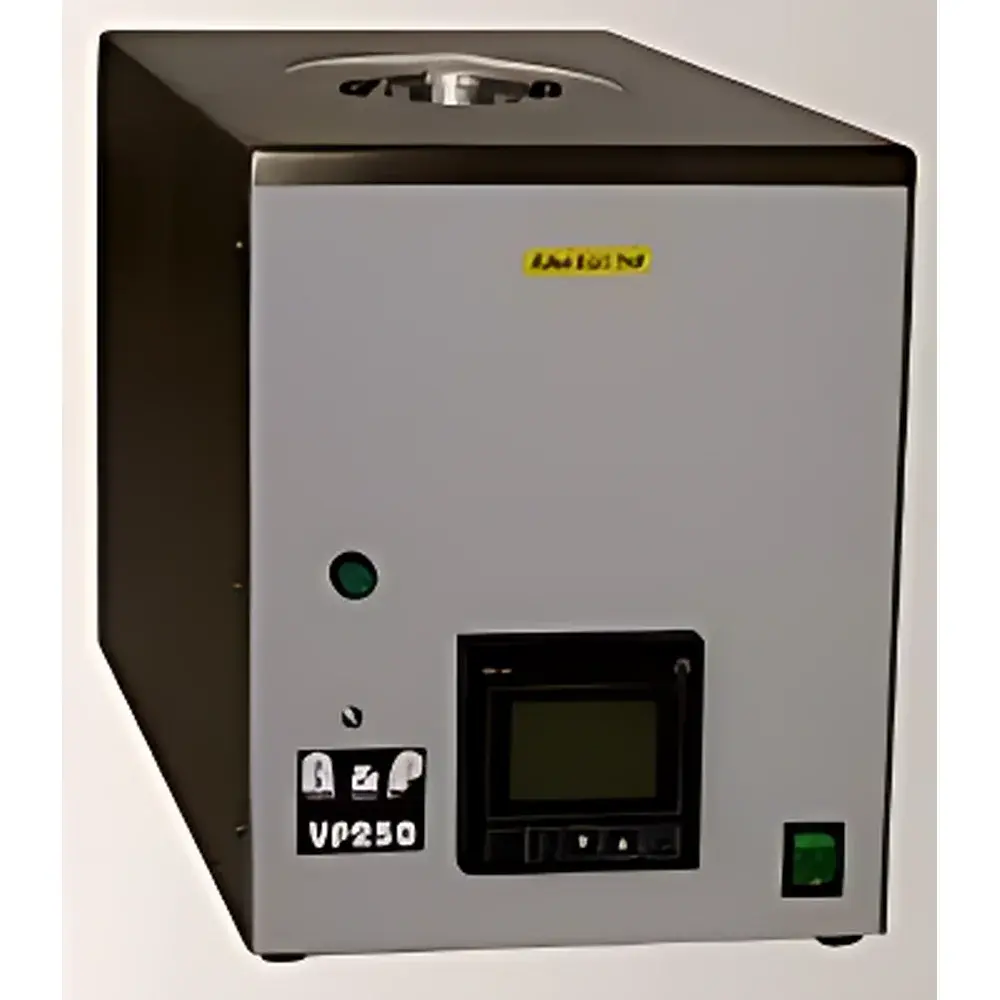
R&P VP250 Lubricating Oil Evaporation Loss Tester
| Brand | R&P |
|---|---|
| Origin | Germany |
| Model | VP250 Lubricating Oil Evaporation Loss Tester |
| Temperature Range | 150–300 °C |
| Temperature Accuracy | ±0.2 °C (at 250 °C: ±0.1 °C) |
| Pressure Range | up to 21 mmWS |
| Pressure Accuracy | ±0.02 mmWS |
| Power Supply | 230 V/110 V ±10%, 50/60 Hz, 1300 VA |
| Max. Power Consumption | 950 VA at 250 °C |
| Dimensions | 278 × 316 × 300 mm |
| Net Weight | 18 kg |
| Display | LCD with 0.1 °C resolution for temperature, pressure, and elapsed time |
| Control System | Digital PID microprocessor with auto-tuning |
| Safety Features | Independent overtemperature cut-off circuit, dual-sensor redundancy, audible/visual fault alerts |
| Calibration | PT100 sensor calibrated against certified mercury thermometer (traceable to national standards), deviation <0.5 °C |
Overview
The R&P VP250 Lubricating Oil Evaporation Loss Tester is a precision-engineered benchtop instrument designed to determine the evaporation loss of lubricating oils under controlled vacuum and elevated temperature conditions—per ASTM D5800 (Noack Method) and ISO 2592. It operates on the principle of gravimetric mass loss measurement: a weighed sample of oil is heated in a standardized crucible within a thermostatically controlled chamber under regulated vacuum, and the percentage mass loss after a defined test duration (typically 60 minutes at 250 °C) is calculated. This parameter directly correlates with volatility, base oil composition stability, and long-term operational reliability—critical for engine oils, gear oils, hydraulic fluids, and high-temperature industrial lubricants. The VP250’s robust thermal architecture and closed-loop vacuum management ensure high reproducibility across inter-laboratory studies and routine QC workflows.
Key Features
- Digital PID microprocessor control with auto-tuning capability ensures stable temperature regulation across the full 150–300 °C operating range, achieving ±0.1 °C accuracy at 250 °C.
- Integrated vacuum system includes a dedicated oil-sealed rotary vane pump with built-in oil filtration to prevent contamination and maintain consistent vacuum integrity (up to 21 mmWS).
- High-resolution LCD interface displays real-time values for temperature (0.1 °C resolution), absolute pressure (±0.02 mmWS), and elapsed test time—with integrated audible timer signaling completion without external chronometers.
- Traceable temperature calibration via PT100 sensor, verified against certified mercury-in-glass thermometers per ISO/IEC 17025 requirements; maximum deviation from reference standard is <0.5 °C.
- Dual-redundant safety architecture: independent overtemperature cut-off circuit with dedicated sensing element, plus visual and audible fault alerts triggered by sensor drift, vacuum failure, or power anomaly—not measurement outliers.
- Self-compensating sensor offset correction algorithm minimizes long-term thermal drift, eliminating manual recalibration during extended daily operation.
Sample Compatibility & Compliance
The VP250 accommodates standard ASTM D5800 aluminum crucibles (40 mL capacity) and supports viscous and semi-solid lubricants—including API Group III/IV synthetic base stocks, EP gear oils, and biodegradable ester-based formulations. Its design conforms to the mechanical and environmental requirements of ASTM D5800, ISO 2592, and DIN 51581. All electrical components meet CE marking directives (2014/30/EU EMC and 2014/35/EU LVD). The instrument’s data logging and alarm functionality support GLP-compliant documentation when paired with validated laboratory information management systems (LIMS). While the VP250 itself does not generate electronic records with audit trails, its analog/digital outputs are compatible with third-party 21 CFR Part 11–compliant data acquisition modules for regulated environments.
Software & Data Management
The VP250 operates as a standalone hardware platform with no embedded operating system or proprietary software stack. All operational parameters—including setpoint temperature, target vacuum level, and test duration—are configured via intuitive menu-driven navigation on the front-panel LCD. Real-time process variables are displayed continuously but are not stored internally. For traceable data capture, optional analog voltage outputs (0–10 V for temperature and pressure) and RS-232 serial interface enable connection to external chart recorders, PLCs, or validated PC-based acquisition software. Laboratories implementing digital quality systems may integrate VP250 measurements into ELN or LIMS platforms using configurable SCADA drivers—ensuring alignment with ALCOA+ data integrity principles (Attributable, Legible, Contemporaneous, Original, Accurate, Complete, Consistent, Enduring, Available).
Applications
- Quality control of finished lubricants per OEM specifications (e.g., GM dexos®, Ford WSS-M2C945-A, VW 502 00).
- Evaluation of base oil volatility during formulation development, especially for low-SAPS (Sulfated Ash, Phosphorus, Sulfur) engine oils.
- Stability assessment of high-temperature greases and turbine oils exposed to prolonged thermal stress.
- Regulatory compliance testing for UN GHS classification of flammability and volatility hazards.
- Comparative analysis of antioxidant package efficacy via accelerated evaporation kinetics under standardized conditions.
- Supporting root-cause investigations of premature oil consumption or sludge formation in field-failure analysis.
FAQ
What standards does the VP250 comply with?
The VP250 is engineered to execute ASTM D5800 (Noack volatility test), ISO 2592, and DIN 51581. Its thermal and vacuum performance envelopes satisfy the instrumental requirements specified in these methods.
Is the VP250 suitable for testing bio-based lubricants?
Yes—the instrument’s wide temperature range (150–300 °C) and inert crucible geometry accommodate thermally sensitive ester- and vegetable-oil-derived formulations, provided sample viscosity allows uniform spreading in the crucible prior to heating.
How is temperature calibration verified?
Calibration is performed using a NIST-traceable mercury-in-glass thermometer (class A, 0.1 °C division) inserted alongside the PT100 sensor in the heating block. Deviation between reference and sensor readings must remain within ±0.5 °C across the operating range.
Does the VP250 include vacuum pump oil?
The unit ships with a pre-filled, ISO VG 100 mineral-based vacuum pump oil meeting DIN 51506 VDL specifications. Replacement oil and filter elements are available as consumable part numbers through R&P authorized distributors.
Can test parameters be modified beyond the default 60-minute cycle?
Yes—test duration is fully programmable via the control menu, allowing method adaptation for research applications (e.g., 30-min screening or 120-min extended stability tests), subject to validation per internal SOPs.




