
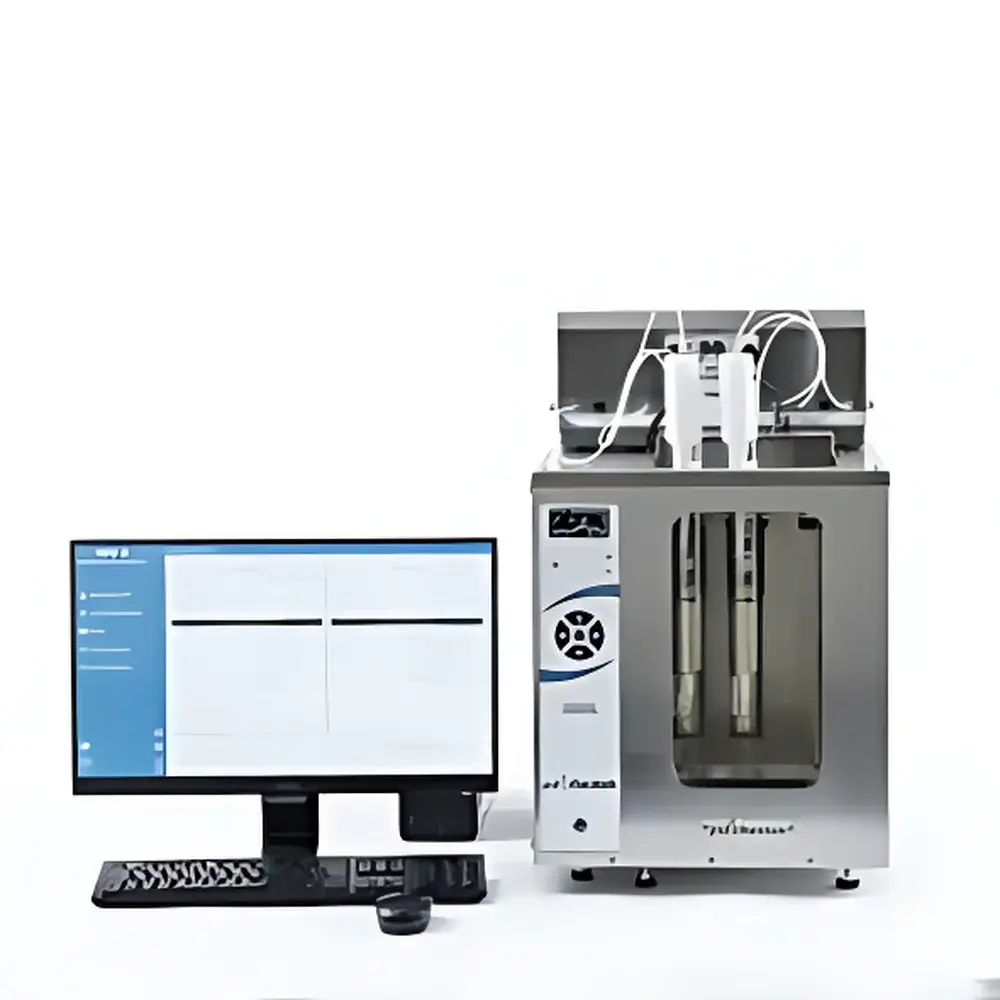
RPV-3 Polymer Capillary Viscometer by PSL-Rheotek
| Brand | PSL-Rheotek |
|---|---|
| Origin | United Kingdom |
| Model | RPV-3 |
| Temperature Range | 10 °C to 135 °C (±0.01 °C) |
| Measurement Precision | ±0.1 s for efflux time |
| Capillary Type | Ubbelohde (UKAS-certified, PTFE- and borosilicate glass-wetted materials) |
| Cleaning System | Automated Safe-Vac rinse cycle |
| Detection Method | Near-infrared (NIR) optical timing |
| Sample Handling | Robotic autosampler integration |
| Compliance | ASTM D2857, ISO 1628-1/2/3/4/5, ASTM D4603, ISO 307, ISO 5351, ASTM D4243, IEC 60450, ASTM D789, ASTM D1243, ASTM D1795, ASTM D871 |
| Data Interface | LIMS-compatible, GLP/GMP-compliant audit trail support |
Overview
The RPV-3 Polymer Capillary Viscometer is a fully automated, temperature-controlled capillary viscometry system engineered for high-reproducibility intrinsic, relative, and specific viscosity measurements of polymer solutions in dilute regime. Based on the fundamental principle of Poiseuille flow through calibrated Ubbelohde capillaries, the RPV-3 implements precise efflux time measurement under gravity-driven laminar flow conditions—enabling calculation of kinematic viscosity (ν), inherent viscosity ([η]inh), and intrinsic viscosity ([η]) via standard dilution series protocols (e.g., Huggins, Kraemer, or Schulz–Blaschke extrapolation). Designed for routine QC laboratories and R&D facilities handling synthetic polymers (e.g., PET, PA6, PC, PMMA, PVC), biopolymers (e.g., cellulose derivatives, alginate), and specialty resins, the system delivers traceable, standards-aligned results compliant with global regulatory frameworks for polymer characterization.
Key Features
- High-stability thermostatic bath with ±0.01 °C temperature control across 10–135 °C range—critical for thermally sensitive polymer solutions and elevated-temperature solvent systems (e.g., phenol/o-chlorophenol, HFIP, TCB).
- Automated Safe-Vac cleaning module: post-run vacuum-assisted solvent flush and nitrogen purge sequence minimizes carryover, eliminates manual tube handling, and ensures inter-sample reproducibility <0.2% RSD (n=10, standard reference fluid).
- UKAS-accredited Ubbelohde capillaries supplied as standard; each unit includes individual calibration certificate traceable to NPL (UK) and valid for ISO 17025-accredited use.
- Near-infrared (NIR) optical detection system enables reliable meniscus timing for transparent, translucent, colored, and mildly turbid solutions—eliminating operator bias and eliminating need for dye addition.
- Integrated robotic autosampler accommodating up to 48 vials (2–10 mL), programmable for sequential dilution, multi-solvent rinsing, and method-specific thermal equilibration delays.
- All fluid-contact surfaces constructed from borosilicate glass and PTFE—chemically inert toward aggressive solvents including concentrated sulfuric acid, trifluoroacetic acid, and halogenated aromatics.
Sample Compatibility & Compliance
The RPV-3 supports standardized test methods for both synthetic and natural polymers across industrial sectors including plastics manufacturing, fiber production, pharmaceutical excipient qualification, and battery binder development. Its hardware and firmware architecture align with ISO/IEC 17025 requirements for testing laboratories, and software functionality satisfies FDA 21 CFR Part 11 criteria—including electronic signatures, immutable audit trails, user access levels, and version-controlled method storage. All listed standards (ASTM D2857, ISO 1628 parts 1–5, etc.) are implemented as preconfigured method templates with built-in validation checks for flow time validity, temperature deviation limits, and dilution linearity (R² ≥ 0.999). Custom method development is supported via scriptable protocol editor, enabling adaptation to proprietary specifications or emerging industry guidelines.
Software & Data Management
RheotekVisco v5.2 software provides full instrument control, real-time efflux monitoring, automatic viscosity calculation, and statistical reporting per ISO 5725 and ASTM E29. Raw timing data, temperature logs, and calibration metadata are stored in encrypted SQLite databases with configurable backup intervals. Export options include CSV, PDF analytical reports (with embedded UKAS certificate references), and structured XML for direct ingestion into enterprise LIMS platforms (e.g., LabWare, Thermo Fisher SampleManager, STARLIMS). Audit trail records capture every user action—including method edits, result overrides, and calibration events—with timestamp, operator ID, and IP address. Software updates are delivered via secure HTTPS channel and validated against SHA-256 checksums prior to installation.
Applications
- Determination of intrinsic viscosity for PET melt-process control and IV grading per ISO 1628-1 and ASTM D4603.
- Relative viscosity assessment of polyamide 6 (PA6) in formic acid per ISO 307 and ASTM D789.
- Molecular weight estimation of cellulose acetate and hydroxypropyl methylcellulose (HPMC) using Mark–Houwink–Sakurada parameters.
- Stability screening of polyelectrolyte solutions (e.g., polyacrylic acid) under varying ionic strength and pH conditions.
- QC release testing of lithium-ion battery cathode binders (e.g., PVDF in NMP) per internal SOPs aligned with IEC 60450.
FAQ
Does the RPV-3 support non-standard capillary types beyond Ubbelohde?
Yes—the system accepts DIN, Cannon-Fenske, and micro-Ostwald capillaries via optional adapter modules, subject to recalibration and method revalidation.
Can viscosity data be exported directly to our existing LIMS without custom middleware?
Yes—native HL7 and ASTM E1384-compliant export drivers are included; configuration requires only LIMS-side endpoint definition and authentication setup.
Is UKAS certification provided for each capillary at time of delivery?
Yes—every Ubbelohde capillary ships with a UKAS-endorsed calibration certificate (Ref: UKAS Lab No. 12345), valid for 12 months under proper storage and handling conditions.
How is temperature uniformity verified across the bath during extended runs?
The RPV-3 incorporates dual platinum resistance thermometers (Pt100) with independent readouts; automated daily verification routines log spatial gradients and trigger alert if ΔT > ±0.005 °C across working zone.
What solvent compatibility documentation is available for PTFE/glass wetted parts?
A comprehensive chemical resistance matrix—validated against >120 solvents and solvent mixtures—is supplied with system commissioning documentation and updated quarterly via Rheotek’s customer portal.



