
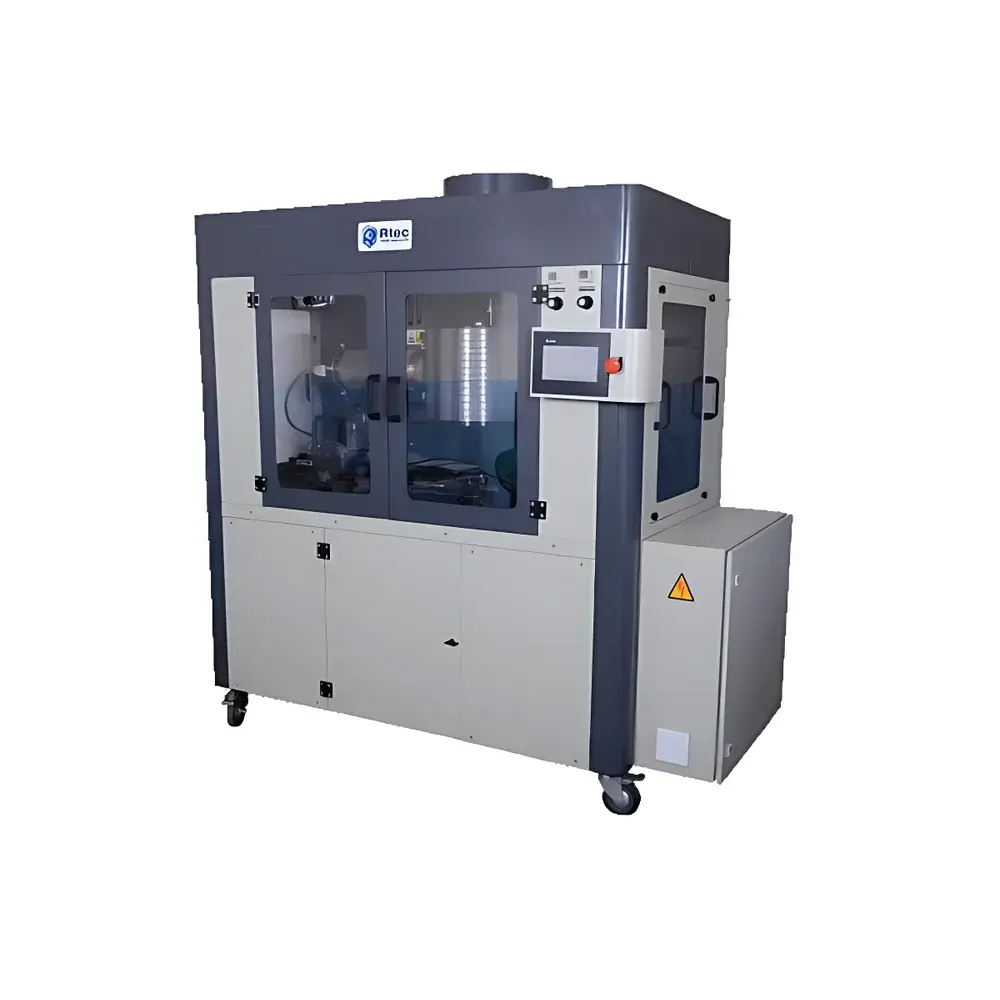
Rtec AJ-1000 Air-Jet Erosion Tester
| Brand | Rtec |
|---|---|
| Origin | Switzerland |
| Model | AJ-1000 |
| Maximum Test Force | Not applicable |
| Frequency Range | Not applicable |
| Host Weight | 320 kg |
| Operating Temperature Range | Up to 900 °C (PID-controlled, closed-loop) |
| Particle Velocity Range | 30–150 m/s |
| Abrasive Feed Rate | 1–10 g/min |
| Hopper Capacity | 1 L |
| Impact Angles | 15°, 30°, 45°, 60°, 90° |
| Compliance Standards | ASTM G76, ASTM G211-14 |
| Velocity Measurement Method | Dual-rotating-disk time-of-flight |
| Control Interface | Touchscreen HMI |
Overview
The Rtec AJ-1000 Air-Jet Erosion Tester is a precision-engineered benchtop system designed for quantitative assessment of solid material resistance to solid-particle erosion under controlled thermal and kinetic conditions. It operates on the principle of high-velocity pneumatic entrainment: abrasive particles—such as alumina, silica, silicon carbide, or custom granular media—are accelerated in a heated gas stream and directed onto a stationary or rotating test specimen at precisely defined impact angles and velocities. Unlike conventional fatigue testing machines that apply cyclic mechanical loads, the AJ-1000 replicates erosive wear mechanisms prevalent in aerospace turbine components, boiler tubes, fluid-handling systems, and thermal barrier coatings—where particle-laden hot gases induce progressive surface degradation via micro-cutting, deformation, and brittle fracture. Its integrated closed-loop PID temperature control enables real-time stabilization from ambient up to 900 °C, allowing researchers to isolate and quantify the thermally activated contributions to erosion kinetics—a critical parameter in high-temperature material qualification per ISO 20808 and ASTM G76 Annex A3.
Key Features
- Real-time dual-rotating-disk time-of-flight velocity measurement: Two synchronized, optically encoded disks spaced at a fixed path length provide direct, non-intrusive particle speed validation with ±2 m/s repeatability—ensuring metrological traceability across all test runs.
- Programmable abrasive feed system: Stainless-steel hopper (1 L capacity) coupled with a motorized screw feeder enables precise, adjustable delivery rates from 1 to 10 g/min; feed profiles can be ramped, stepped, or held constant via touchscreen interface.
- Multi-angle impact configuration: Five pre-calibrated nozzle positions (15°, 30°, 45°, 60°, and 90° relative to specimen normal) allow systematic investigation of angular dependence—essential for correlating erosion rate with material ductility, hardness anisotropy, or coating interfacial strength.
- High-fidelity thermal management: In-line thermocouple array and digital PID controller maintain temperature stability within ±3 °C over the full 900 °C range; heating zone geometry ensures uniform thermal exposure of both particle stream and target surface.
- Modular gas handling: Compatible with compressed air, nitrogen, or inert process gases; includes calibrated pressure regulator, digital pressure transducer, and leak-tested flow path to ensure consistent carrier gas dynamics across velocity regimes.
Sample Compatibility & Compliance
The AJ-1000 accommodates flat or curved specimens up to 50 mm × 50 mm × 25 mm (custom fixtures available), including metallic alloys (Inconel, Ti-6Al-4V), ceramics (Al2O3, SiC), polymer composites, and thin-film coated substrates. Specimen mounting is vacuum-secured or mechanically clamped to minimize vibration-induced measurement uncertainty. The system conforms to ASTM G76–22 “Standard Test Method for Determining Resistance to Erosion by Solid Particle Impingement Using Gas Jets” and ASTM G211–14 “Standard Practice for Calibration of Refractory Ceramic Fibers and Other High-Temperature Materials Using Air-Jet Erosion.” All operational parameters—including pressure, temperature, feed rate, angle, and velocity—are logged with timestamped metadata to support GLP-compliant reporting and FDA 21 CFR Part 11 audit trails when paired with optional Rtec DataVault software.
Software & Data Management
The embedded touchscreen HMI provides intuitive setup of test sequences, real-time monitoring of all process variables (gas pressure, temperature gradient, feed rate, disk RPM), and immediate visualization of velocity-derived histograms. Raw data—including mass loss (via analytical balance integration), surface profilometry coordinates (via optional laser scanning module), and thermal transient curves—is exported in CSV or HDF5 format. For advanced analysis, Rtec’s ErosionSuite™ software (optional) enables automated erosion rate calculation (mg/g or mm³/g), statistical comparison across parameter matrices, Weibull distribution fitting for threshold velocity determination, and generation of ISO/ASTM-compliant test reports with electronic signature capability.
Applications
- Qualification of thermal barrier coatings (TBCs) for gas turbine blades under simulated combustor exit conditions.
- Ranking of refractory linings used in fluidized bed combustors operating above 700 °C.
- Development of erosion-resistant composites for wind turbine blade leading edges exposed to sand-laden airflow.
- Fundamental studies on temperature-dependent erosion transition mechanisms—from ductile groove formation to brittle spallation—in nanocrystalline metals.
- Validation of predictive erosion models (e.g., Oka’s semi-empirical equation) across multi-parameter experimental design spaces.
FAQ
Does the AJ-1000 support automated long-duration testing with unattended operation?
Yes—programmable test sequences, hardware interlocks, and watchdog timers enable fully autonomous runs up to 72 hours; system halts automatically upon pressure deviation >5%, temperature overshoot >10 °C, or feed interruption exceeding 30 seconds.
Can I use custom abrasive materials not listed in the standard protocol?
Absolutely—the feed system accepts any dry, free-flowing granular medium with particle size between 10 µm and 500 µm; user-defined density and shape factors are entered into the erosion model during post-processing.
Is calibration certification included with shipment?
Each unit ships with NIST-traceable calibration certificates for pressure transducer, thermocouples, and velocity measurement subsystem, valid for 12 months from date of manufacture.
What safety features prevent operator exposure to high-temperature zones or high-velocity particles?
The system incorporates dual-interlocked access doors, Class 1 laser-safe enclosure for velocity sensors, redundant thermal cutoffs, and positive-pressure purge for optical viewports—all compliant with EN 61000-6-4 and ISO 13857.
How is specimen mass loss measured during or after testing?
Integrated compatibility with METTLER TOLEDO XP series microbalances (0.1 µg resolution) allows pre- and post-test gravimetric analysis; optional in-situ quartz crystal microbalance (QCM) modules provide real-time erosion rate feedback at sub-milligram sensitivity.



