
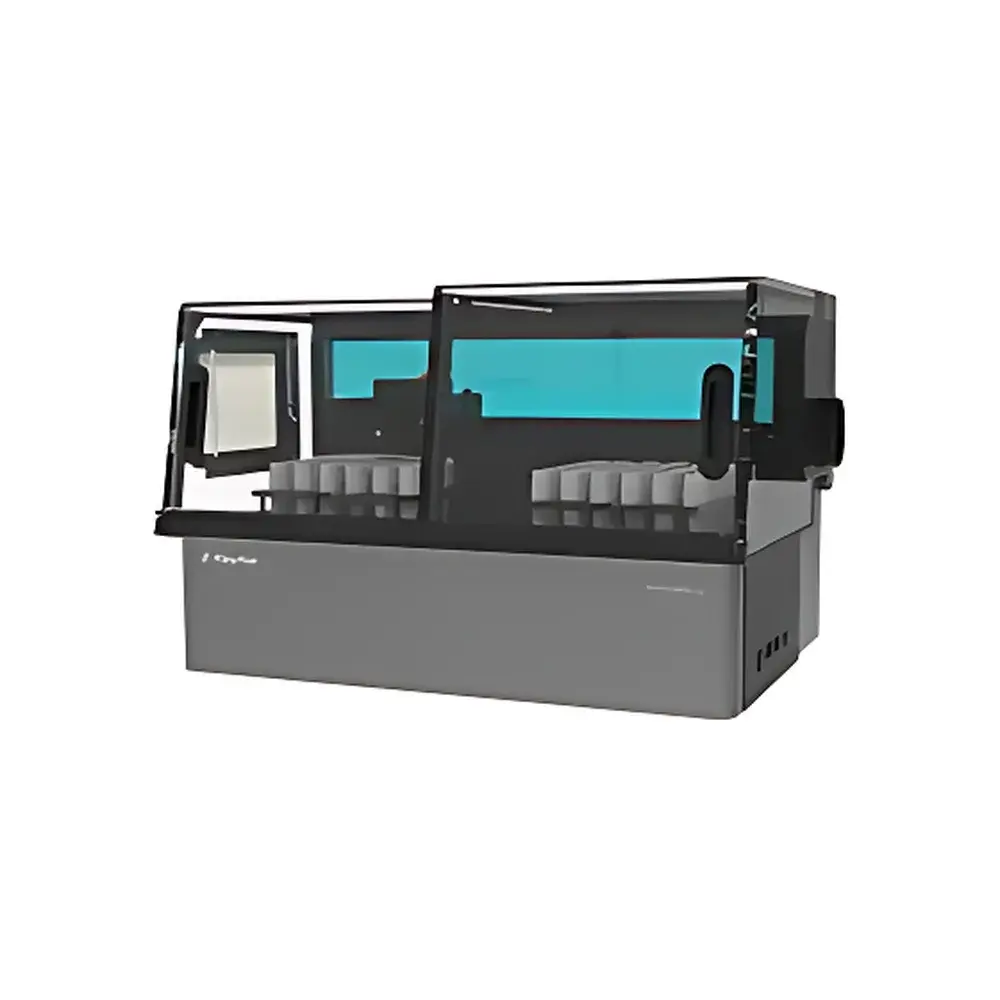
Ruike Auto GDA-72 Fully Automated Graphite Block Digestion System
| Origin | Fujian, China |
|---|---|
| Manufacturer Type | Authorized Distributor |
| Model | Auto GDA-72 |
| Pricing | Available Upon Request |
Overview
The Ruike Auto GDA-72 Fully Automated Graphite Block Digestion System is an integrated, walk-away sample preparation platform engineered for high-throughput, reproducible wet digestion of solid and semi-solid matrices prior to elemental analysis by AAS, AFS, ICP-OES, and ICP-MS. It operates on the principle of controlled acid-mediated thermal decomposition in a programmable graphite heating block, enabling complete mineralization of organic and inorganic matrices under precisely regulated temperature, time, and reagent addition profiles. Unlike conventional hot plates or open-vessel digestion systems, the Auto GDA-72 eliminates manual intervention through synchronized coordination of liquid handling, thermal control, lid actuation, and volumetric finishing—ensuring inter-sample consistency, operator safety, and method traceability required in accredited environmental, food, and regulatory laboratories.
Key Features
- Fully automated digestion workflow: sequential acid addition, vortex-assisted mixing, lid sealing/unsealing, multi-stage ramp-and-hold heating, acid evaporation (‘ashing’), forced-air cooling, and final volume adjustment.
- Dual independent heating modules with circumferential graphite block design—delivering uniform thermal distribution across all 72 positions; inter-well temperature deviation ≤ ±1 °C at 150 °C; temperature control accuracy ±0.1 °C via adaptive PID algorithm.
- Corrosion-resistant liquid handling system: fully enclosed PTFE-coated magnetic levitation robotic arm; dual-mode reagent delivery combining peristaltic pumps (for bulk acids) and precision syringe pumps (for low-volume, high-accuracy additions); up to six chemically inert reagent channels—including dedicated pathways compatible with hydrofluoric acid (HF) and HF-containing mixtures.
- Intelligent reagent dosing logic: supports variable acid type and volume per vial within a single method—enabling matrix-adapted digestion protocols (e.g., HNO₃/HF for silicate-rich soils vs. HNO₃/H₂O₂ for biological tissues).
- Ultrasonic sensor-based volumetric endpoint detection: ensures precise final dilution to target volume (e.g., 25 mL or 50 mL) after digestion completion, minimizing human error and improving downstream analytical precision.
Sample Compatibility & Compliance
The Auto GDA-72 accommodates standard 50 mL PTFE or quartz digestion vessels and supports diverse sample types including soil, sediment, sludge, fly ash, filter media (e.g., quartz fiber filters), wastewater solids, food homogenates, plant tissues, and pharmaceutical excipients. Its operational methodology aligns with multiple internationally recognized digestion standards: GB/T 17141–1997, GB/T 17138–1997, and HJ 491–2019 (China); EPA Methods 3050B, 3051A, 3052, and 4021 (U.S. Environmental Protection Agency); and ISO 11466:2023 (soil and sediment analysis). The system architecture supports GLP-compliant data integrity through method parameter logging, audit trail generation, and user-access-controlled operation—facilitating readiness for ISO/IEC 17025 or FDA 21 CFR Part 11 validation.
Software & Data Management
The embedded Windows-based control software provides intuitive method development, real-time monitoring of temperature, reagent consumption, and vessel status, plus full event logging (start/stop times, alarms, error codes). All method files, run logs, and calibration records are timestamped and exportable in CSV or PDF formats. Optional integration with LIMS via OPC UA or direct database write enables seamless data flow into laboratory informatics infrastructure. Software updates are delivered via secure USB or network interface, with version history retained for compliance review.
Applications
- Environmental testing: Heavy metal determination (As, Cd, Cr, Cu, Hg, Ni, Pb, Zn) in contaminated soils, industrial sludges, air particulate filters (TSP, PM₁₀, PM₂.₅), and municipal wastewater biosolids.
- Food safety: Regulatory screening of Pb, Cd, and inorganic As in rice, infant formula, seafood, and dietary supplements per EU Commission Regulation (EU) No 2023/915 and China GB 2762–2022.
- Agricultural research: Bioaccumulation studies in crop tissues, fertilizer residue analysis, and phytoextraction efficiency assessment.
- Industrial QA/QC: Catalyst residue analysis in petrochemical feedstocks; impurity profiling in battery-grade metal salts (e.g., LiCoO₂ precursors); leachable metal quantification in medical device packaging per USP /.
FAQ
Does the Auto GDA-72 support EPA Method 3052 for microwave-compatible digestion protocols?
Yes—the system implements the same acid mixture ratios, temperature ramp profiles, and hold durations specified in EPA 3052, adapted for open-vessel graphite block digestion with extended ramp times to ensure complete dissolution of refractory silicates and oxides.
Can the instrument handle hydrofluoric acid without degradation of fluidic components?
Yes—critical wetted parts (tubing, syringe barrels, valve manifolds, and robotic arm end-effectors) are constructed from PTFE, PFA, or sapphire-reinforced ceramics; all HF-handling channels undergo factory validation with 5% (v/v) HF solutions over ≥500 cycles.
Is method transfer from manual hot plate digestion straightforward?
Yes—pre-validated method templates are provided for common matrices (soil, food, sludge); users can directly import existing temperature/time/acid volume parameters, with automatic conversion to Auto GDA-72’s coordinated sequence logic.
What maintenance is required for long-term reliability?
Scheduled maintenance includes quarterly calibration of ultrasonic sensors and syringe pump accuracy, biannual inspection of PTFE seals and heating block emissivity, and annual verification of thermal uniformity across all 72 wells using NIST-traceable RTD probes.



