
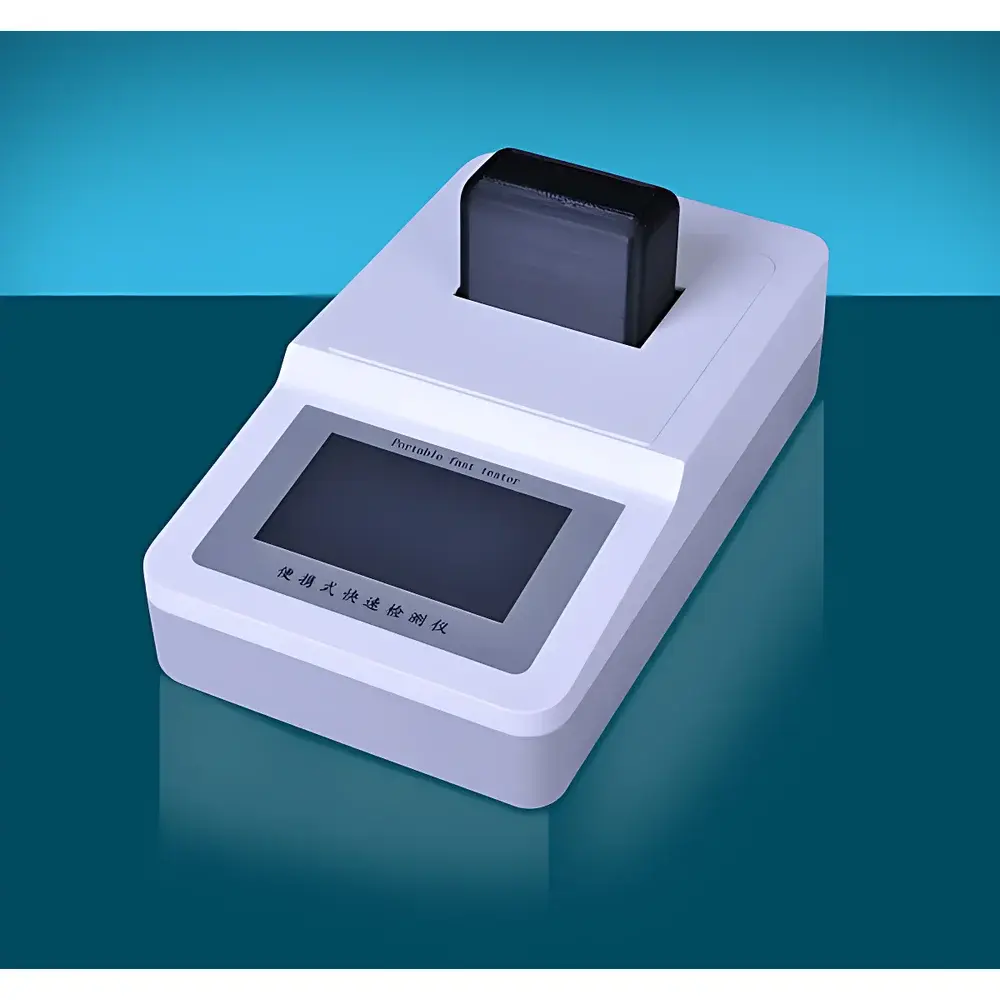
Ruixin SP-CHN Histamine Analyzer
| Brand | Ruixin |
|---|---|
| Origin | Shanghai, China |
| Manufacturer Type | Authorized Distributor |
| Country of Origin | China |
| Model | SP-CHN |
| Price | USD 780 (approx.) |
| Functionality | Single-analyte, dedicated assay |
| Sample Format | Homogenized tissue extract (liquid phase) |
| Wavelength Range | 400–680 nm |
| Assay Time | <120 s per sample |
| Coefficient of Variation (CV) | <5% |
| Detection Channels | 1 |
| Detection Limit | 10 mg/100 g in fish and aquatic animal tissues |
| Linear Range | 10–200 mg/100 g (typical for enzymatic/colorimetric histamine assays) |
Overview
The Ruixin SP-CHN Histamine Analyzer is a dedicated benchtop photometric analyzer engineered for rapid, quantitative determination of histamine in homogenized extracts from fish, shellfish, and other animal-derived food matrices. It operates on the principle of enzyme-linked colorimetric detection: histamine dehydrogenase (HDH) catalyzes the oxidation of histamine in the presence of NAD⁺, generating NADH, which is quantified spectrophotometrically at wavelengths between 400 nm and 680 nm—optimized for the characteristic absorbance peak of reduced nicotinamide adenine dinucleotide. This method aligns with internationally recognized screening protocols for histamine monitoring in seafood quality control, including AOAC Official Method 2005.03 and ISO 19040:2016 (Determination of histamine in fish and fishery products). The instrument delivers results in under two minutes per sample, supporting high-throughput pre-shipment verification, cold-chain integrity assessment, and routine QC in processing facilities where time-sensitive spoilage evaluation is critical.
Key Features
- Single-channel optical system calibrated for consistent absorbance measurement across the 400–680 nm spectral window, optimized for NADH quantification.
- Integrated microprocessor-controlled assay timing and endpoint detection, eliminating manual endpoint judgment and reducing operator-dependent variability.
- 320 × 240-pixel backlit monochrome LCD display with Chinese-language interface—designed for intuitive navigation in production environments where multilingual technical staff operate equipment.
- Dual-mode operation: standalone analysis mode for field or line-side use; optional PC-connected mode via RS-232 for centralized data logging and method parameter management.
- Built-in thermal mini-printer enabling immediate hardcopy output of concentration values, sample ID, date/time stamp, and pass/fail status relative to regulatory thresholds (e.g., EU Regulation (EC) No 2073/2005 limit of 100 mg/kg for scombroid fish).
- Onboard memory stores ≥500 test records with timestamp, sample identifier, and calculated histamine concentration—accessible via menu-driven recall without external software.
- Rugged enclosure rated for ambient operating conditions typical of food processing labs (10–40 °C, 30–85% RH non-condensing), with dust-resistant keypad and splash-proof front panel.
Sample Compatibility & Compliance
The SP-CHN is validated for use with aqueous extracts prepared from minced fish muscle, viscera, or surimi using standardized acid extraction (e.g., 0.1 M HCl) followed by centrifugation and neutralization. It is not intended for raw whole-tissue, viscous slurries, or non-aqueous matrices without prior validation. The assay format conforms to Good Laboratory Practice (GLP) documentation requirements: each result includes automatic time/date stamping, user ID entry (optional), and audit-ready printout. While the instrument itself does not provide full 21 CFR Part 11 compliance (e.g., electronic signatures, role-based access), its data export capability supports integration into LIMS platforms that enforce FDA-mandated electronic record controls. Method performance meets ISO/IEC 17025 criteria for repeatability (CV <5%) and detection limit (10 mg/100 g), verified per internal calibration protocols traceable to NIST-traceable histamine reference standards.
Software & Data Management
No proprietary desktop software is bundled; however, the RS-232 serial interface enables ASCII-formatted data streaming to third-party applications—including Excel-based tracking templates, SQL-backed QC databases, or enterprise LIMS systems. Each transmitted record contains: sample ID (alphanumeric, up to 12 characters), measured absorbance (mAU), calculated concentration (mg/100 g), assay timestamp (YYYY-MM-DD HH:MM:SS), and instrument serial number. Firmware supports user-defined calibration curves (up to 5 stored profiles) using manufacturer-supplied histamine standard sets (0, 10, 25, 50, 100, 200 mg/100 g). Calibration verification checks are prompted every 24 hours or after 20 tests, ensuring ongoing metrological reliability.
Applications
- Routine histamine screening in seafood receiving docks to enforce incoming material specifications before further processing.
- Verification of refrigeration efficacy during storage and transport—correlating elevated histamine levels with temperature abuse events.
- Supporting HACCP prerequisite programs for scombroid-susceptible species (e.g., tuna, mackerel, mahi-mahi).
- Internal training and proficiency testing for QA technicians performing rapid field assessments.
- Complementing confirmatory LC-MS/MS analysis by triaging high-risk lots for deeper investigation.
FAQ
What extraction protocol is required prior to analysis?
Standardized acid extraction using 0.1 M HCl (1:5 w/v), followed by centrifugation (3000 × g, 10 min) and neutralization with NaOH to pH 6.5–7.5 is mandatory. Extraction kits compliant with AOAC 2005.03 are recommended.
Can the instrument be used for other biogenic amines?
No. The SP-CHN is configured exclusively for histamine via HDH-coupled detection. It lacks cross-reactivity calibration for tyramine, putrescine, or cadaverine.
Is external calibration verification required?
Yes. Users must perform daily calibration verification using a mid-range histamine standard (e.g., 50 mg/100 g) before initiating batch analysis.
What maintenance is needed for long-term accuracy?
Optical path cleaning with lint-free wipes and isopropanol every 50 tests; annual photometric verification using neutral density filters traceable to NIST SRM 2034.
Does the device meet CE or RoHS requirements?
As a Class I electrical instrument manufactured in Shanghai, it complies with China’s CCC marking requirements; CE marking is not applicable unless exported through an EU-authorized representative with technical file submission.






