
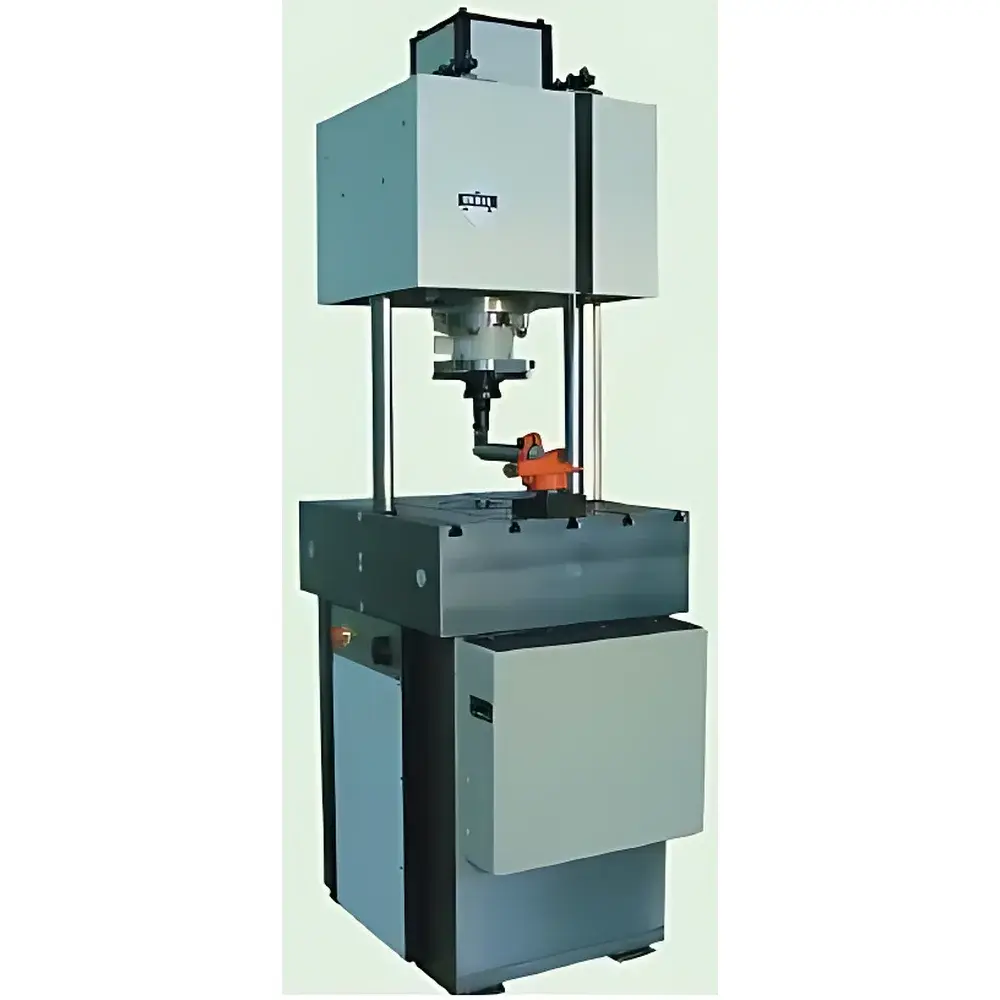
RUMUL TESTRONIC High-Frequency Resonant Fatigue Testing Machine
| Brand | RUMUL |
|---|---|
| Model | TESTRONIC |
| Origin | Switzerland |
| Type | Electromagnetic Resonant Fatigue Tester |
| Max Dynamic Load | ±250 kN |
| Static Load Capacity | 250 kN |
| Frequency Range | 40–300 Hz (8 discrete steps) |
| Frequency Control Accuracy | ±0.01 Hz |
| Dynamic Load Accuracy | ±0.5% |
| Static Load Accuracy | ±0.5% |
| Displacement Measurement Accuracy | ≤0.5% of reading |
| Vertical Test Space | >500 mm |
| Crosshead Travel | ≥300 mm |
| Test Table Dimensions | 690 × 840 mm with M16 T-slots |
| Resonance Damping | Optimized lateral elastic suspension |
| Compliance | ISO 7500-1 Class 1, ASTM E4, ASTM E647, DIN 969, ISO 3800 |
Overview
The RUMUL TESTRONIC High-Frequency Resonant Fatigue Testing Machine is an electromagnetically driven, resonance-based mechanical testing system engineered for high-cycle fatigue (HCF), very-high-cycle fatigue (VHCF), and crack propagation studies in metallic materials and structural components. Unlike servo-hydraulic or electrodynamic shaker-based systems, the TESTRONIC leverages the physical principle of mechanical resonance—where a specimen’s natural frequency is excited via a precisely tuned electromagnetic actuator—to achieve highly efficient, low-energy, high-amplitude cyclic loading at frequencies ranging from 40 to 300 Hz. This architecture eliminates hydraulic power units, cooling circuits, valves, and associated maintenance, resulting in exceptional operational reliability and long-term measurement stability. Developed by RUMUL AG (founded 1964, Zurich), the system embodies over four decades of specialized expertise in resonant fatigue instrumentation, rooted in Max E. Russenberger’s 1938 invention of the first resonant fatigue tester. It is widely deployed in aerospace R&D labs, automotive OEM validation centers, national metrology institutes, and leading universities—including ETH Zurich, TU Munich, Georgia Tech, and Southwest Jiaotong University—for standardized fatigue life assessment, fracture mechanics parameter derivation (e.g., ΔKIC, JIC, da/dN vs. ΔK), and pre-crack preparation per ASTM E647.
Key Features
- Proprietary MAGNODYN electromagnetic excitation system with independent static and dynamic load application pathways
- Resonance-optimized oscillation architecture featuring high-strength aluminum alloy and heat-treated steel frames for minimal energy loss and superior modal fidelity
- Laterally decoupled elastic suspension system that suppresses parasitic transverse modes, ensuring >95% of input energy is delivered axially to the specimen
- Integrated precision load cell and displacement transducer with traceable calibration per ISO 7500-1 Class 1 (<5% verification error)
- Modular test space accommodating specimens up to 500 mm vertical clearance and ≥300 mm crosshead travel, configurable with T-slot worktable (690 × 840 mm, M16 threaded)
- Real-time frequency tracking with 0.01 Hz resolution; automatic shutdown triggered upon predefined resonance shift—correlating directly with crack growth progression
Sample Compatibility & Compliance
The TESTRONIC supports a broad spectrum of standardized and custom geometries: compact tension (CT), single-edge notched bend (SENB), center-cracked tension (CCT), round-bar axial, torsional, three-point and four-point bending specimens, as well as industrial components including crankshafts, connecting rods, fasteners, gear teeth, and welded joints. Optional environmental chambers enable testing from –70 °C to +300 °C. All hardware and control firmware comply with ISO 7500-1 (static calibration), ISO 1099 (fatigue testing), ASTM E4 (load verification), ASTM E647 (da/dN measurement), DIN 50100 (S–N testing), and ISO 3800 (statistical evaluation of fatigue data). The system meets GLP/GMP documentation requirements when paired with audit-trail-enabled software configurations.
Software & Data Management
RUMUL’s integrated software suite comprises four dedicated modules: SAFD (Statistical Analysis of Fatigue Data), Woehler (real-time machine control and resonance monitoring), BLOCK (unlimited batch sequencing), and Precrack/Crack (ASTM E647-compliant crack growth protocols). SAFD generates S–N curves in semi-log or log–log format, applies Weibull, normal, and log-normal distribution fitting per DIN 969 and ISO 3800, and computes confidence intervals for fatigue limit estimation. Woehler provides full GUI-based machine operation, real-time display of setpoints/actuals, alarm logging, and event-triggered data capture (e.g., at resonance drop thresholds). All modules support export to CSV, ASCII, and XML; optional integration with LIMS and ELN platforms via OPC UA or TCP/IP interfaces ensures alignment with FDA 21 CFR Part 11 electronic record requirements when configured with digital signatures and user access controls.
Applications
- Determination of fatigue strength and endurance limits (N > 10⁶ cycles) under stress-controlled conditions
- Generation of da/dN vs. ΔK relationships for linear-elastic fracture mechanics (LEFM) analysis
- Pre-cracking of fracture toughness specimens (e.g., ASTM E399, E1820) with precise r-ratio and ΔK control
- High-frequency thermal-mechanical fatigue (TMF) when coupled with environmental chambers
- Validation of surface enhancement techniques (shot peening, laser shock peening) via comparative fatigue life mapping
- Qualification testing of additively manufactured (AM) metal parts under resonant spectral loading profiles
FAQ
What distinguishes resonant fatigue testing from servo-hydraulic or electrodynamic methods?
Resonant systems operate at a specimen’s natural frequency, enabling high-force cyclic loading with minimal input power—ideal for long-duration, high-cycle tests where thermal drift and energy consumption are critical constraints.
Can the TESTRONIC perform tests below 40 Hz or above 300 Hz?
No—the system is mechanically tuned for optimal efficiency within its specified 40–300 Hz range; out-of-band operation compromises resonance integrity and measurement accuracy.
Is ASTM E647 crack growth testing fully automated?
Yes—via the Crack module, which executes stepwise ΔK-controlled loading, monitors resonance frequency decay in real time, logs crack length increments, and auto-terminates upon reaching target da/dN thresholds.
How is calibration traceability maintained?
All load cells and displacement sensors are calibrated against NIST-traceable standards; full calibration certificates per ISO/IEC 17025 are provided with each system shipment.
Does the system support remote monitoring and multi-user access?
Yes—Woehler and SAFD support concurrent networked access via secure HTTPS; role-based permissions and session logging satisfy audit requirements for regulated environments.



