RWD 68200 Stereotaxic Instrument Holder Kit
| Origin | Guangdong, China |
|---|---|
| Manufacturer Type | Authorized Distributor |
| Origin Category | Domestic (China) |
| Model | 68200 |
| Pricing | Upon Request |
Overview
The RWD 68200 Stereotaxic Instrument Holder Kit is a modular, precision-engineered accessory system designed for integration with standard stereotaxic frames used in preclinical neuroscience research. It does not function as a standalone stereotaxic apparatus but serves as a critical interface between the manipulator arm and experimental probes—enabling reproducible, millimeter- and micrometer-scale positioning of electrodes, cannulae, microinjection needles, microdialysis probes, and cranial drilling tools within rodent or non-human primate brain coordinates. The system operates on mechanical clamping principles, relying on precisely machined V-grooves, wedge-based compression, and C-shaped lateral loading mechanisms to secure instruments without slippage during stereotactic surgery or chronic implantation procedures. All holders are manufactured from corrosion-resistant stainless steel and anodized aluminum alloys, ensuring long-term dimensional stability under repeated autoclaving and exposure to saline, ethanol, and common neuropharmacological solvents.
Key Features
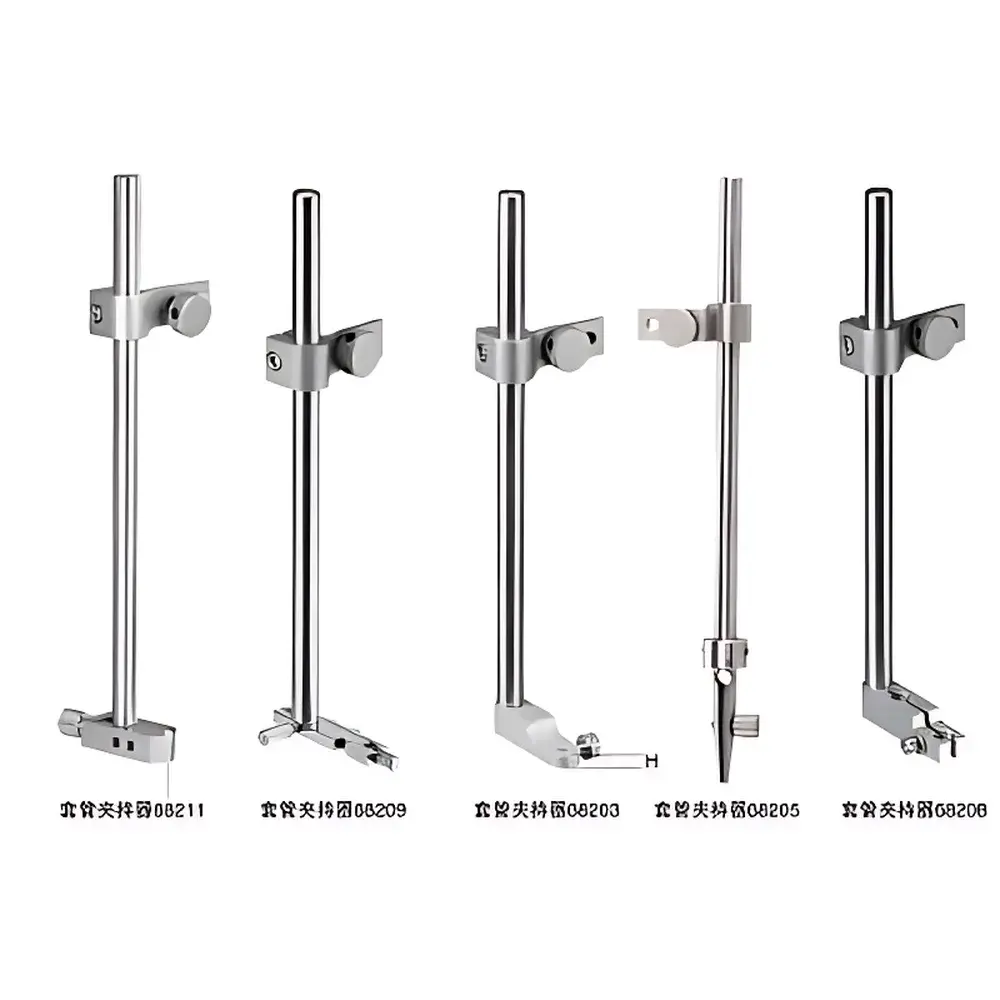
- Modular Design: Comprises 14 distinct holder types (e.g., 68201–68219, 68605), each optimized for specific probe geometries, diameters, and functional requirements—including dual-electrode proximity control, coaxial cannula alignment, and horizontal vs. vertical mounting orientation.
- Precision Clamping Range: Individual holders support probe diameters from 0.3 mm to 12 mm, with sub-200 µm inter-electrode spacing capability (e.g., model 68216) for high-density electrophysiology or optogenetic co-implantation studies.
- V-Groove & Wedge Architecture: Standard holders (e.g., 68201, 68212) utilize laser-etched V-grooves for passive centering of cylindrical probes; wedge-type holders (e.g., 68203, 68209) provide visual access to the probe tip during insertion and enable rapid tool exchange without frame disassembly.
- Cranial Drilling Integration: Model 68605 rigidly couples handheld cranial drills to the stereotaxic manipulator arm, converting manual drill operation into depth-controlled, vertically actuated motion—reducing risk of dural tear or cortical damage during burr hole preparation.
- Customization Pathway: RWD offers OEM-grade customization services—including bespoke groove profiles, material upgrades (e.g., titanium alloy), and mounting interface adaptations—for labs requiring non-standard probe compatibility or integration with third-party imaging-guided stereotaxy platforms.
Sample Compatibility & Compliance
The 68200 Holder Kit is validated for use with widely adopted neuroscientific tools, including Plastics One® 3.4 mm guide cannulae, CMA® microdialysis probes (models CMA7, CMA12), Alzet® osmotic minipumps (1003D, 2004), and standard glass micropipettes (1.0–1.5 mm OD). All holders comply with ISO 13485:2016 design control requirements for medical device accessories and meet biocompatibility standards per ISO 10993-5 (cytotoxicity) and ISO 10993-10 (irritation/sensitization) when sterilized via autoclave (121°C, 20 min) or ethylene oxide. While not classified as a medical device under FDA 21 CFR Part 820, the kit supports GLP-compliant study execution when used in conjunction with validated stereotaxic workflows and documented calibration protocols.
Software & Data Management
This is a purely mechanical holder system with no embedded electronics, firmware, or software dependencies. Its operation requires no driver installation, network connectivity, or proprietary control interface. All positional repeatability and accuracy derive from the physical rigidity of the stereotaxic frame and the precision machining tolerances of the holder components (±5 µm groove alignment, ±0.02° angular deviation). Users maintain full traceability through manual logbooks or integration with third-party digital lab notebooks (e.g., LabArchives, Benchling) that support SOP-driven documentation of holder selection, probe type, insertion depth, and coordinate mapping per animal subject.
Applications
- Chronic intracerebral cannulation for repeated drug infusion or microdialysis sampling in longitudinal behavioral pharmacology studies.
- High-resolution single-unit and multi-unit extracellular recordings using tungsten, platinum-iridium, or silicon-based electrodes.
- Stereotactic delivery of viral vectors (AAV, lentivirus), CRISPR-Cas9 constructs, or cell suspensions into discrete nuclei (e.g., hippocampus, ventral tegmental area, amygdala).
- Simultaneous dual-probe implantation for closed-loop neuromodulation experiments requiring precise inter-electrode spacing (≤200 µm).
- Calibrated cranial drilling under stereotaxic guidance for craniotomy, skull window implantation, or chronic electrode array placement.
FAQ
Are these holders compatible with non-RWD stereotaxic frames?
Yes—models 68200 series holders feature standardized 1/4″-20 UNC threaded base mounts and universal dovetail interfaces, enabling mechanical interoperability with major brands including Kopf, Stoelting, David Kopf Instruments, and Leica Biosystems stereotaxic systems.
Do any holders support temperature-controlled probes?
No—these are passive mechanical fixtures. For thermoregulated probes (e.g., heated recording electrodes), users must integrate external temperature controllers and verify thermal isolation between the holder and probe shaft to prevent conductive heat loss.
What is the recommended torque for mounting screws?
A maximum torque of 0.3 N·m is specified for all 1/4″-20 mounting hardware to avoid thread deformation while maintaining ≥200 N clamping force across the operational temperature range (15–35°C).
Can holders be sterilized in hydrogen peroxide plasma systems?
Yes—stainless steel and anodized aluminum components are compatible with STERRAD® NX and similar low-temperature plasma sterilizers. Avoid prolonged exposure to liquid H₂O₂ solutions (>3% concentration) to prevent surface oxidation.
Is technical documentation available in English with dimensional drawings?
Yes—RWD provides comprehensive English-language CAD drawings (STEP, IGES), tolerance specifications, and mounting instructions upon request through authorized distribution channels.