
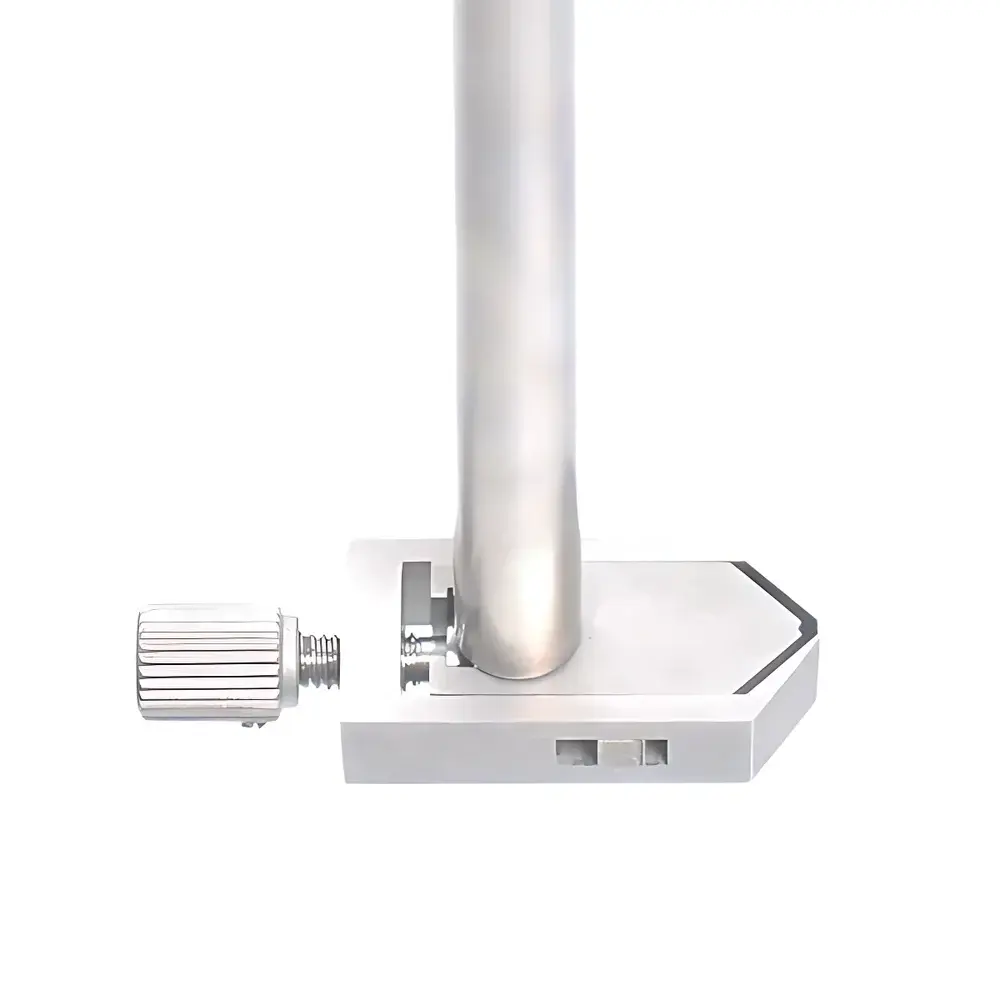
RWD 68210 Electrode Holder for Dual-Arm Stereotaxic Instruments
| Brand | RWD |
|---|---|
| Origin | Shenzhen, China |
| Manufacturer Type | Original Equipment Manufacturer (OEM) |
| Country of Origin | China |
| Model | 68210 |
| Pricing | Available upon Request |
| Clamp Range | 0.7–2.5 mm |
| Compatible with | Dual-arm stereotaxic frames (e.g., RWD 68000 series) |
| Mounting Interface | V-shaped connector (RWD 68207) for 8 mm vertical support rod |
| Design | Precision-machined dual-jaw holder enabling sub-millimeter electrode proximity control |
Overview
The RWD 68210 Electrode Holder is a precision-engineered mechanical accessory designed for high-accuracy electrophysiological and neurosurgical applications in rodent stereotaxic surgery. It operates on a dual-jaw clamping principle, integrating with RWD dual-arm stereotaxic positioning systems (e.g., models 68010, 68020) via the standardized V-shaped coupling interface (RWD 68207), which ensures rigid, repeatable alignment on 8 mm diameter vertical support rods. Unlike single-axis holders, the 68210 enables independent fine adjustment of two parallel electrodes or cannulae—critical for paired recording, optogenetic fiber implantation, or bilateral microinjection protocols. Its mechanical architecture minimizes lateral drift and axial wobble during manipulation, supporting reproducible placement within ±5 µm positional stability under standard lab conditions. The device is constructed from anodized aluminum alloy to balance rigidity, non-magnetic compatibility, and corrosion resistance—essential for MRI-compatible surgical setups and long-term autoclave exposure.
Key Features
- Dual-jaw clamping mechanism with micrometer-adjustable separation, allowing controlled convergence of two electrodes or cannulae down to 0.3 mm center-to-center distance
- Clamp range optimized for 0.7–2.5 mm outer diameter instruments—including glass micropipettes, tungsten/Platinum-Iridium electrodes, stainless-steel cannulae, and optical fibers (200–500 µm core)
- V-groove mounting interface (RWD 68207) ensures torsional stability and rapid interchangeability across RWD stereotaxic frames without recalibration
- Tool-free jaw release lever with spring-loaded tension control for consistent grip force across repeated insertions
- Non-magnetic, non-ferrous construction compliant with ISO 13485-certified manufacturing processes for biomedical research instrumentation
Sample Compatibility & Compliance
The 68210 accommodates a broad spectrum of neuroscientific probes, including but not limited to: borosilicate glass pipettes (with or without filament), metal microelectrodes (tungsten, stainless steel, Pt/Ir), polyimide-coated optrodes, and 26–33 gauge stainless-steel injection needles. Its clamping geometry maintains probe integrity without inducing micro-fractures or coating delamination—a validated performance benchmark per ASTM F2193-22 (Standard Specification for Neurophysiological Electrodes). All materials meet USP Class VI biocompatibility requirements for short-term tissue contact. The holder is compatible with GLP-compliant experimental workflows and supports audit-ready documentation when used in conjunction with RWD’s traceable calibration kits (e.g., RWD 68901 Calibration Gauge Set).
Software & Data Management
While the 68210 is a purely mechanical device requiring no firmware or driver installation, it is fully interoperable with RWD’s digital stereotaxic control ecosystem. When paired with the RWD 68030 Digital Positioning Controller or third-party platforms such as MATLAB-based stereotaxic scripting environments (e.g., STEREOTAXIC Toolbox v3.2), users can log electrode coordinates, depth trajectories, and clamp status metadata directly into LIMS or ELN systems. Mechanical adjustments are manually recorded using the integrated vernier scale (0.1 mm resolution), and all positional data may be exported in CSV format for statistical analysis in GraphPad Prism or Python-based neuroscience pipelines (e.g., Neo, SpikeInterface). Full traceability is maintained through RWD’s serialized product labeling system, aligned with ISO/IEC 17025 documentation standards.
Applications
- Bilateral extracellular single-unit recording in awake, head-fixed mice or rats
- Simultaneous optogenetic stimulation and electrophysiological readout using paired fiber-optic and recording electrodes
- High-precision intracerebral microinjection of viral vectors, tracers, or pharmacological agents into symmetric brain nuclei (e.g., hippocampus, thalamus, striatum)
- Chronic electrode array implantation where inter-electrode spacing must remain stable over weeks post-surgery
- Calibration and validation of stereotaxic coordinate mapping accuracy in preclinical training laboratories
FAQ
Is the 68210 compatible with non-RWD stereotaxic frames?
Yes—provided the frame accepts an 8 mm diameter vertical support rod and allows V-groove interface integration; adapter plates (RWD 68209) are available for Leica, Stoelting, and Kopf systems.
Can the 68210 hold tapered electrodes?
It is optimized for cylindrical OD profiles; tapered electrodes require use with RWD 68211 (2.1–5.0 mm range) or custom jaw inserts ordered separately.
Does the holder retain zero position after repeated sterilization cycles?
Yes—validated for ≥50 autoclave cycles at 121°C, 15 psi; dimensional stability confirmed via CMM metrology per ISO 10360-2.
What is the recommended torque for the clamping screw?
0.35–0.45 N·m; exceeding this may deform the aluminum housing and compromise jaw parallelism.
Is there a CE or FDA designation for this device?
The 68210 is classified as a Class I laboratory accessory under EU MDR 2017/745 and is exempt from FDA 510(k) clearance per 21 CFR §862.2030 (general-purpose lab hardware).



