
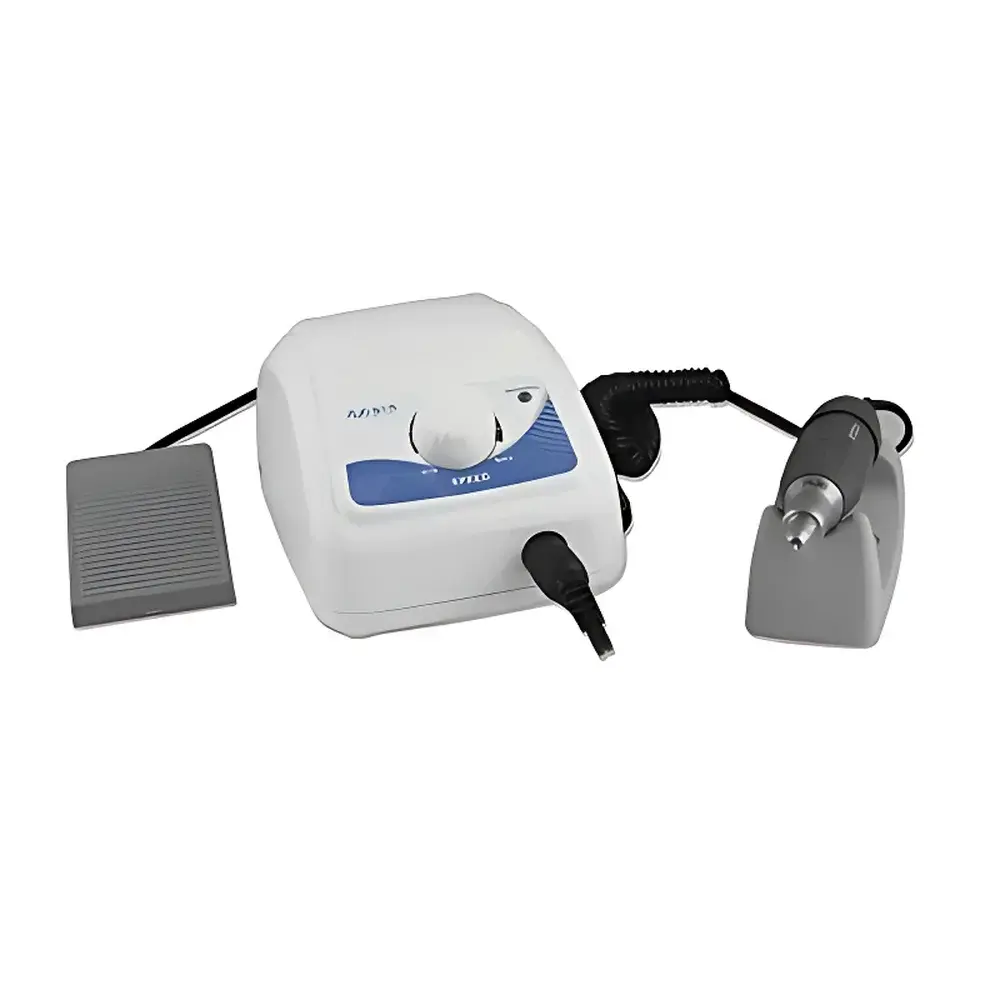
RWD 78001 Miniature Handheld Cranial Drill
| Brand | RWD |
|---|---|
| Origin | Shenzhen, China |
| Manufacturer Type | OEM Manufacturer |
| Country of Origin | China |
| Model | 78001 |
| Max Speed | 38,000 rpm |
| Rotation Direction | Forward/Reverse Selectable |
| Control Mode | Manual or Footswitch-Activated |
| Mounting Compatibility | Compatible with RWD Stereotaxic Frame via Drill Holder (Model 68605) |
| Drill Bit Diameter Range | 0.5–2.3 mm |
| Bit Tip Geometry Options | Round-tipped (for drilling) and Flat-tipped (for skull thinning) |
| Bit Material | High-speed steel (HSS) |
| Power Supply | DC input (specification per regional variant) |
Overview
The RWD 78001 Miniature Handheld Cranial Drill is an ergonomically engineered precision instrument designed for controlled, low-trauma craniotomy in small-animal stereotaxic surgery. It operates on a high-efficiency brushless DC motor platform, delivering stable rotational output up to 38,000 rpm with minimal vibration and thermal drift—critical parameters for maintaining cortical integrity during burr hole creation. Unlike bulkier benchtop drills, its compact form factor (length < 120 mm, weight < 180 g) enables precise intraoperative manipulation under microscopic visualization while minimizing hand fatigue during prolonged procedures. The drill is not intended for human use and is validated exclusively for rodent (mouse, rat) and lagomorph (rabbit) neurosurgical applications where submillimeter spatial accuracy and mechanical reproducibility are required for electrode implantation, viral vector delivery, microdialysis probe insertion, or optogenetic fiber placement.
Key Features
- High-speed brushless motor with digitally regulated speed control ensures consistent torque delivery across the full 0–38,000 rpm range, reducing stalling risk during cortical bone penetration.
- Bidirectional rotation selection (clockwise/counterclockwise) supports specialized tasks such as controlled removal of bone fragments or counter-rotation during bit withdrawal to prevent tissue snagging.
- Dual activation interface: integrated thumb switch for manual operation and optional footswitch (RWD FS-1, sold separately) for hands-free, contamination-free control—essential in aseptic surgical workflows.
- Modular mounting system compatible with standard RWD stereotaxic frames (e.g., 68605 Drill Holder), enabling rigid fixation and fine Z-axis positioning via the manipulator arm for stepwise depth-controlled drilling.
- Interchangeable HSS drill bits with ISO-standard shank geometry (1.6 mm diameter shank), available in two functional tip configurations: round-tipped (HM-series) for clean through-hole drilling and flat-tipped (HM3-series) for gradual skull thinning without dural breach.
- Bit size selection spanning 0.5 mm to 2.3 mm in 0.1–0.2 mm increments allows experiment-specific optimization—e.g., 0.6 mm for single-unit electrode tracks, 1.4 mm for dual-optrode arrays, or 2.1 mm for chronic cannula implantation.
Sample Compatibility & Compliance
The RWD 78001 is validated for use with adult C57BL/6, Sprague-Dawley, and Wistar subjects (weight range: 20–500 g). Its mechanical design conforms to IEC 61000-6-2 (immunity) and IEC 61000-6-4 (emission) standards for laboratory medical equipment. While not FDA-cleared or CE-marked as a Class IIa medical device (due to its exclusive preclinical research designation), the instrument meets GLP-aligned engineering controls for traceability, including serialized unit labeling and manufacturer-maintained calibration records upon request. All drill bits comply with ISO 7153-1:2016 (surgical instruments — materials — part 1: stainless steels) and undergo batch-certified hardness testing (≥63 HRC). Sterilization is performed via autoclaving at 121°C, 15 psi for 20 minutes; repeated cycles do not compromise bit geometry or motor insulation integrity.
Software & Data Management
The RWD 78001 operates as a standalone electromechanical tool and does not incorporate embedded firmware, wireless connectivity, or onboard data logging. This architecture eliminates electromagnetic interference (EMI) risks near sensitive electrophysiology rigs (e.g., patch-clamp amplifiers or neural recording systems) and avoids regulatory classification complexities associated with “software-as-a-medical-device” (SaMD) frameworks. Operational parameters—including activation duration, direction, and approximate speed setting—are documented manually in electronic lab notebooks (ELN) or integrated with third-party stereotaxic workflow platforms (e.g., Stoelting Quintessential Stereotaxic Suite or Neurostar Pro) via timestamp-synchronized footswitch event triggers. For audit readiness, RWD provides a Certificate of Conformance (CoC) with each shipment, listing manufacturing lot number, date of final inspection, and compliance references.
Applications
- Creation of stereotaxically guided craniotomies for intracranial electrode array implantation (e.g., Neuropixels, Michigan probes).
- Preparation of thinned-skull windows for longitudinal two-photon imaging of cortical vasculature or neuronal activity.
- Drilling of pilot holes for chronic guide cannula or microdialysis probe anchoring in behavioral neuroscience paradigms.
- Controlled skull thinning over target regions (e.g., barrel cortex, hippocampus) using flat-tipped bits to enable optical access without dural resection.
- Supporting optogenetic interventions requiring precise fiber optic cannula placement with minimal periosteal disruption.
- Facilitating targeted intracerebral injections (AAV, lentivirus, pharmacological agents) with reduced risk of hemorrhage compared to manual trephine methods.
FAQ
Is the RWD 78001 suitable for non-rodent species such as non-human primates or ferrets?
The drill’s mechanical design and bit size range are optimized for skulls ≤ 0.8 mm thickness. Use in larger species requires validation of torque transmission, heat dissipation, and bit deflection characteristics—RWD does not provide application support or warranty coverage for such use cases.
Can the drill be sterilized using ethylene oxide (EtO) gas?
No. EtO exposure degrades the polymer housing and compromises motor winding insulation. Autoclaving (121°C, 15 psi, 20 min) is the only validated sterilization method.
Are replacement drill bits traceable to material certifications?
Yes. Each HM- and HM3-series bit is supplied with a batch-specific CoA confirming composition (ISO 7153-1 compliant 440C stainless steel), Rockwell hardness (63–65 HRC), and dimensional tolerance (±0.01 mm).
Does RWD offer custom bit geometries (e.g., diamond-coated or carbide-tipped)?
Standard production is limited to HSS round- and flat-tipped bits per ISO 7153-1. Custom geometries require minimum order quantities ≥500 units and 12-week lead time; feasibility assessment is conducted case-by-case.
What maintenance schedule is recommended for long-term reliability?
Motor brushes are not present (brushless design); annual inspection of chuck retention torque (target: 0.15–0.2 N·m) and visual verification of housing integrity is advised. No scheduled lubrication is required.



