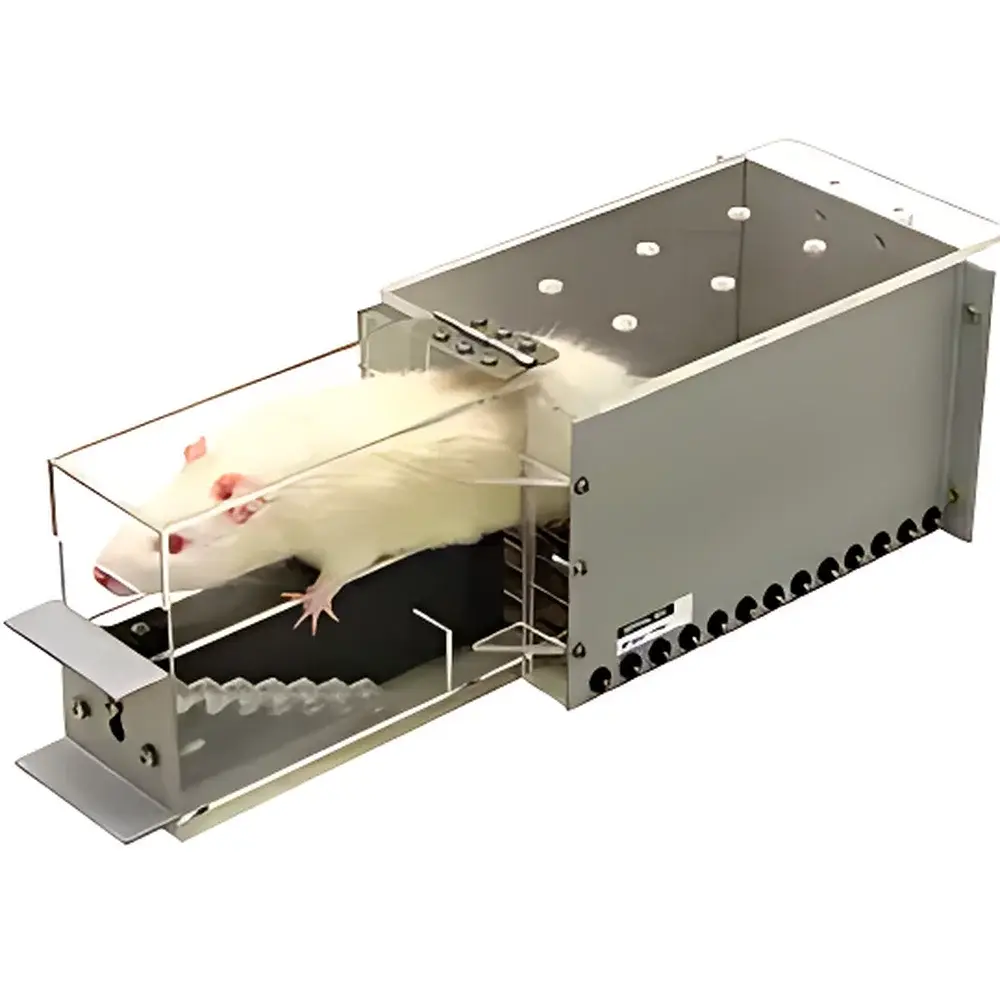
RWD 80300 Staircase Skilled Reaching Test Apparatus for Rats
| Brand | RWD |
|---|---|
| Origin | Shenzhen, China |
| Manufacturer Type | Original Equipment Manufacturer (OEM) |
| Country of Origin | China |
| Model | 80300 |
| Pricing | Upon Request |
Overview
The RWD 80300 Staircase Skilled Reaching Test Apparatus is a standardized, ethologically grounded behavioral assessment platform engineered for quantitative evaluation of forelimb motor coordination, distal dexterity, and skilled reaching capacity in laboratory rats. Based on the validated staircase paradigm first described by Montoya et al. (1991), this apparatus employs a symmetrical, elevated staircase with dual lateral steps—each accommodating food pellets of defined dimensions—to elicit voluntary, goal-directed reaching movements. The animal initiates testing from a confined start chamber aligned with the central platform; to retrieve pellets placed at increasing horizontal distances on either side, it must execute precise shoulder abduction, elbow extension, wrist pronation, and digit flexion—movements requiring intact corticostriatal, nigrostriatal, and sensorimotor cortical circuitry. Unlike forced-movement or restraint-based assays, the staircase test captures spontaneous, untrained behavior under minimal handling stress, yielding high inter-session reproducibility and sensitivity to subtle neuroanatomical or pharmacological perturbations.
Key Features
- Modular staircase design with two independently configurable step widths (standardized for rat forepaw biomechanics), enabling separate quantification of left- and right-limb reaching proficiency without physical limb restraint or surgical tethering.
- Precision-machined acrylic construction ensures dimensional stability, optical clarity for video tracking integration, and chemical resistance to standard disinfectants (e.g., 70% ethanol, sodium hypochlorite).
- Optimized step geometry: step height, depth, and inter-step spacing calibrated per published protocols to maximize extension range while minimizing pellet displacement artifacts—critical for distinguishing true reach attempts from accidental contact.
- Rat-specific configuration (Model 80300): 360 mm × 120 mm footprint (14″ × 4.75″), compatible with animals weighing up to 450 g; internal chamber dimensions prevent 180° turning, ensuring consistent starting posture and directional bias control.
- Compatible with automated pellet detection systems (e.g., infrared beam break or machine vision-based counting) for objective, observer-independent data acquisition.
Sample Compatibility & Compliance
The apparatus is validated for use with Sprague-Dawley, Wistar, and Long-Evans rats (150–450 g). Its mechanical specifications align with recommendations in the NIH Guide for the Care and Use of Laboratory Animals and support compliance with institutional Animal Care and Use Committee (IACUC) protocol requirements. Experimental outcomes are interpretable within frameworks established by the Stroke Therapy Academic Industry Roundtable (STAIR) and the European Stroke Organisation (ESO) guidelines for preclinical motor outcome assessment. Data generated meet minimum reporting standards for GLP-compliant neuropharmacology studies evaluating dopaminergic agents, neural grafts, or rehabilitative interventions.
Software & Data Management
While the core apparatus operates manually, it integrates seamlessly with third-party behavioral analysis platforms—including EthoVision XT (Noldus), ANY-maze (Stoelting), and open-source tools such as DeepLabCut—for synchronized video recording, frame-by-frame reach segmentation, and kinematic parameter extraction (e.g., reach onset latency, success rate, pellet displacement distance, drop frequency). All raw behavioral logs (pellet retrieval count per side, drop count per step level) are exportable in CSV/Excel format. When paired with audit-trail-enabled software, data collection workflows may be configured to satisfy FDA 21 CFR Part 11 requirements for electronic records in regulated nonclinical studies.
Applications
This apparatus delivers high sensitivity in detecting functional deficits following unilateral striatal lesions (e.g., 6-OHDA or quinolinic acid models), focal cerebral ischemia (MCAO), sensorimotor cortex ablation, or dopamine depletion. It differentiates between impairments in maximal reach distance (reflecting proximal musculoskeletal capacity) and successful pellet retrieval (requiring fine motor control and sensorimotor integration)—a distinction critical in evaluating therapeutic efficacy of cell transplantation, neurotrophic factor delivery, or rehabilitative training paradigms. Published applications include longitudinal monitoring of recovery trajectories post-stroke, dose-response characterization of L-DOPA or D2-receptor agonists, and validation of optogenetic or chemogenetic modulation of corticostriatal projections.
FAQ
What is the recommended acclimatization period prior to baseline testing?
Animals should undergo three 5-minute habituation sessions over two days to reduce novelty-induced anxiety and establish consistent exploratory patterns.
Can the same apparatus be used for both rats and mice?
No—Model 80300 is dimensionally optimized for rats; mice require Model 80301 (145 mm × 55 mm × 51 mm) due to distinct scaling of limb length, body mass, and grasping biomechanics.
How is inter-rater reliability ensured during manual scoring?
Scoring follows a standardized binary criterion: a successful reach requires visible forelimb extension beyond the platform edge, independent digit engagement with the pellet, and transport of the pellet into the start chamber without dropping—criteria detailed in the included SOP documentation.
Is calibration required before each session?
No mechanical calibration is needed; however, daily verification of pellet placement consistency (using calipers) and step surface cleanliness is mandatory to maintain assay fidelity.
Does the apparatus support automated pellet dispensing?
It is compatible with external pellet dispensers (e.g., Campden Instruments or Lafayette Instrument systems) via TTL trigger input, though dispensing logic must be externally programmed.