
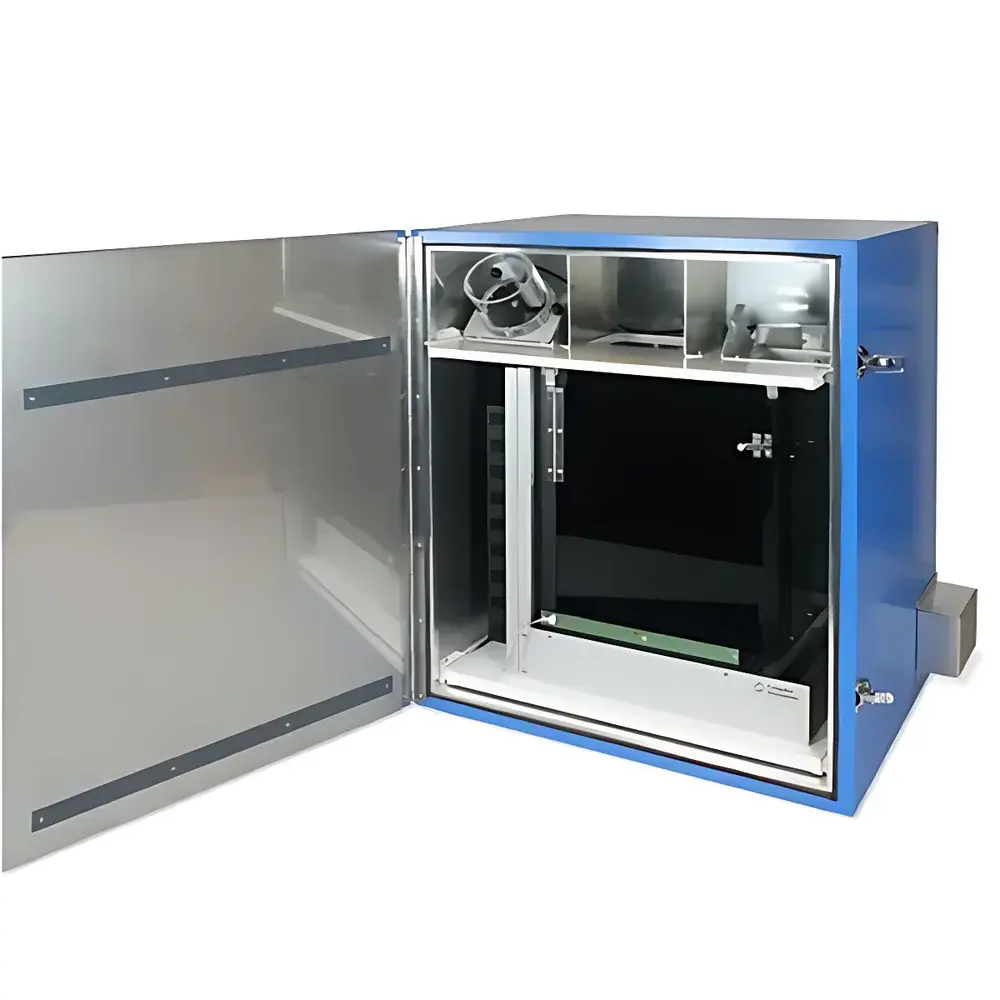
RWD Bussey-Saksida Touchscreen Operant Chamber
| Brand | RWD |
|---|---|
| Origin | Shenzhen, China |
| Manufacturer Type | Original Equipment Manufacturer (OEM) |
| Country of Origin | China |
| Model | Bussey-Saksida |
| Price Range | USD 1,400 – 7,200 |
Overview
The RWD Bussey-Saksida Touchscreen Operant Chamber is a rigorously validated, translational behavioral testing platform engineered for high-fidelity assessment of cognitive function in rodents. Based on the well-established Bussey–Saksida touchscreen paradigm—originally developed at the University of Cambridge and refined through decades of preclinical neuroscience research—the system implements operant conditioning principles within a trapezoidal enclosure optimized for visual attention control and minimal environmental distraction. It operates on a computer-controlled touchscreen interface calibrated to rodent visual acuity and motor response profiles, enabling precise delivery of visual stimuli (e.g., shapes, patterns, spatial configurations), contingent reinforcement (liquid or pellet reward), and real-time detection of nose-poke responses. This architecture supports ethologically relevant, trial-structured tasks that model human neuropsychological constructs—including attentional set-shifting, visual discrimination learning, reversal learning, paired-associates learning, and delayed matching-to-sample—thereby bridging rodent behavioral phenotyping with clinical endophenotypes observed in Alzheimer’s disease, Parkinson’s disease, schizophrenia, Huntington’s disease, ADHD, and obsessive-compulsive disorder.
Key Features
- Trapezoidal chamber design engineered to direct rodent gaze toward the touchscreen display, minimizing peripheral distraction and enhancing stimulus salience.
- High-resolution, infrared touchscreen panel with millisecond-level response latency and calibrated touch sensitivity for accurate nose-poke detection.
- Fully modular hardware architecture: standardized mounting rails allow rapid reconfiguration of stimulus modules (LEDs, speakers, houselights), response devices (standard/thick levers, nose-poke apertures), and reward delivery systems (liquid sipper tubes, pellet dispensers).
- Integrated stimulus generation: programmable pure-tone audio (1–20 kHz), intensity-adjustable broadband white noise, spectrally neutral LED illumination (450–650 nm), and spatially defined visual stimuli rendered in grayscale or color.
- Optional footshock module compliant with IACUC-defined intensity ranges (0.05–0.8 mA, adjustable pulse duration), fully isolated and independently controllable for aversive conditioning protocols.
- Acoustically and optically shielded enclosure compatible with standard sound-attenuating chambers (e.g., Med Associates ENV-018MD or Lafayette 80000 series), equipped with active ventilation to maintain thermal stability during extended sessions.
Sample Compatibility & Compliance
The system is validated for use with C57BL/6, BALB/c, DBA/2, and transgenic mouse lines (e.g., APP/PS1, α-synuclein overexpression models), as well as Sprague-Dawley and Long-Evans rats. All hardware components meet ISO 13485-aligned manufacturing standards for laboratory instrumentation. Software operation supports audit trail logging and user-access controls required under GLP-compliant study conduct. Experimental paradigms adhere to published guidelines from the Cognitive Neuroscience Society (CNS) and the International Behavioral Neuroscience Society (IBNS), and are referenced in peer-reviewed publications indexed in PubMed and Web of Science. The system does not require FDA clearance as it is intended solely for non-clinical research use.
Software & Data Management
The proprietary RWD Touchscreen Suite (v4.2+) provides a graphical experiment builder with drag-and-drop task logic sequencing, conditional branching, and parametric stimulus definition. Preloaded protocol libraries include all Cambridge-standard paradigms authored by Prof. Trevor Robbins’ laboratory—fully validated for cross-species translatability and published in journals such as Neuropsychopharmacology, Biological Psychiatry, and Journal of Neuroscience. Raw data (timestamped response events, latency, accuracy, reward consumption) are exported in CSV and HDF5 formats, supporting direct import into MATLAB, Python (via Pandas/NumPy), GraphPad Prism, and R. Audit trails record operator ID, session start/end timestamps, parameter modifications, and calibration logs—meeting ALF (Animal Laboratory Framework) metadata standards and facilitating 21 CFR Part 11–aligned documentation where required.
Applications
- Translational modeling of executive dysfunction in neurodegenerative and neurodevelopmental disorders.
- Pharmacological screening of pro-cognitive compounds (e.g., cholinesterase inhibitors, NMDA modulators, dopamine D1 agonists).
- Genetic validation of cognitive endophenotypes in knockout/knock-in models.
- Longitudinal assessment of cognitive decline or recovery following surgical, pharmacological, or environmental interventions.
- Combined behavioral-electrophysiological or behavioral-optogenetic experiments via synchronized TTL output ports.
- Standardized training protocols requiring ≤7 days for stable baseline performance across cohorts.
FAQ
Is the touchscreen calibrated for rodent visual acuity and contrast sensitivity?
Yes—the display luminance (10–300 cd/m²), spatial frequency (≤0.5 cycles/degree), and chromatic contrast are empirically optimized for murine photoreceptor spectral sensitivity and cortical processing limits.
Can the system be integrated with third-party electrophysiology or imaging hardware?
Yes—TTL-compatible input/output ports support synchronization with neural recording systems (e.g., Intan, Neuralynx) and behavioral video tracking platforms (e.g., EthoVision XT, DeepLabCut).
Does the software support automated data analysis beyond raw event logging?
Yes—built-in analytics modules compute discrimination index, perseverative errors, learning rate slopes, and session-by-session asymptotic performance metrics, with exportable summary reports.
What is the typical throughput for cohort-based studies?
With automated cleaning and schedule-driven task rotation, up to 12 animals per day can be tested across 3–4 parallel chambers using staggered session timing.
Are validation datasets and benchmarking protocols available?
Yes—RWD provides reference performance datasets from C57BL/6J mice and Sprague-Dawley rats across 12 core paradigms, including normative latency and accuracy baselines stratified by age and sex.



