
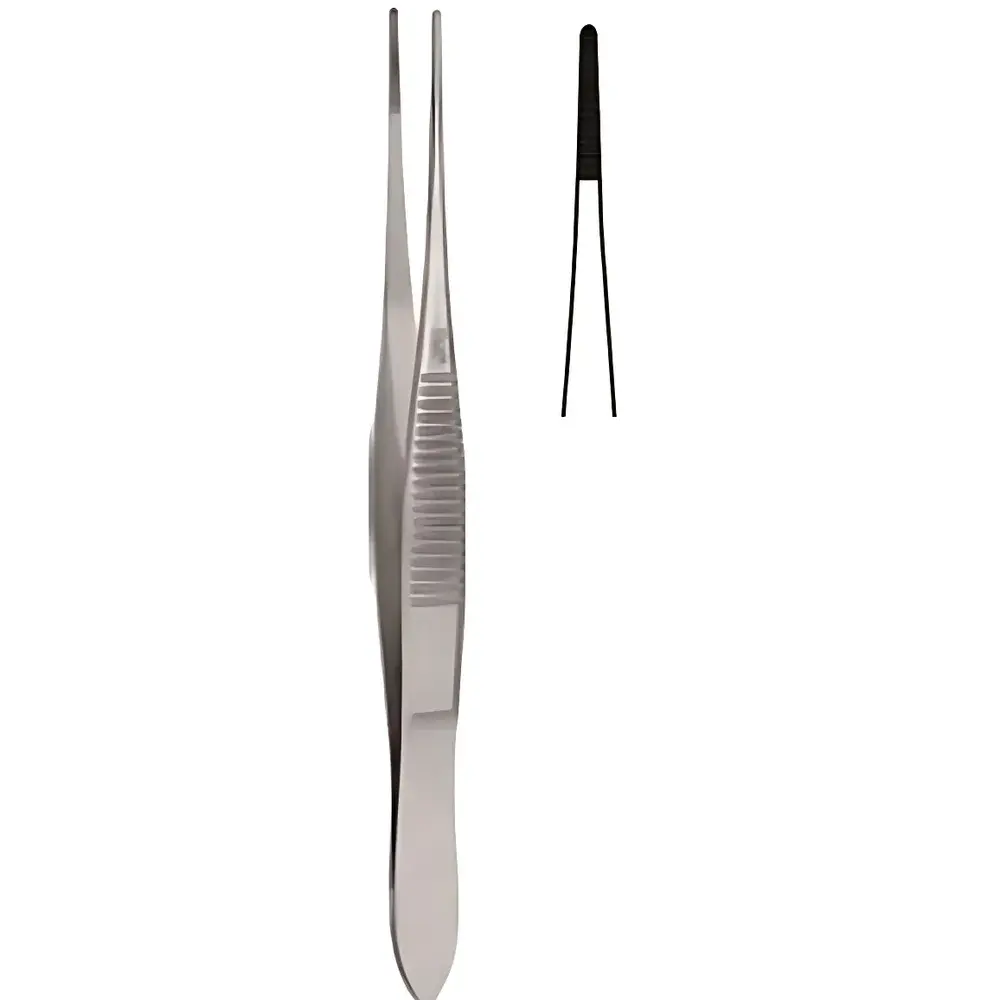
RWD F12009-11 Straight/Blunt & Blunt/Blunt Micro Dissecting Forceps (11.5 cm)
| Brand | RWD |
|---|---|
| Origin | Shenzhen, China |
| Manufacturer Type | Original Equipment Manufacturer (OEM) / Producer |
| Country of Origin | China |
| Model | F12009-11 |
| Pricing | Upon Request |
Overview
The RWD F12009-11 is a precision-engineered micro dissecting forceps designed for delicate manual manipulation in stereomicroscopic and high-magnification surgical or laboratory procedures. Constructed from high-grade stainless steel with electropolished surfaces, this 11.5 cm instrument features dual-tip configurations—straight/blunt on one jaw and blunt/blunt on the opposing jaw—to support versatile tissue handling while minimizing trauma to fragile biological structures. Its design adheres to established ergonomic principles for fine motor control under prolonged use, making it suitable for applications requiring consistent tactile feedback and minimal slippage during manipulation of neural tissue, embryonic samples, vascular grafts, or cultured cell monolayers.
Key Features
- Dual-tip geometry: One jaw configured with straight/blunt tips for precise grasping and positioning; opposing jaw with blunt/blunt tips for non-traumatic compression and stabilization of soft tissues.
- 11.5 cm total length optimized for balance between reach and control—ideal for use with stereo microscopes (7×–50× magnification) and within laminar flow hoods or biosafety cabinets.
- Electropolished 316L stainless steel construction ensures corrosion resistance, biocompatibility, and compatibility with standard autoclaving cycles (121°C, 15 psi, 20 min) and chemical sterilants including ethanol, isopropanol, and hydrogen peroxide vapor.
- Tapered, hand-finished tips with sub-50 µm edge consistency provide uniform pressure distribution across contact surfaces—critical for avoiding puncture or shear damage to membranes, axons, or epithelial sheets.
- Non-slip knurled shaft section enhances grip stability during extended microsurgical sessions, reducing operator fatigue without compromising dexterity.
Sample Compatibility & Compliance
The F12009-11 forceps are validated for use across diverse biological specimen types, including but not limited to: fresh and fixed rodent brain slices, zebrafish embryos (24–72 hpf), avian neural crest explants, primary neuronal cultures, and decellularized extracellular matrix scaffolds. Instrument dimensions and tip geometry comply with ISO 7740-1:2018 (Surgical Instruments — Requirements for Materials and Construction) and meet essential requirements outlined in Annex I of Regulation (EU) 2017/745 (MDR) for Class I non-sterile, reusable surgical instruments. Documentation includes material traceability certificates and biocompatibility test reports per ISO 10993-1 and ISO 10993-5 (cytotoxicity). Sterilization validation data supports repeated processing under EN 556-1:2015 standards.
Software & Data Management
As a manually operated mechanical instrument, the F12009-11 does not incorporate embedded electronics, firmware, or digital connectivity. It requires no software integration, driver installation, or firmware updates. All usage records—including sterilization logs, maintenance intervals, and instrument assignment—must be maintained manually or via institutional Laboratory Information Management Systems (LIMS) compliant with Good Laboratory Practice (GLP) and ISO/IEC 17025:2017 documentation requirements. Traceability is ensured through laser-engraved model number (F12009-11) and batch identifier on the proximal shaft.
Applications
- Microdissection of cortical layers and hippocampal subregions in acute brain slice preparations.
- Embryo handling and yolk sac removal in murine and avian developmental biology workflows.
- Placement and anchoring of microelectrode arrays on ex vivo retinal explants.
- Transfer and alignment of hydrogel-based organoid constructs during scaffold-assisted culture.
- Manipulation of microvascular fragments during angiogenesis assay setup.
- Non-crushing tissue retraction in intracranial microsurgery training models.
FAQ
Is the F12009-11 autoclavable?
Yes—validated for up to 500 cycles of saturated steam sterilization at 121°C, 15 psi, 20 minutes per cycle.
What is the recommended cleaning protocol prior to sterilization?
Rinse immediately after use with deionized water, followed by ultrasonic cleaning in enzymatic detergent (pH 7.0–8.5) for 5–10 minutes, then thorough rinsing and drying.
Can these forceps be used in sterile tissue culture environments?
Yes—provided they undergo validated terminal sterilization and are handled using aseptic technique within ISO Class 5 laminar flow workstations.
Does RWD provide calibration or certification documentation?
No calibration is required for mechanical forceps; however, material compliance certificates and biocompatibility test summaries are available upon request with purchase order confirmation.
Are replacement tips or refurbishment services offered?
RWD does not offer tip replacement; however, full instrument refurbishment—including re-polishing and functional verification—is available through authorized service centers in APAC and EMEA regions.
Related Products





