
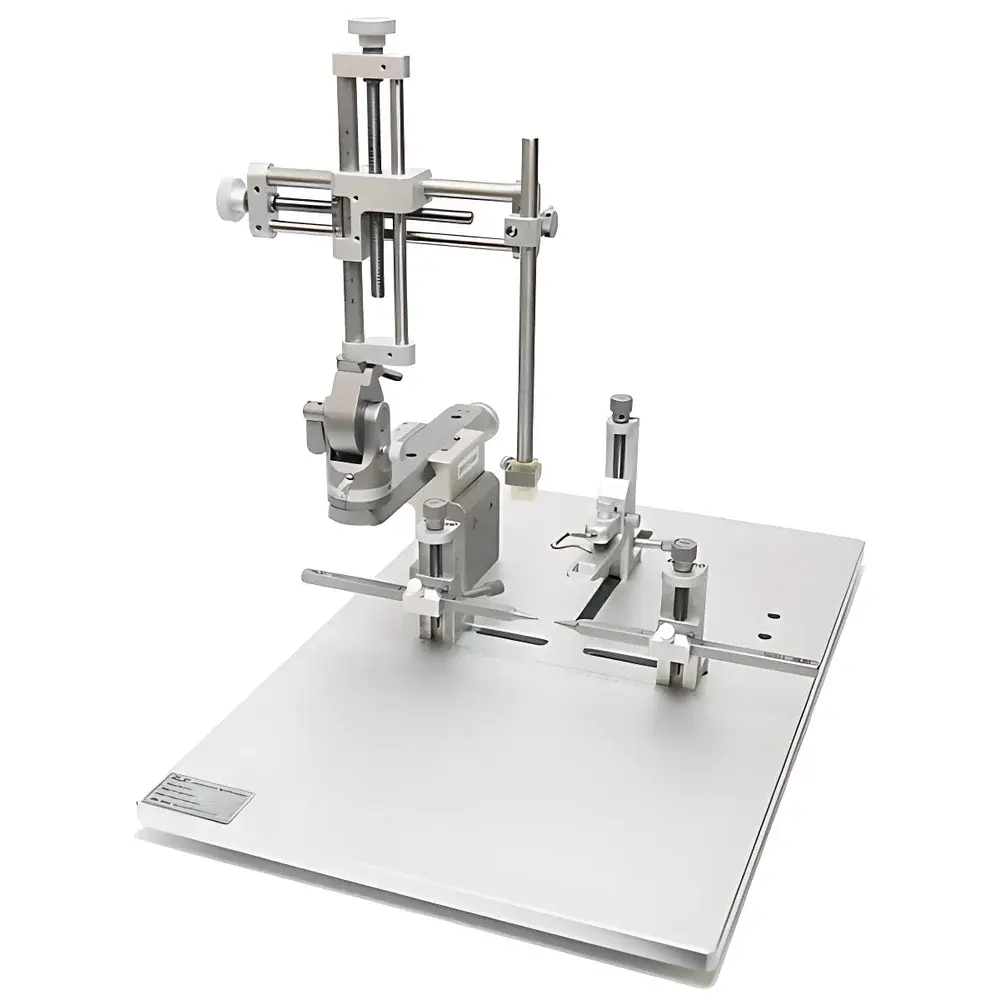
RWD Light-Duty Stereotaxic Instrument for Rodents (Rat & Mouse)
| Brand | RWD |
|---|---|
| Origin | Shenzhen, China |
| Manufacturer Type | Direct Manufacturer |
| Regional Classification | Domestic (China) |
| Model | Light-Duty |
| Price Range | USD 1,400 – 7,000 |
Overview
The RWD Light-Duty Stereotaxic Instrument for Rodents is an engineered precision platform designed to support consistent, reproducible intracranial interventions in preclinical neuroscience research. Based on the classical stereotaxic coordinate system—defined by bregma and lambda landmarks—the instrument enables accurate three-dimensional targeting of subcortical and cortical brain structures in rats and mice. Its mechanical architecture adheres to fundamental principles of stereotaxy: orthogonal motion control (anterior–posterior, medial–lateral, dorsal–ventral), rigid fixation of the animal’s skull via ear bars and incisor plate, and calibrated micrometric displacement with minimal backlash. Unlike high-throughput or MRI-guided systems, this instrument serves as a foundational benchtop tool for manual or pump-coupled procedures including microinjection, electrode implantation, optogenetic fiber placement, and cranial window surgery. It is not intended for human use and complies with standard laboratory biosafety and animal welfare protocols under IACUC- or AAALAC-aligned experimental design.
Key Features
- Universal base plate compatible with interchangeable adapters for rat, mouse, guinea pig, rabbit, cat, avian, and gecko models—enabling cross-species experimental flexibility without hardware replacement.
- Triaxial micromanipulator with ±80 mm travel range in X (medial–lateral), Y (anterior–posterior), and Z (dorsal–ventral) axes; vernier scale resolution of 0.1 mm ensures repeatable positioning under visual or microscopic guidance.
- Full 360° horizontal rotation and 180° vertical articulation of the manipulator arm, both lockable at arbitrary angles via dual independent locking mechanisms—separating vertical clamping from positional indexing to prevent torque-induced drift.
- Laser-etched metric scales integrated into an open U-shaped base structure improve parallax-free reading and accommodate auxiliary equipment such as stereomicroscopes, LED surgical lights, or pump manifolds.
- Dual-lead screw drive system minimizes play and hysteresis during fine adjustments, delivering smooth, stable motion across temperature ranges typical of vivarium environments (18–26°C).
- Extended base dimensions (400 × 255 mm) provide enhanced stability and spatial clearance for multi-instrument setups, including simultaneous use of cranial drills, microinjectors, and real-time imaging rigs.
- Ergonomically optimized刻度 components (scale markings) with matte-finish surface treatment reduce visual fatigue during prolonged sessions; U-frame and mounting plates undergo proprietary surface hardening to sustain long-term dimensional integrity and cleanability under ethanol or enzymatic decontamination.
Sample Compatibility & Compliance
The instrument supports standardized rodent head fixation using species-specific adapters: curved-head cradles ensure conformal contact with murine and rat calvaria, while spring-loaded ear bar clamps utilize a lever-actuated pressure plate mechanism—eliminating threaded knob fatigue and enabling rapid repositioning. All adapters comply with widely adopted stereotaxic atlases (e.g., Paxinos & Watson, Franklin & Paxinos) when used with appropriate bregma-based coordinate referencing. The system meets general requirements for GLP-compliant preclinical studies involving CNS-targeted delivery, though final validation must be performed per institutional SOPs. No electrical certification (e.g., CE, UL) is claimed, as the device is purely mechanical and non-powered.
Software & Data Management
This is a fully manual, analog stereotaxic instrument with no embedded electronics or firmware. Coordinate entry, trajectory planning, and procedural documentation are conducted externally using digital lab notebooks, spreadsheet-based calculation tools, or third-party stereotaxic planning software (e.g., Stereotaxic Atlas Viewer, Brain Explorer). Optional digital readout modules (models 68528/68529) integrate external linear encoders with USB or RS-232 interfaces, supporting timestamped position logging compatible with CSV export and basic LIMS integration. Audit trails, electronic signatures, or 21 CFR Part 11 compliance require supplementary software layers deployed at the institutional IT level—not provided by RWD.
Applications
- Intracerebral microinjection of viral vectors, tracers, or pharmacological agents in behavioral, neurodegenerative, or psychiatric disease models.
- Chronic implantation of bilateral or unilateral electrodes for electrophysiological recording (LFP, single-unit) or deep brain stimulation.
- Optical fiber cannula placement for in vivo photometry or optogenetics experiments requiring precise dorsoventral depth control.
- Craniotomy and cranial window installation for two-photon imaging, where stable skull immobilization and angular adjustability are critical.
- Validation of targeting accuracy in conjunction with post-hoc histology or MRI co-registration workflows.
FAQ
Is this instrument compatible with automated microinjection systems?
Yes—standardized mounting threads (M4 and 1/4″-20) allow secure integration with syringe pumps (e.g., WPI UltraMicroPump, KD Scientific Legato) and motorized manipulators via optional adapter brackets.
What calibration standards are recommended?
Users should perform daily mechanical zeroing using the provided alignment jig and verify repeatability via repeated positioning of a reference probe tip across three axes; NIST-traceable gauge blocks may be used for annual verification.
Can the base plate be sterilized?
The anodized aluminum base and hardened steel components tolerate autoclaving at 121°C for 20 minutes; however, polymer adapters (e.g., mouse cradle) require low-temperature sterilization (e.g., hydrogen peroxide plasma or 70% ethanol immersion).
Does RWD supply stereotaxic atlases or coordinate templates?
No—RWD provides mechanical specifications only. Users must source validated coordinate frameworks from peer-reviewed atlases or institutional neuroanatomy resources.
Are replacement parts available globally?
Yes—standardized adapters (Cat. #68087, #68088), base plates (68867S/D), and manipulator assemblies are stocked by authorized RWD distributors in North America, EU, and APAC regions with lead times under 4 weeks.




