
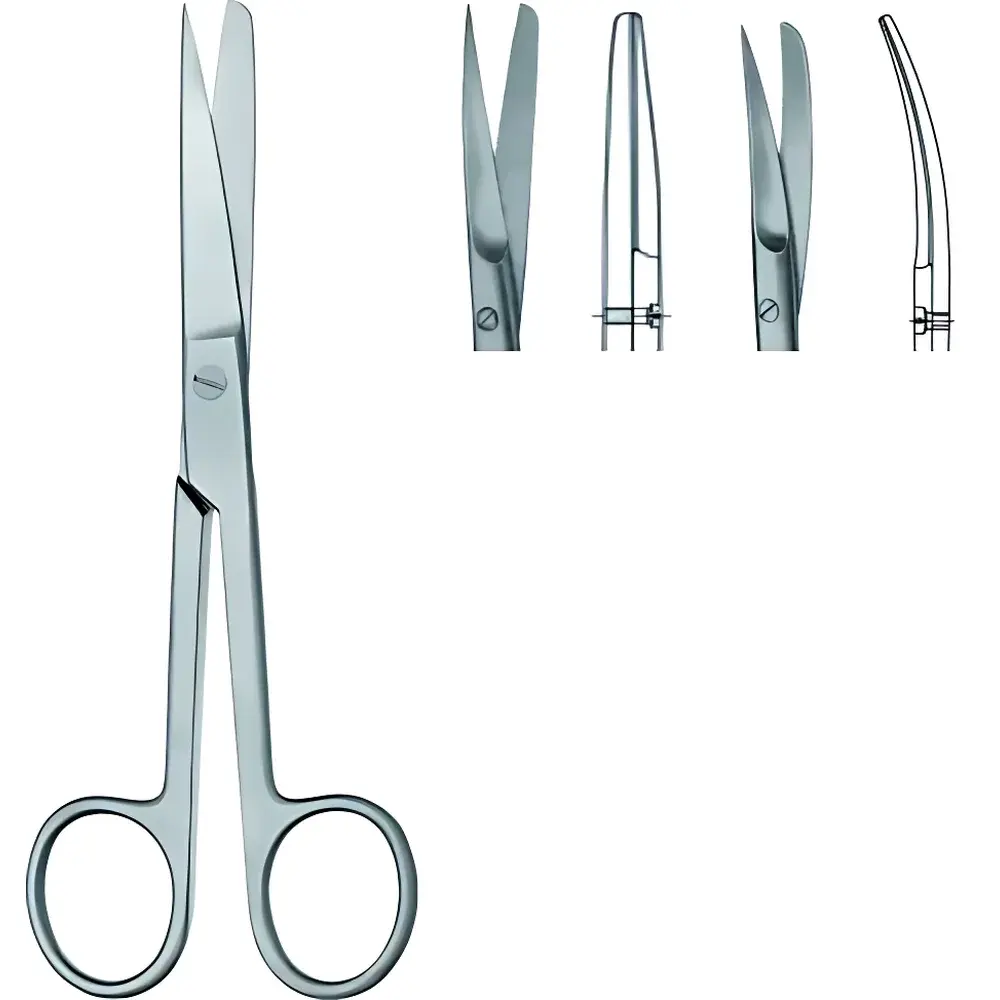
RWD S14005-13 & S14006-13 Straight and Curved Surgical Scissors
| Brand | RWD |
|---|---|
| Origin | Shenzhen, China |
| Manufacturer Type | Direct Manufacturer |
| Country of Origin | China |
| Model Numbers | S14005-13 (Straight), S14006-13 (Curved) |
| Length | 13 cm |
| Tip Configuration | Sharp/Blunt (Serrated) |
| Pricing | Available Upon Request |
Overview
The RWD S14005-13 and S14006-13 surgical scissors are precision-engineered stainless steel instruments designed for controlled tissue dissection, suture trimming, and delicate manipulation in both open and minimally invasive procedures. The S14005-13 features a straight blade configuration optimized for linear cutting tasks requiring direct line-of-sight access, while the S14006-13 incorporates a 13-mm radius curvature in the distal third of the blades—enabling improved visibility and maneuverability around anatomical structures without repositioning the instrument or disrupting surgical field integrity. Both models operate on a double-action, scissor-style pivot mechanism with hardened stainless steel (AISI 420 or equivalent) construction, ensuring consistent edge retention, corrosion resistance, and compatibility with standard hospital sterilization protocols including steam autoclaving (134 °C, 3 bar), ethylene oxide, and low-temperature hydrogen peroxide plasma.
Key Features
- 13 cm overall length provides ergonomic balance between control and reach for medium-depth surgical fields.
- Dual-tip design: each pair includes one sharp-pointed blade and one blunt-tipped (serrated) blade—reducing unintended puncture risk during tissue separation while maintaining cutting efficiency.
- Micron-level surface finish (Ra ≤ 0.4 µm) on cutting edges ensures smooth tissue glide and minimizes micro-tearing during shearing.
- Electropolished finish enhances passive oxide layer formation, improving resistance to pitting and crevice corrosion in saline-rich biological environments.
- Precision-machined tungsten carbide inserts optional upon request for extended edge life in high-volume laboratory or training settings.
- Autoclavable up to 2000 cycles under validated Class B vacuum-assisted steam sterilization conditions (EN ISO 17664, EN 285).
Sample Compatibility & Compliance
These scissors are intended for use with human and animal soft tissues—including fascia, muscle, peritoneum, and vascular structures—as well as synthetic suture materials (polypropylene, nylon, polyester, absorbable monofilaments). They comply with ISO 7153-1:2016 (Surgical Instruments — Metallic Materials — Part 1: Stainless Steels) and meet biocompatibility requirements per ISO 10993-1 for short-term mucosal contact (Category 12). Device labeling adheres to UDI requirements under China NMPA Regulation No. 226 and is CE-marked under MDR 2017/745 Annex I essential requirements for Class I non-sterile, reusable surgical instruments. Sterilization validation documentation is available upon request for GMP-compliant facilities.
Software & Data Management
As manually operated mechanical instruments, the S14005-13 and S14006-13 do not incorporate embedded electronics or software interfaces. However, their standardized dimensions, material traceability (batch-coded etching), and sterilization-cycle logging compatibility support integration into digital instrument tracking systems compliant with ISO 13485:2016 and FDA 21 CFR Part 820. Each unit carries a permanent laser-etched identifier enabling audit-ready reconciliation in central sterile supply departments (CSSD) using barcode or RFID-based inventory platforms.
Applications
- General surgery: layer-by-layer dissection during laparotomy, wound debridement, and hernia repair.
- Neurosurgery: dural opening and arachnoid membrane separation where tactile feedback and tip control are critical.
- Veterinary clinical practice: orthopedic soft-tissue release and dental flap elevation in canine/feline procedures.
- Academic research labs: precise excision of murine tissue specimens for histopathology or organotypic culture preparation.
- Medical device training simulators: included in standardized suture kits for OSCE and ACS-approved skills assessment modules.
FAQ
Are these scissors certified for use in sterile human surgical procedures?
Yes—when processed according to validated sterilization parameters and handled under aseptic technique, they meet requirements for reuse in Class I surgical applications per ISO 15883 and AAMI ST79.
What is the recommended maintenance protocol between uses?
After each use, rinse immediately in warm water with neutral pH detergent; ultrasonically clean for 5–10 minutes; inspect visually and under magnification for blade alignment and edge integrity; lubricate pivot point with medical-grade mineral oil before sterilization.
Can replacement parts be ordered separately?
No—the instruments are manufactured as single-piece forged units; blade resharpening is not supported due to metallurgical constraints. Replacement is recommended after 500+ sterilization cycles or upon detection of visible wear or misalignment.
Is technical documentation available in English for regulatory submissions?
Yes—full IFU, Declaration of Conformity, material certifications (MTR), and sterilization validation summaries are provided in English upon formal request through RWD’s international regulatory affairs department.




