
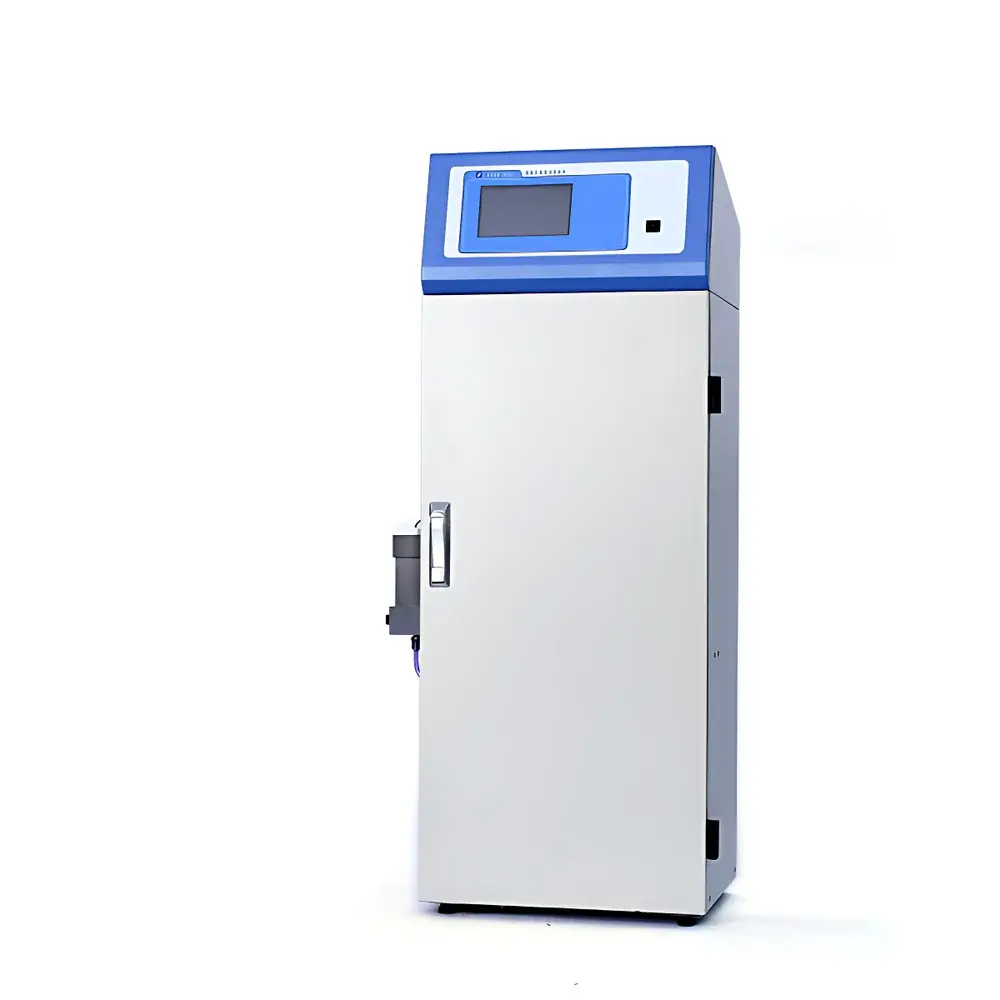
SAIL HERO XHAN-91 Online Ammonia Nitrogen Analyzer
| Brand | SAIL HERO |
|---|---|
| Origin | Hebei, China |
| Manufacturer Type | Manufacturer |
| Country of Origin | Domestic (China) |
| Model | XHAN-91 |
| Price Range | USD 21,000 – 28,000 (FOB) |
| Instrument Type | Online Analyzer |
| Measurement Principle | Colorimetric Method (Nesslerization or Salicylate, compliant with ISO 7150-1 & HJ 1002-2018) |
| Measurement Range | 0.1–80 mg/L NH₃–N (extendable via dilution module) |
| Detection Limit | 0.005 mg/L NH₃–N |
| Cycle Time | 40–60 minutes per analysis |
| Temperature Control Accuracy | ±0.1 °C |
| Reagent Consumption | <100 µL per measurement |
| Flow System | Zero-dead-volume sequential injection manifold |
| Calibration | Auto-range switching without standard solution replacement |
| Data Integrity | Built-in audit trail, event logging, and power-loss recovery |
Overview
The SAIL HERO XHAN-91 Online Ammonia Nitrogen Analyzer is an industrial-grade, fully automated water quality monitoring system engineered for continuous, unattended quantification of ammonia nitrogen (NH₃–N) in diverse aqueous matrices. It operates on the colorimetric principle—specifically optimized for either Nesslerization (for low-turbidity samples) or the salicylate-hypochlorite method (for higher interference tolerance)—in strict alignment with internationally recognized protocols including ISO 7150-1:1984 and China’s HJ 1002–2018 standard for online ammonia nitrogen monitoring. Designed for deployment in municipal drinking water treatment plants, wastewater reclamation facilities, surface water surveillance networks, groundwater observation wells, and industrial effluent discharge points, the XHAN-91 delivers laboratory-grade accuracy under field-operational constraints. Its core architecture integrates a zero-dead-volume sequential injection fluidic platform, enabling precise metering, minimal reagent carryover, and high inter-run reproducibility—critical for long-term regulatory compliance reporting.
Key Features
- Sequential injection manifold with <1 µL volumetric resolution and zero dead volume—ensuring minimal cross-contamination and high repeatability across extended operational cycles.
- Digital PID temperature control system maintaining reaction cuvette temperature within ±0.1 °C, essential for stabilizing chromophore formation kinetics in colorimetric assays.
- Ultra-low reagent consumption: average usage ≤100 µL per analysis—approximately one-tenth that of conventional flow-injection systems—reducing operational cost and hazardous waste generation.
- Multi-mode operation: supports continuous monitoring, programmable interval sampling (1–24 h), external TTL-triggered acquisition, remote command execution via Modbus TCP/RTU, and manual override.
- Intelligent calibration management: automatic range-switching between low/mid/high sub-ranges without physical standard solution replacement—minimizing operator intervention and consumables logistics.
- Comprehensive fault resilience: integrated dry-run protection, low-water-flow detection, power-fail data retention (non-volatile memory), and auto-resume functionality upon utility restoration.
- Real-time analytical validation: onboard standard reference material (SRM) verification cycle, scheduled at user-defined intervals, to confirm instrument response drift and measurement traceability.
Sample Compatibility & Compliance
The XHAN-91 accepts raw, filtered (≤80 µm), or pre-sedimented water samples with turbidity ≤100 NTU and suspended solids ≤150 mg/L. It has been validated for use with groundwater, river/lake surface water, potable water post-chlorination, domestic sewage influent/effluent, and selected industrial discharges (e.g., food processing, pharmaceutical manufacturing). All wetted components comply with USP Class VI biocompatibility and EN 14350-1 chemical resistance standards. The analyzer meets China’s HJ 353–2019 technical specification for water pollution source online monitoring instruments and supports data export formats compatible with national environmental monitoring platforms (e.g., MEP’s National Water Quality Monitoring System). Optional 21 CFR Part 11-compliant software modules are available for GMP-regulated pharmaceutical or biotech applications requiring electronic signatures and audit trails.
Software & Data Management
Embedded Linux-based firmware provides local web interface (HTTPS-enabled) for configuration, diagnostics, and real-time chromatogram-like absorbance curve visualization. Raw spectral data (340–660 nm), temperature logs, reagent pressure profiles, and event timestamps are stored internally for ≥90 days. Data export supports CSV, XML, and Modbus TCP mapping to SCADA, DCS, or LIMS environments. Remote firmware updates and parameter push are supported via secure SSH tunneling. All critical events—including calibration failures, reagent depletion warnings, optical path contamination alerts, and temperature excursions—are logged with ISO 8601 timestamps and retained for GLP/GMP audit readiness.
Applications
- Regulatory compliance monitoring at wastewater treatment plant discharge outfalls per local environmental protection bureau requirements.
- Early-warning detection of ammonia breakthrough in granular activated carbon (GAC) or ion-exchange polishing units within drinking water distribution systems.
- Process control feedback in aquaculture recirculating systems where NH₃–N concentration directly correlates with fish health metrics.
- Long-term trend analysis of nutrient loading in watershed-scale surface water quality networks.
- Supporting ISO/IEC 17025-accredited laboratories performing matrix-matched method validation for ammonia nitrogen in complex effluents.
FAQ
What sample pretreatment is required prior to analysis?
Minimal pretreatment is needed: samples must be homogenized and passed through an 80-µm filter to prevent particulate clogging. No acidification or distillation is required for typical applications.
Can the XHAN-91 interface with existing SCADA systems?
Yes—it supports native Modbus RTU (RS-485) and Modbus TCP/IP protocols with configurable register mapping for seamless integration into industrial automation infrastructures.
How often does the system require maintenance?
Routine maintenance includes quarterly optical window cleaning, biannual pump tube replacement, and annual photometer wavelength verification—typically totaling <2 hours per quarter.
Is remote diagnostic support available?
SAIL HERO provides cloud-connected remote diagnostics (opt-in) with encrypted session handshaking, enabling firmware-level troubleshooting and predictive component life estimation.
Does the analyzer meet international metrological traceability requirements?
Yes—each unit ships with NIST-traceable photometric verification certificate and factory calibration against CRM-certified ammonia standards (NIST SRM 2194 or equivalent).
Related Products







