
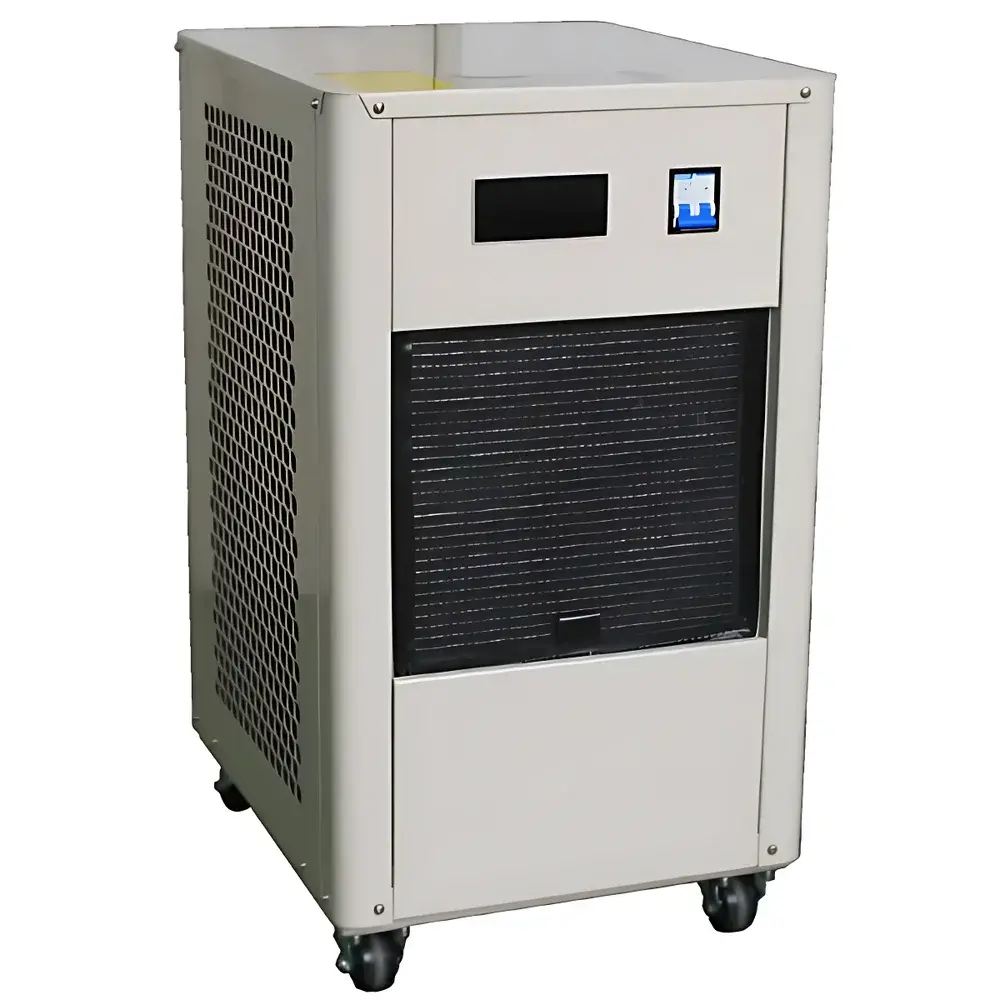
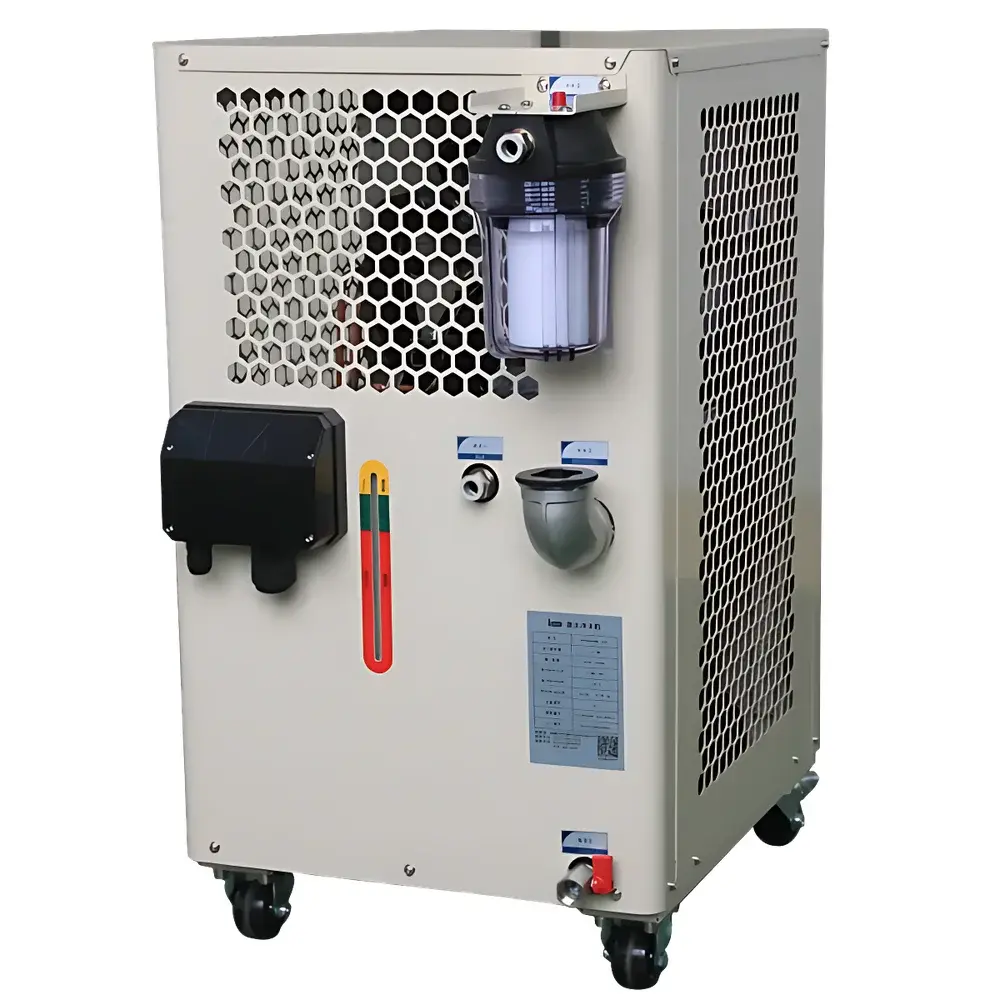
Saintins SY-1600S High-Precision Air-Cooled Circulating Chiller
| Brand | Saintins |
|---|---|
| Origin | Jiangsu, China |
| Manufacturer Type | Direct Manufacturer |
| Equipment Type | Integrated Unit |
| Cooling Method | Air-Cooled |
| Temperature Control Range | 8–30 °C |
| Cooling Capacity | 1600 W |
| Temperature Stability | ±0.1 °C |
| Circulation Pump Pressure | 3.60 bar |
| Circulation Flow Rate | 32 L/min |
| Reservoir Volume | 12 L |
| Operating Mode | Continuous |
| Power Supply | 220 V~, 50 Hz |
| Refrigerant | R410a |
| Communication Interface | RS485 |
| Max. Input Power | 1630 W |
| Max. Current Draw | 7.4 A |
| Heating Power | 500 W |
| Pump Head | 36 m |
| Inlet/Outlet Fitting | 4-mm BSP male thread to 12-mm quick-connect |
| Flow Protection Threshold | ≤1.5 L/min |
| Filtration | 5-inch deionized water filter |
| Net Weight | 45 kg |
| Dimensions (L×W×H) | 433×600×764 mm |
Overview
The Saintins SY-1600S is an integrated, air-cooled circulating chiller engineered for high-stability thermal management in laboratory and light industrial environments. It operates on a vapor-compression refrigeration cycle using R410a—a zero-ozone-depletion-potential (zero-ODP), low-global-warming-potential (GWP) refrigerant compliant with current EU F-Gas Regulation and EPA SNAP guidelines. The unit delivers precise, continuous cooling of process fluids—typically deionized water or water-glycol mixtures—at flow rates up to 32 L/min and pressures up to 3.60 bar, maintaining setpoint temperatures within ±0.1 °C across its operational range of 8–30 °C. Its closed-loop architecture eliminates dependency on municipal water supply, mitigating risks associated with fluctuating inlet temperature, pressure, and water quality—critical for sensitive analytical instrumentation requiring long-duration thermal stability.
Key Features
- Integrated design with compact footprint (433 × 600 × 764 mm) optimized for benchtop or under-bench installation in ISO Class 5–7 lab spaces;
- Dual-mode temperature control: PID-regulated refrigeration combined with optional 500 W electric heating for bidirectional thermal setpoint adjustment;
- High-efficiency scroll compressor paired with copper-aluminum finned condenser and microchannel evaporator for consistent heat rejection at ambient temperatures ≤40 °C;
- Stainless-steel reservoir (12 L capacity) with level sensor, leak-detection circuitry, and integrated 5-inch deionized water filtration to protect downstream equipment from particulate and ionic contamination;
- RS485 serial interface supporting Modbus RTU protocol for integration into centralized building management systems (BMS) or LIMS-controlled lab environments;
- Real-time monitoring of critical parameters—including flow rate, outlet temperature, compressor discharge pressure, and reservoir level—via onboard LCD display with password-protected configuration menu.
Sample Compatibility & Compliance
The SY-1600S is compatible with standard aqueous coolants meeting ASTM D1121 (coolant corrosion test) and ASTM D3306 (automotive antifreeze specifications) when diluted per manufacturer guidance. Its fluid path materials—EPDM seals, stainless-steel reservoir, and brass fittings—are chemically inert toward water, 20–30% ethylene glycol, and common laboratory-grade corrosion inhibitors. The unit complies with IEC 61000-6-3 (EMC emission limits) and IEC 61000-6-2 (immunity requirements), and meets CE marking directives for electrical safety (IEC 61010-1). While not certified for use in classified hazardous locations (e.g., ATEX Zone 1), it is suitable for general-purpose laboratories operating under GLP and ISO/IEC 17025 frameworks where documented temperature traceability and system validation are required.
Software & Data Management
The chiller supports remote parameter logging via RS485-to-USB gateway and third-party SCADA platforms (e.g., Ignition, LabVIEW, or Siemens Desigo CC). All temperature setpoints, alarm events (low-flow, high-temp, compressor fault), and runtime statistics are timestamped and stored in non-volatile memory with configurable retention (default: 30 days). Audit trails include operator ID (via optional RFID login module), parameter change history, and firmware revision logs—enabling compliance with FDA 21 CFR Part 11 requirements when deployed in regulated pharmaceutical or biotech QC/QA labs. Exportable CSV reports facilitate trend analysis of thermal performance against instrument uptime metrics or environmental chamber correlation studies.
Applications
- Analytical Instrument Cooling: Stable thermal loading for NMR spectrometers (cryoprobes), SEM/TEM column chillers, XRD goniometers, and high-resolution mass spectrometers requiring sub-0.2 °C thermal drift over >8-hour acquisition windows;
- Chemical Synthesis Support: Precise jacket temperature control for glass reactors, rotary evaporators (up to 5 L scale), and crystallization vessels during exothermic or endothermic batch processes;
- Laser System Thermal Management: Heat extraction from CO₂ laser tubes, fiber laser diode stacks, and ultrafast amplifier pump sources where optical alignment stability depends on <±0.3 °C coolant temperature;
- Materials Testing: Integration with universal testing machines (UTMs), dynamic mechanical analyzers (DMA), and differential scanning calorimeters (DSC) for isothermal conditioning of specimens prior to mechanical or thermal characterization;
- Pharmaceutical Process Validation: Use as a qualified utility in API synthesis suites and lyophilizer condenser cooling loops where temperature deviation must be recorded and justified per ICH Q5C and USP guidelines.
FAQ
What is the minimum allowable coolant flow rate before the unit triggers protective shutdown?
The built-in flow sensor initiates automatic pump stop and alarm if measured flow falls below 1.5 L/min for more than 10 seconds—preventing dry-run damage to the circulation pump and ensuring safe operation with narrow-bore tubing or high-backpressure applications.
Can the SY-1600S maintain 8 °C output temperature in a 35 °C ambient environment?
Yes—tested performance data confirms full-rated 1600 W cooling capacity at ambient ≤40 °C and setpoint ≥8 °C, provided adequate ventilation (≥300 mm clearance on all sides) and unrestricted airflow across the condenser fins.
Is the RS485 interface compatible with LabVIEW and MATLAB?
Yes—the Modbus RTU implementation follows standard function codes (03h Read Holding Registers, 06h Write Single Register) and includes register mapping documentation for seamless integration with NI LabVIEW’s Modbus I/O library or MATLAB’s Instrument Control Toolbox.
Does the unit support external temperature feedback from a user-installed probe?
No—the SY-1600S relies exclusively on its factory-calibrated Pt100 sensor embedded in the outlet manifold; external loop feedback is not supported in firmware v2.4.1 and later.
What maintenance intervals are recommended for optimal long-term reliability?
Compressor oil inspection every 24 months; condenser coil cleaning every 6 months in dust-prone environments; filter cartridge replacement every 12 months or after 2000 operating hours—whichever occurs first.



