
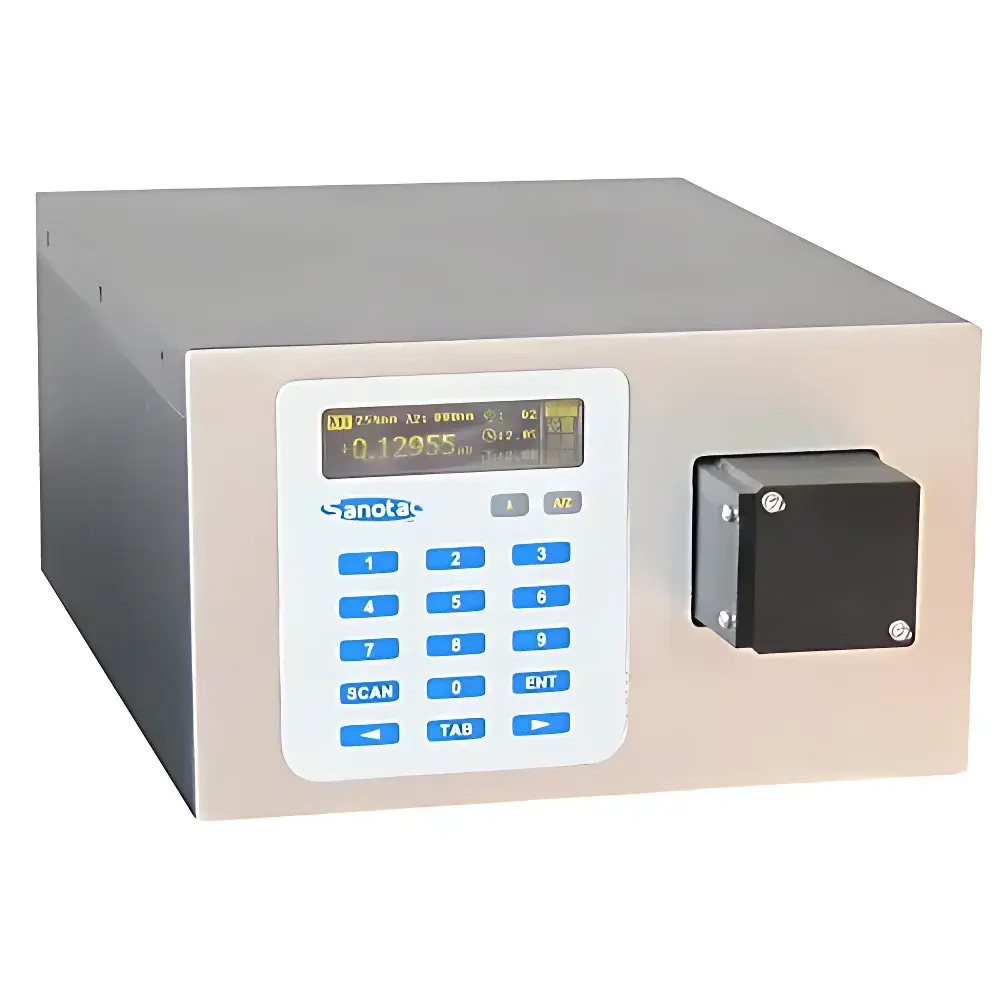
Sanotac B1000 Nucleic Acid & Protein UV Detector for Chromatography Systems
| Brand | Sanotac |
|---|---|
| Origin | Shanghai, China |
| Manufacturer Type | Manufacturer |
| Product Category | Domestic |
| Model | B1000 |
| Price Range | USD 1,400–2,800 |
| Optical Design | Dual-Beam |
| Detector Type | Photomultiplier Tube (PMT) |
| Wavelength Range | 190–700 nm |
| Wavelength Automation | Automatic |
| Spectral Bandwidth | <5 nm |
| Wavelength Accuracy | ±1 nm |
| Stray Light | ≤0.2% |
Overview
The Sanotac B1000 Nucleic Acid & Protein UV Detector is a high-stability, dual-beam ultraviolet-visible absorbance detector engineered for integration into medium-pressure liquid chromatography (MPLC) and protein purification systems. It operates on the fundamental principle of Beer–Lambert law-based UV absorption spectroscopy, enabling quantitative and qualitative analysis of biomolecules—including proteins, nucleic acids, peptides, and enzymes—that exhibit characteristic absorbance at 254 nm (nucleic acids), 280 nm (aromatic amino acids), and other wavelengths across the 190–700 nm range. Designed specifically for chromatographic workflows, the B1000 delivers real-time, high-fidelity absorbance monitoring with minimal baseline drift and low electronic noise—critical for reproducible peak integration, fraction collection triggering, and method transfer across laboratory environments. Its optical architecture employs a dual-lamp source (deuterium lamp for UV, tungsten-halogen lamp for visible), automatic lamp switching, and precision PMT detection to ensure broad spectral coverage and long-term photometric stability.
Key Features
- Dual-beam optical path design with real-time reference compensation, minimizing thermal and mechanical drift effects during extended runs.
- Automated wavelength calibration and three scanning modes (full-spectrum, fixed-wavelength, dual-wavelength) supporting simultaneous monitoring of primary analytes and co-eluting impurities.
- Adjustable flow cell pathlength (1–5 mm), compatible with analytical (1/16″), semi-preparative (1/16″), and preparative (1/8″) chromatographic configurations without flow splitting.
- Low-noise electronics: baseline noise ≤±5×10⁻⁵ AU at 254 nm (1 s time constant); baseline drift ≤1.5×10⁻⁴ AU/h at 254 nm—meeting ICH Q2(R2) sensitivity expectations for trace-level detection in purification QC.
- Integrated digital zeroing, 10 user-defined methods, and configurable time constants (0.1–10.0 s) for optimized signal-to-noise ratio across varying flow rates and column dimensions.
- Self-illuminating 256×64-pixel LCD display with uniform contrast across viewing angles and adjustable backlight—enabling operation in ambient-lit or darkroom conditions typical of cold rooms and biosafety cabinets.
Sample Compatibility & Compliance
The B1000 is validated for use with aqueous and organic-aqueous mobile phases common in ion-exchange, size-exclusion (SEC/GPC), affinity, and reversed-phase chromatography. It supports direct coupling to glass or stainless-steel columns (including Bio-Lot and other third-party systems), SPE cartridges, and inline conductivity detectors. All hardware and firmware comply with electromagnetic compatibility (EMC) standards per IEC 61326-1. The system meets regulatory requirements for data integrity under FDA 21 CFR Part 11 and CFDA GxP guidelines, including role-based user authentication, electronic signatures, immutable audit trails, and secure database-driven project management for instrument methods, chromatograms, and processing parameters.
Software & Data Management
Control and data acquisition are performed via Windows-compatible PC software (Windows 7/8/10/11) using USB 2.0 and RS-232 interfaces. The software implements an open communication protocol compliant with ASTM E1381 and EU Annex 11 principles, allowing seamless integration with third-party pump controllers, fraction collectors, and LIMS platforms. All chromatographic data—including raw absorbance traces, integrated peak areas, retention times, and calibration curves—are stored in encrypted SQLite databases with timestamped metadata. Audit trail records capture operator identity, parameter changes, method execution, and data export events—fully traceable for GLP/GMP audits and regulatory submissions.
Applications
- Monitoring elution profiles during protein purification (e.g., His-tagged protein isolation via Ni-NTA affinity chromatography).
- Quantifying DNA/RNA yield and purity (A260/A280 ratios) in oligonucleotide synthesis and plasmid purification workflows.
- Tracking degradation products and aggregates in monoclonal antibody SEC analysis.
- Validating gradient formation and column equilibration in method development for biopharmaceutical intermediates.
- Supporting academic research in molecular biology labs conducting CRISPR guide RNA purification or viral capsid assembly studies.
- Enabling quality control testing in food safety labs analyzing mycotoxin-bound proteins or allergenic epitopes.
FAQ
What is the minimum detectable absorbance change under standard operating conditions?
The detector achieves a signal-to-noise ratio (S/N) ≥3 at 254 nm with 1 s time constant, corresponding to ~1×10⁻⁵ AU resolution for stable baselines.
Can the B1000 be used with high-salt mobile phases commonly employed in ion-exchange chromatography?
Yes—the flow cell is constructed from chemically resistant quartz and stainless steel; routine flushing with water/methanol post-run prevents salt crystallization and maintains optical clarity.
Is remote monitoring or network-based control supported?
While native Ethernet is not included, the RS-232/USB interface enables integration into local area networks via serial-to-Ethernet converters compliant with Modbus RTU protocols.
Does the system support GLP-compliant electronic lab notebook (ELN) export?
Yes—chromatogram data (in .csv and .cdf formats) and audit logs can be exported with embedded metadata, supporting import into validated ELN platforms such as LabArchives or IDBS E-WorkBook.
How frequently must the deuterium lamp be replaced under continuous usage?
Typical lamp lifetime exceeds 1,500 hours; the software provides lamp usage tracking and alerts at 90% end-of-life threshold to ensure uninterrupted compliance with calibration schedules.






