
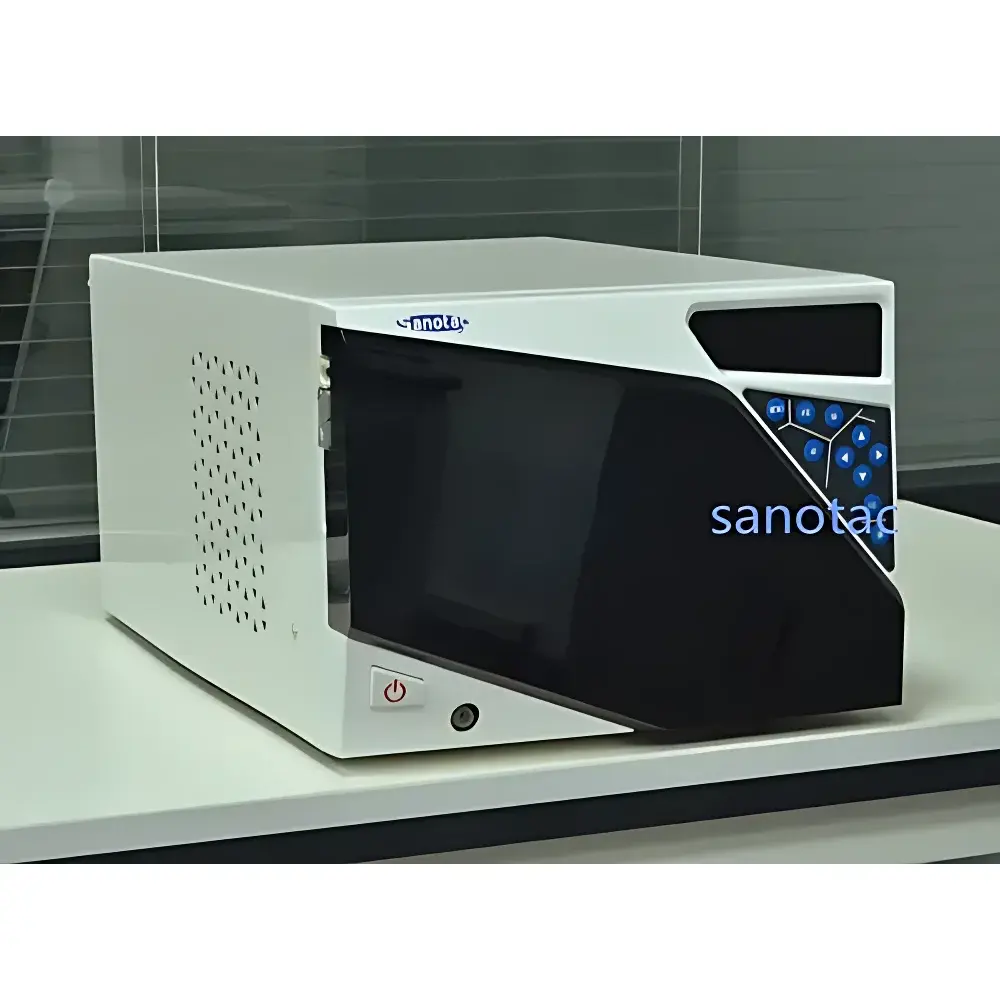
Sanotac ELSD9000 Evaporative Light Scattering Detector
| Brand | Sanotac |
|---|---|
| Origin | Shanghai, China |
| Manufacturer Type | OEM Manufacturer |
| Product Category | Domestic |
| Model | ELSD9000 |
| Price Range | USD 7,000–14,000 |
| Instrument Type | Conventional HPLC-Compatible Detector |
| Flow Rate Range | 0.01–3 mL/min |
| Max Operating Pressure | 1 bar |
| Sample Injection Port | Single-channel |
| Injection Volume Range | Not applicable (flow-through detector) |
| Temperature Control Range | Ambient to 150 °C (1 °C step resolution) |
| Light Source | 650 nm, 30 mW laser diode |
| Data Acquisition Rate | 20 Hz (digital output), 100 Hz (internal sampling) |
Overview
The Sanotac ELSD9000 is a high-performance evaporative light scattering detector engineered for universal detection in liquid chromatography systems—particularly reversed-phase, normal-phase, and HILIC separations where analytes lack chromophores or UV absorbance. It operates on the principle of nebulization, solvent evaporation, and light scattering measurement: the column effluent is pneumatically nebulized into fine droplets, passed through a heated drift tube to remove volatile mobile phase components, and the resulting non-volatile analyte particles are illuminated by a stable 650 nm laser beam. Scattered light intensity—proportional to analyte mass—is captured by a photomultiplier tube (PMT) with high quantum efficiency. Unlike UV-Vis detectors, the ELSD9000 delivers near-uniform response across diverse compound classes—including lipids, carbohydrates, surfactants, polymers, and natural products—without requiring structural chromophores or derivatization.
Key Features
- Optimized optical architecture with low-noise PMT and collimated 30 mW laser source, achieving baseline noise ≤ 0.01 mV and drift ≤ 0.2 mV/30 min
- Independent dual-zone temperature control: drift tube (ambient to 150 °C, ±1 °C accuracy) and nebulizer (ambient to 56 °C, ±1 °C accuracy), enabling precise method transfer and robustness across solvent gradients
- Heated nebulizer tip with adjustable spray angle—enhances雾化 efficiency for viscous or oily samples and minimizes clogging
- Rapid thermal recovery: drift tube cooling rate ≥ 8 °C/min, supporting rapid method switching without thermal equilibration delays
- Integrated mass flow controller for carrier gas (clean air or nitrogen, 2–5 bar; flow accuracy ±0.02 L/min), ensuring reproducible aerosol generation
- 16-point automated self-diagnostic routine covering gas pressure, heater status, laser emission, PMT gain, and safety interlocks
- Programmable external event interface for synchronization with autosamplers, fraction collectors, or auxiliary modules
Sample Compatibility & Compliance
The ELSD9000 is compatible with all standard HPLC and UHPLC systems operating within 0.01–3 mL/min flow range and ≤1 bar backpressure. It supports gradient elution with acetonitrile, methanol, THF, chloroform, and aqueous buffers containing up to 0.1% TFA or formic acid. No mobile phase restrictions apply beyond volatility requirements—non-volatile salts must be minimized to prevent drift tube fouling. The instrument complies with CE Directive 2014/30/EU (EMC) and 2014/35/EU (LVD). Its hardware and Clarity™ software stack meet FDA 21 CFR Part 11 requirements for electronic records and signatures, including full audit trail logging, user access controls, electronic signatures, and data integrity safeguards aligned with ALCOA+ principles. System validation documentation supports GLP and GMP environments per ICH Q2(R2) and USP .
Software & Data Management
The ELSD9000 integrates natively via RS-232, RS-485, USB, or TCP/IP (HTTP/LAN) into third-party chromatography data systems (CDS), including Waters Empower, Thermo Chromeleon, Agilent OpenLab, and Shimadzu LabSolutions. Its native Clarity™ SDK provides dynamic-link library (DLL) support for custom CDS integration and real-time parameter control. Method storage accommodates 10 predefined methods (25 parameters each), with automatic recall triggered by sequence events. All operational parameters—including temperature setpoints, gain, offset, zero calibration, and gas flow—are logged with timestamps and user IDs. Raw analog output (±1200 mV) and digital data streams (20 Hz) are simultaneously available, enabling parallel acquisition with legacy integrators or modern DAQ systems. Audit trails record every configuration change, calibration event, and alarm condition with immutable metadata.
Applications
The ELSD9000 is routinely deployed in pharmaceutical QC for assay of excipients (e.g., polysorbates, PEGs), lipid-based drug products, and non-UV-absorbing impurities. In food and beverage analysis, it quantifies sucrose esters, glycerides, and oligosaccharides without derivatization. Natural product labs use it for fingerprinting saponins, triterpenoids, and flavonoid glycosides in herbal extracts. Polymer characterization includes molecular weight distribution of PEO/PPO copolymers and residual monomer analysis. Its linear dynamic range of 10⁴ (at fixed gain) and sub-nanogram detection limit (0.5 ng on-column for typical standards) make it suitable for semi-quantitative screening and validated quantitative workflows alike.
FAQ
Does the ELSD9000 require post-column derivatization or UV-active groups?
No. It detects non-volatile analytes based on light scattering after solvent evaporation—no chromophore or derivatization is needed.
Can it be used with gradient elution containing high water content?
Yes, provided the drift tube temperature is optimized to ensure complete solvent removal; water-rich gradients may require higher drift tube temperatures (≥120 °C) and stable gas flow.
Is the laser output adjustable or replaceable in the field?
The 650 nm laser module is factory-aligned and sealed; output power is fixed at 30 mW and not user-adjustable, but field-replaceable under service contract.
How does the system prevent solvent condensation in the detection chamber?
By maintaining strict thermal zoning: the nebulizer zone is heated independently to prevent premature condensation, while the drift tube wall temperature exceeds the dew point of all common mobile phases.
What validation documentation is provided for regulated laboratories?
IQ/OQ protocols, traceable calibration certificates for temperature sensors and gas flow meter, and 21 CFR Part 11 compliance reports are included with purchase.





