
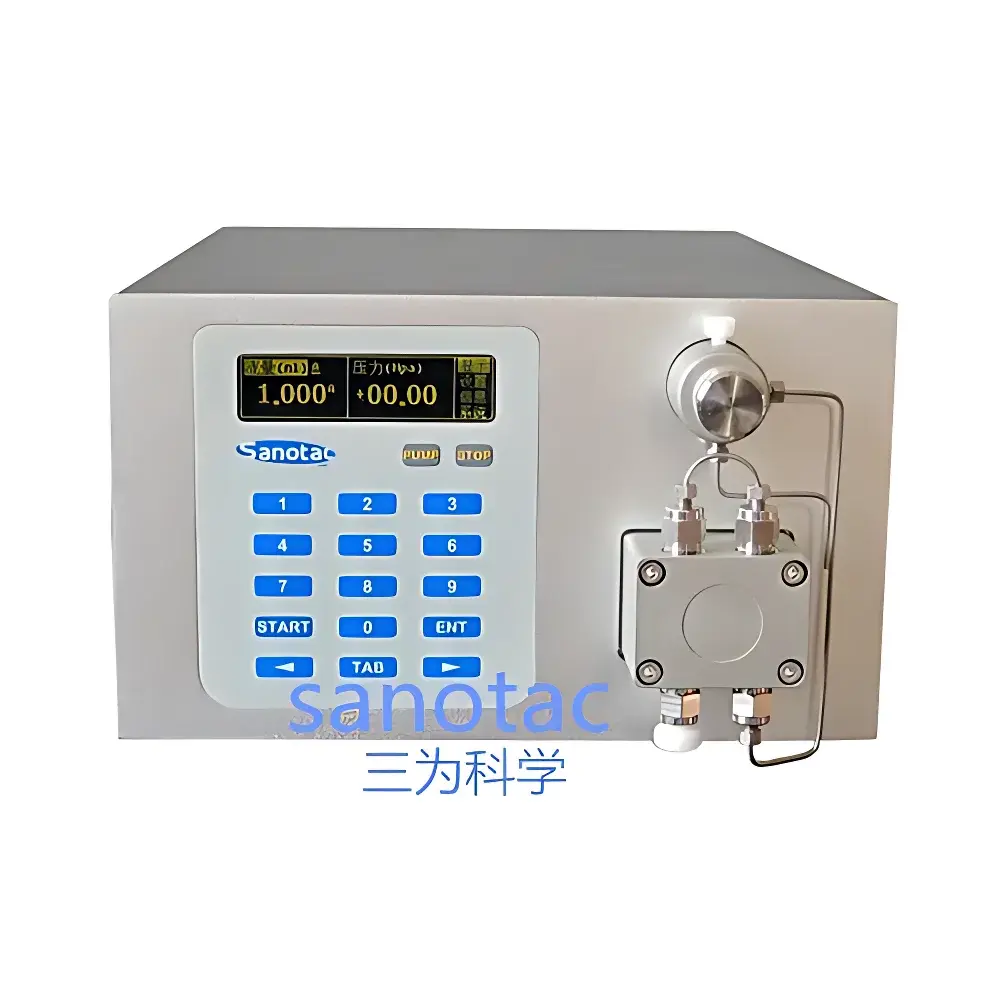
Sanotac HP0530 High-Pressure Constant Flow Pump (50 mL/min, 30 MPa)
| Brand | Sanotac |
|---|---|
| Origin | Shanghai, China |
| Manufacturer Type | Direct Manufacturer |
| Model | HP0530 |
| Flow Rate | 0.01–50.00 mL/min |
| Pressure Range | ≤ 30 MPa |
| Flow Accuracy | ±0.5% |
| Flow Precision | ≤ 0.1% RSD |
| Pressure Pulsation | ≤ 0.2 MPa |
| Fluidic Path Materials | 316L Stainless Steel, Sapphire, PTFE, Ceramic |
| Connection | 1/16" Standard Fittings |
| Display | 256×64 Dot Matrix Backlit LCD |
| Control | Front Panel or RS232/Ethernet Remote Control (Open Protocol) |
| Power Supply | 85–264 VAC, 50 Hz |
| Dimensions | 370 × 240 × 152 mm |
Overview
The Sanotac HP0530 is a high-performance, microprocessor-controlled high-pressure constant flow pump engineered for precision fluid delivery in demanding laboratory and pilot-scale applications. It operates on a dual-piston parallel pumping principle with floating piston design—minimizing mechanical stress on seals and ensuring long-term operational stability under sustained pressure loads up to 30 MPa. Its core architecture leverages solvent compressibility compensation and multi-point flow calibration algorithms to maintain consistent volumetric delivery across the full dynamic range (0.01–50.00 mL/min), making it suitable for applications requiring both low-flow accuracy (e.g., microfluidic synthesis) and high-throughput reagent dosing (e.g., continuous-flow catalysis). Unlike peristaltic or syringe-based systems, the HP0530 delivers true constant-flow behavior under variable backpressure conditions—critical for reproducible chromatographic separations, controlled reaction feeding, and supercritical fluid processing.
Key Features
- Dual-piston parallel drive system with floating piston mechanism—reduces seal wear and extends service life of high-pressure wetted components
- Advanced cam-profile compensation and real-time electronic pulse suppression—limits pressure pulsation to ≤ 0.2 MPa (measured at 1 mL/min, water, 10 MPa)
- Multi-point flow calibration across the entire range—enables ±0.5% flow accuracy and ≤0.1% RSD repeatability (per ISO 5725-2)
- Open communication protocol (RS232/Ethernet)—supports bidirectional control and status monitoring via third-party chromatography data systems (CDS) or custom LabVIEW/Python scripts
- Preloaded gradient capability—combines isocratic, linear, and step gradients to generate user-defined elution profiles without external mixing hardware
- Chemically inert fluid path constructed from 316L stainless steel, sapphire check valves, PTFE seals, and ceramic plungers—compatible with aggressive solvents (e.g., THF, DMF, conc. HCl) and particulate-laden slurries
- Backlit 256×64 dot-matrix LCD interface with intuitive menu navigation—stores up to 10 programmable methods with independent flow, gradient, and hold-time parameters
Sample Compatibility & Compliance
The HP0530 accommodates a broad spectrum of process fluids—including aqueous buffers, organic solvents, ionic liquids, catalyst suspensions, and supercritical CO₂—with minimal risk of corrosion or degradation. Its wetted materials conform to USP Class VI biocompatibility standards for elastomers and meet ASTM F2028 requirements for high-pressure fluid handling components. The pump supports GLP/GMP-compliant operation through audit-trail-enabled software interfaces (when integrated with compliant CDS platforms), and its pressure/flow logging functionality satisfies traceability requirements under FDA 21 CFR Part 11 when paired with validated electronic records systems. It is routinely deployed in ASTM D7984-compliant polymerization studies and ISO 13877-2-aligned continuous hydrogenation workflows.
Software & Data Management
The HP0530 features an open ASCII-based command set documented in the publicly available Programmer’s Manual—enabling seamless integration into existing automation frameworks. Raw flow and pressure telemetry data are timestamped and output at configurable intervals (1–10 Hz) via serial or TCP/IP stream. When connected to Sanotac’s optional ChromaControl™ workstation (v3.2+), users gain access to real-time flow deviation plots, automatic calibration report generation (including uncertainty budgets per GUM guidelines), and CSV-exportable run logs with metadata tagging (operator ID, method version, ambient temperature). All firmware updates are digitally signed and delivered via secure HTTPS endpoint.
Applications
- HPLC and preparative LC systems requiring stable, low-pulsation solvent delivery at pressures up to 30 MPa
- Continuous-flow chemical synthesis—precise stoichiometric feeding of reagents, catalysts, and initiators into micro/meso-reactors
- Supercritical fluid chromatography (SFC) and extraction—accurate CO₂ co-solvent metering under dense-phase conditions
- Electrochemical flow cells—controlled electrolyte circulation with minimal pressure-induced current noise
- Foam extrusion and polyurethane dispensing—repeatable volumetric dosing in industrial R&D environments
- Hydrogenation and hydroformylation reactors—safe, leak-tight introduction of gaseous reactants dissolved in liquid carriers
- Material science labs—slurry delivery for battery slurry coating, ceramic tape casting, and additive manufacturing feedstock preparation
FAQ
What is the maximum operating pressure and flow rate specification?
The HP0530 is rated for continuous operation at ≤30 MPa with a flow range of 0.01–50.00 mL/min.
Does the pump support gradient elution without external mixing modules?
Yes—it implements internal gradient generation via synchronized dual-piston timing and pre-programmed solvent ratio sequencing.
Can the HP0530 be integrated into a fully automated chromatography platform?
Yes—its open communication protocol allows native integration with Agilent OpenLab, Waters Empower, Thermo Chromeleon, and custom Python/LabVIEW control environments.
How often does the pump require recalibration?
Under typical laboratory use (≤8 h/day, non-abrasive solvents), annual calibration is recommended; however, built-in flow verification routines enable daily performance checks without external standards.
Is the fluid path compatible with halogenated solvents and strong acids?
Yes—the combination of 316L stainless steel, sapphire valves, and chemically resistant PTFE/FFKM seals ensures compatibility with HCl, HNO₃, chlorinated hydrocarbons, and fluorinated solvents at room temperature.



