
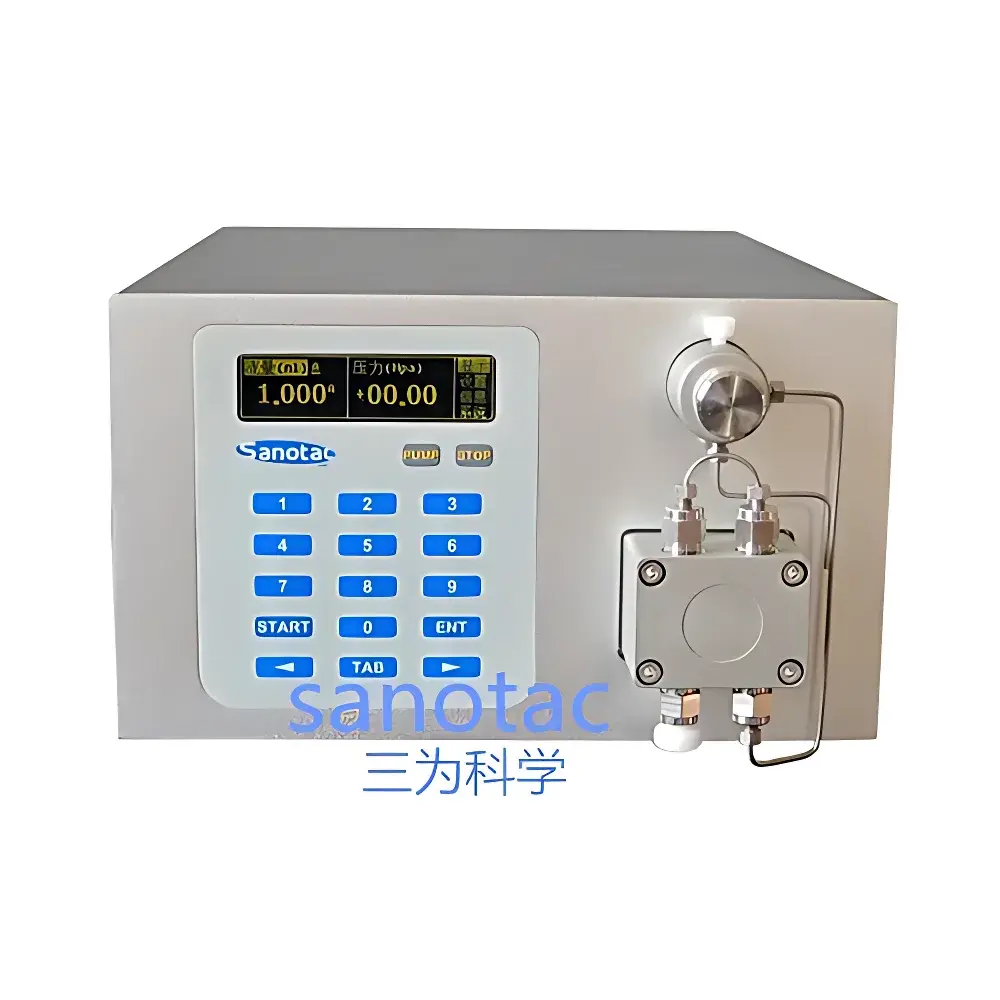
Sanotac HP1020 High-Pressure Constant Flow Pump (100 mL/min, 20 MPa)
| Brand | Sanotac |
|---|---|
| Origin | Shanghai, China |
| Manufacturer Type | Direct Manufacturer |
| Model | HP1020 |
| Flow Rate | 0.01–100.00 mL/min (0.01 mL/min increment) |
| Pressure Range | ≤ 20 MPa |
| Flow Accuracy | ±0.5% |
| Flow Precision (RSD) | ≤ 0.1% |
| Pressure Pulsation | ≤ 0.2 MPa |
| Fluid Path Materials | 316L Stainless Steel, Sapphire, PTFE, Ceramic |
| Connection | 1/16" Standard Fittings |
| Display | 256×64 Dot Matrix Backlit LCD |
| Control | Front Panel Keypad or PC Reverse Control (Open Protocol) |
| Power Supply | 85–264 VAC, 50 Hz |
| Dimensions | 370 × 240 × 152 mm |
Overview
The Sanotac HP1020 is a high-precision, high-pressure constant flow pump engineered for demanding analytical and preparative liquid delivery applications requiring stable, pulse-free solvent transport across wide dynamic flow ranges. Operating on a dual-piston parallel architecture with floating piston design, the HP1020 delivers consistent volumetric displacement under elevated backpressures—up to 20 MPa—making it suitable for ultra-high-performance liquid chromatography (UHPLC), supercritical fluid chromatography (SFC), high-pressure reaction monitoring, and continuous-flow synthesis systems. Its core operation relies on real-time solvent compressibility compensation, cam-profile optimization, and multi-point flow calibration algorithms to maintain metrological integrity across its full 0.01–100.00 mL/min range. Unlike conventional peristaltic or single-piston designs, the HP1020’s mechanical architecture minimizes elastic deformation effects in fluid paths and eliminates dead-volume accumulation, ensuring trace-level reproducibility essential for quantitative analysis and method transfer.
Key Features
- Dual-piston parallel pumping mechanism with dynamically balanced floating piston assembly to reduce seal wear and extend service life beyond 10,000 hours of continuous operation.
- Solvent compressibility compensation algorithm integrated into microprocessor control firmware, automatically adjusting stroke volume based on solvent density and compressibility coefficients (e.g., acetonitrile vs. water vs. CO₂-rich mobile phases).
- Multi-point flow curve calibration across five decades (0.01, 0.1, 1, 10, 100 mL/min), enabling ±0.5% absolute accuracy and ≤0.1% RSD repeatability per ISO 11607-2 and ASTM D3418 verification protocols.
- Cam-profile optimized drive system coupled with electronic flow pulsation suppression circuitry, reducing pressure ripple to ≤0.2 MPa (peak-to-peak) at all operating points—critical for baseline stability in UV-Vis and mass spectrometric detection.
- Chemically inert fluid path constructed from 316L stainless steel, sapphire check valves, PTFE seals, and ceramic plungers—compatible with aggressive solvents including concentrated acids, halogenated organics, and supercritical CO₂.
- Open communication protocol (RS-232 and optional Ethernet) supporting bidirectional reverse control from third-party chromatography data systems (CDS), including Agilent OpenLab, Waters Empower, and Thermo Chromeleon.
Sample Compatibility & Compliance
The HP1020 accommodates aqueous, organic, and mixed-phase mobile phases commonly used in HPLC, UHPLC, and SFC workflows—including TFA, HFIP, trifluoroethanol, and ionic liquids—without degradation of flow integrity or seal performance. All wetted materials comply with USP Class VI biocompatibility standards and meet ISO 9001:2015 manufacturing requirements. The pump’s firmware supports audit trail logging and user-access level configuration (admin/operator), aligning with FDA 21 CFR Part 11 compliance when deployed within validated GxP environments. It is routinely qualified per IQ/OQ protocols referencing ASTM E2500-13 and ICH Q2(R2) guidelines for analytical instrument qualification.
Software & Data Management
The HP1020 operates natively via an embedded 256×64 pixel backlit LCD interface with intuitive keypad navigation. Ten pre-programmable methods store flow rate ramps, gradient profiles (isocratic, linear, step, and custom composite gradients), and pressure limit thresholds. For integration into automated laboratories, the pump supports ASCII-based command sets over RS-232 or TCP/IP, enabling seamless scripting in Python, LabVIEW, or MATLAB. All parameter changes—including flow setpoints, gradient start times, and pressure alarms—are timestamped and logged internally with operator ID tagging, satisfying GLP/GMP traceability requirements. Firmware updates are performed via USB port without hardware modification.
Applications
- Preparative and analytical-scale liquid chromatography under pressures up to 20 MPa, including peptide purification, natural product isolation, and chiral separations.
- Continuous-flow chemical synthesis reactors where precise stoichiometric reagent dosing and residence time control are critical.
- High-pressure material testing rigs simulating downhole conditions in petrochemical and geothermal research.
- Calibration of flow meters and pressure transducers in metrology laboratories accredited to ISO/IEC 17025.
- Mobile phase delivery in hyphenated techniques such as LC-MS, LC-ICP-MS, and LC-NMR, where low pulsation ensures signal-to-noise ratio optimization.
FAQ
What is the maximum operating pressure of the HP1020?
The HP1020 is rated for continuous operation up to 20 MPa (2900 psi), with safety cutoffs activated at 22 MPa.
Does the pump support gradient elution?
Yes—it enables isocratic, linear, step, and user-defined composite gradients via front-panel programming or external workstation control.
Is the communication protocol proprietary or open?
The HP1020 uses an openly documented ASCII command set over RS-232 or Ethernet, allowing integration with custom-built or third-party CDS platforms.
How is flow accuracy verified during routine operation?
The pump includes built-in self-diagnostic routines that validate flow output against calibrated gravimetric measurements at three user-selectable points, generating PDF-formatted validation reports.
Can the HP1020 be used with corrosive solvents such as hydrochloric acid or sodium hypochlorite?
When equipped with optional PEEK or titanium fluidic modules (model variants HP1020-PK / HP1020-Ti), it maintains compatibility with strong oxidizers and mineral acids per ASTM G152 corrosion resistance testing.



