
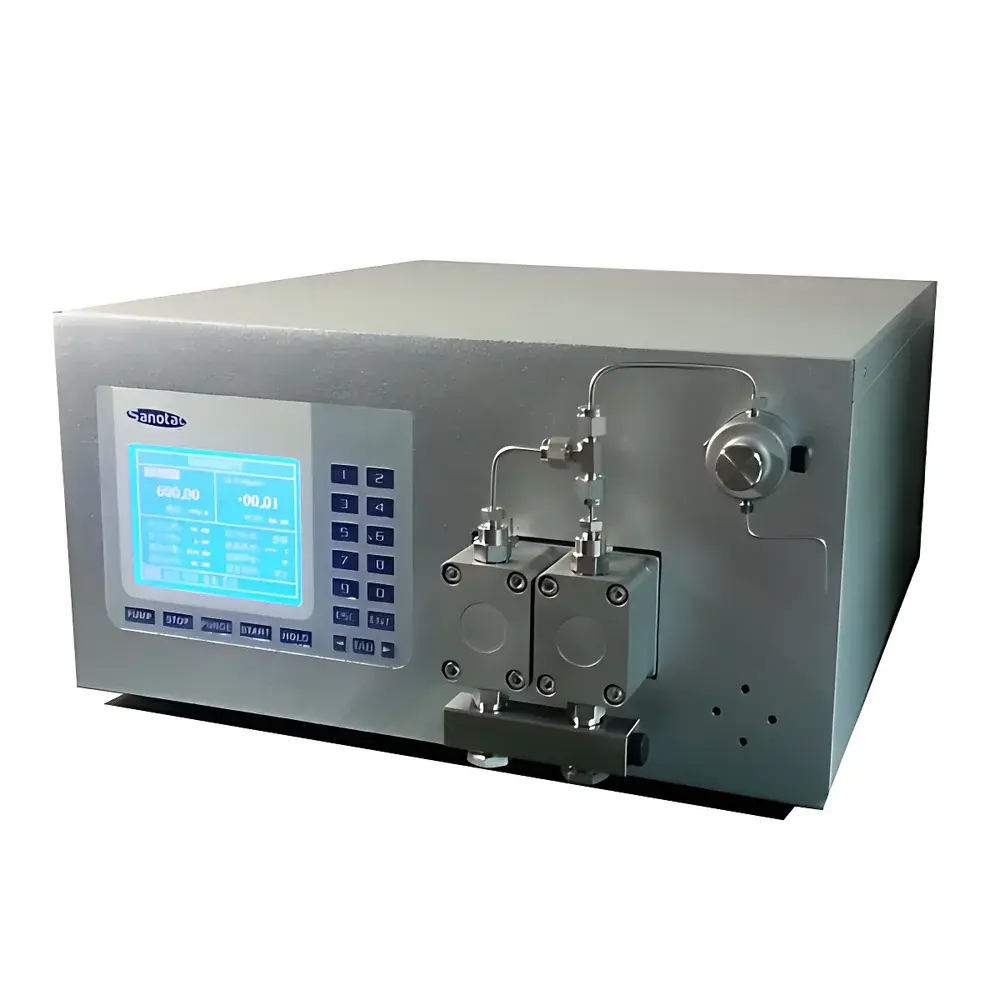
Sanotac Omnito CP6010 Constant-Pressure Infusion Pump
| Brand | Sanotac |
|---|---|
| Origin | Shanghai, China |
| Manufacturer Type | Direct Manufacturer |
| Model | Omnito CP6010 |
| Flow Range | 0.01–600.00 mL/min |
| Constant Pressure Range | 1–10 MPa |
| Constant Pressure Accuracy | ±0.1 MPa |
| Pressure Pulsation | ≤0.2 MPa |
| Flow Accuracy | ±0.5% |
| Flow Repeatability | ≤0.5% |
| Pump Head Material | 316L Stainless Steel (PEEK/Titanium optional) |
| Wetted Materials | 316L SS, Ruby, PTFE, Ceramic |
| Tubing Connection | 1/8" Standard |
| Display | 256×64 Dot Matrix Self-Illuminating LCD |
| Control Interface | Front Panel + Open-Protocol Computer Remote Control (RS232/USB) |
| Power Supply | 85–264 VAC, 50 Hz |
| Dimensions | 370 × 240 × 152 mm |
| Drive Mechanism | Dual-Piston Parallel Architecture with Cam-Profile Compensation & Electronic Pulse Suppression |
| Sealing Design | Floating Piston Architecture for Extended Seal Life |
| Check Valves | Swiss-Origin Precision Non-Return Valves |
Overview
The Sanotac Omnito CP6010 is an advanced constant-pressure infusion pump engineered for precision fluid delivery in demanding laboratory and research environments. Unlike conventional positive-displacement piston pumps that prioritize flow rate control, the CP6010 implements real-time closed-loop pressure regulation—continuously adjusting piston displacement and stroke frequency to maintain user-defined backpressure across variable system resistance. This capability is grounded in dual-piston parallel architecture combined with cam-profile motion compensation and active electronic pulsation suppression, enabling stable hydrostatic conditions critical for organ perfusion, microfluidic integration, and reaction-controlled dosing. The pump operates within a certified pressure range of 1–10 MPa, with pressure stability maintained at ±0.1 MPa under dynamic load changes—a specification validated per ISO 8536-4 for infusion device performance testing protocols.
Key Features
- Dual-piston parallel drive mechanism with floating piston design, minimizing radial seal loading and extending service life of elastomeric components beyond 10,000 operational hours.
- Integrated cam-profile compensation algorithm synchronizes mechanical motion with fluid inertia, reducing pressure ripple to ≤0.2 MPa (measured per ASTM D3923).
- Swiss-sourced sapphire-faced non-return valves ensure long-term chemical compatibility and zero leakage at rated pressure—certified to ISO 594-2 for conical fittings.
- Open-protocol remote control interface (RS232/USB) supports custom LabVIEW, Python, or MATLAB integration; full command set documentation provided for GLP-compliant method development.
- Wetted path constructed from 316L stainless steel as standard; optional PEEK, titanium, or ceramic pump heads available for aggressive solvents, halogenated media, or high-pH applications.
- Self-illuminating 256×64 dot-matrix LCD provides simultaneous display of pressure setpoint, actual pressure, flow rate, operating mode, and fault diagnostics—no external lighting required in darkroom or biosafety cabinet settings.
Sample Compatibility & Compliance
The Omnito CP6010 accommodates diverse fluid chemistries—including aqueous buffers, organic solvents (e.g., acetonitrile, THF), viscous polymer solutions (up to 500 cP), and particulate-laden suspensions—without compromising pressure fidelity. Its modular wetted-path configuration complies with USP and ISO 10993-5 for biocompatibility when configured with PEEK or titanium components. For regulated pharmaceutical or clinical research use, the pump supports audit-trail-enabled operation when paired with compliant SCADA software, satisfying FDA 21 CFR Part 11 requirements for electronic records and signatures. All pressure transducers are traceably calibrated to NIST standards, and factory calibration certificates include uncertainty budgets per ISO/IEC 17025.
Software & Data Management
Sanotac provides the Omnito Control Suite—a Windows-based application enabling programmable multi-step pressure/flow profiles, real-time data logging (≥10 Hz sampling), and CSV export compatible with JMP, OriginLab, or MATLAB. The open ASCII command protocol allows integration into existing LIMS or ELN platforms via TCP/IP or serial gateways. Each session generates a timestamped metadata file containing operator ID, environmental temperature, pressure deviation history, and valve cycle counts—facilitating root-cause analysis during GMP investigations. Firmware updates preserve all user-defined methods and retain calibration coefficients without revalidation.
Applications
- Ex vivo organ perfusion: Maintains physiologically relevant coronary or hepatic perfusion pressure (8–12 kPa) during isolated heart or liver studies, eliminating flow-induced shear stress artifacts.
- Controlled reagent addition in catalytic reactors: Delivers stoichiometrically precise reactants under constant backpressure to prevent vapor lock or bubble formation in high-temperature/pressure synthesis.
- Microfluidic platform interfacing: Supplies stable inlet pressure to droplet generators, laminar mixers, or organ-on-chip devices where flow-rate fluctuations induce interfacial instability.
- Gene delivery vector formulation: Enables reproducible mixing of lipid nanoparticles (LNPs) under defined shear and residence time constraints—critical for mRNA encapsulation efficiency.
- Petrochemical process simulation: Mimics downhole injection conditions in core flooding experiments using corrosion-resistant titanium or Hastelloy configurations.
FAQ
What distinguishes constant-pressure mode from constant-flow mode on the CP6010?
In constant-pressure mode, the pump actively modulates piston velocity and dwell time to hold user-set backpressure regardless of downstream resistance changes—ideal for permeable membranes or packed-bed systems. In constant-flow mode, it delivers volumetrically precise output (±0.5% accuracy) but cannot compensate for sudden pressure spikes.
Is the CP6010 suitable for GLP-regulated toxicology studies?
Yes—when operated with audit-trail software and documented calibration, its pressure control repeatability (≤0.5% RSD over 8-hour runs) meets OECD 407 and 422 guideline requirements for dose administration consistency.
Can I replace the standard 316L pump head with a PEEK variant post-purchase?
Yes—field-upgradable pump head kits include recalibration files and are mechanically interchangeable without tools; full traceability documentation provided with each kit.
Does the open communication protocol support synchronization with high-speed cameras or electrophysiology rigs?
Yes—the RS232 trigger output provides TTL-compatible pulse signals synchronized to piston top-dead-center events, enabling sub-millisecond temporal alignment with external acquisition hardware.
How often does the system require recalibration?
Annual pressure transducer calibration is recommended; flow calibration is optional unless subjected to >5000 cycles/month or exposure to abrasive slurries—both procedures are user-executable using built-in verification routines.



