
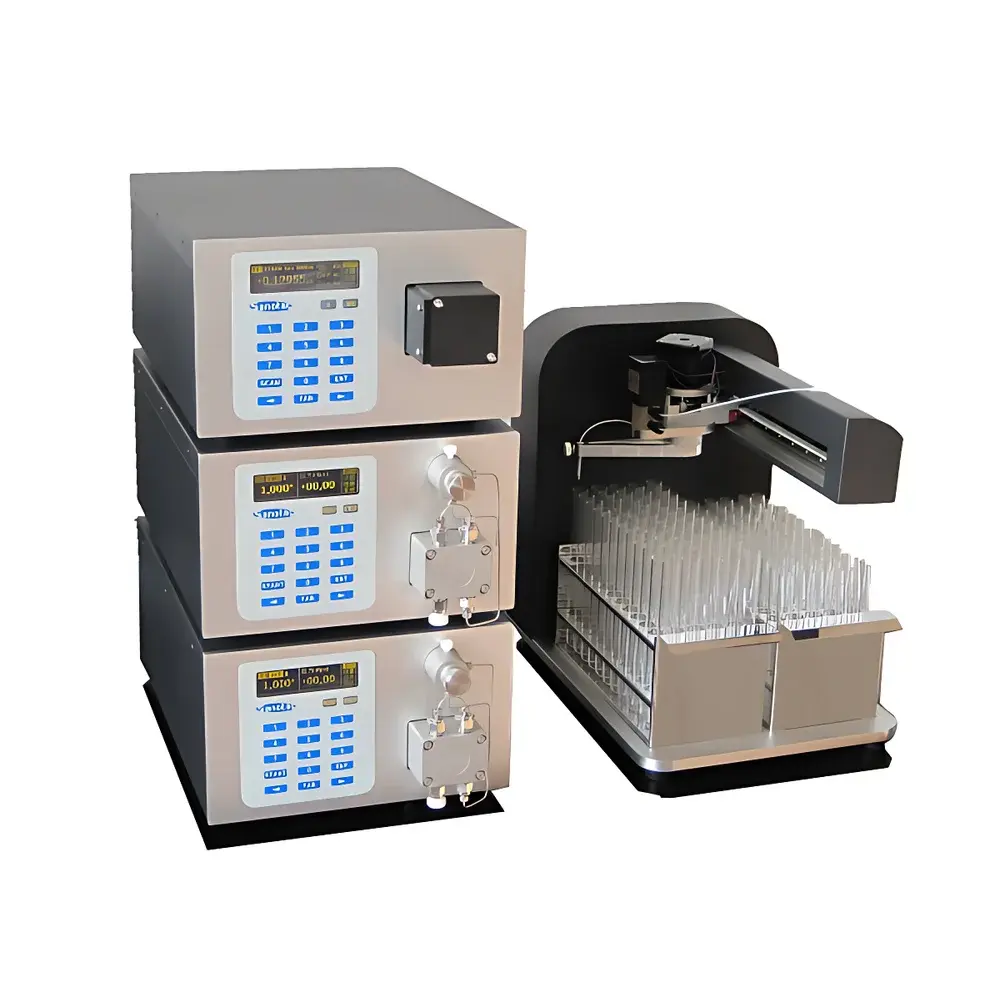
Sanotac Pilot100 Preparative Liquid Chromatography System
| Brand | Sanotac |
|---|---|
| Origin | Shanghai, China |
| Manufacturer Type | Manufacturer |
| Product Category | Domestic |
| Model | Pilot100 |
| Application Level | Laboratory Grade |
| Instrument Type | High-Pressure Preparative LC |
| Flow Rate Range | 0.01–100.00 mL/min |
| Flow Accuracy | ±1% |
| Flow Precision (RSD) | ≤0.5% |
| Maximum Pressure | 30 MPa |
| Wavelength Range | 190–800 nm |
| Wavelength Accuracy | ±1 nm |
| Wavelength Repeatability | 0.2 nm |
| Baseline Noise | ±0.75×10⁻⁵ AU (254 nm, TC = 1 s) |
| Data Acquisition Rate | 10 Hz |
Overview
The Sanotac Pilot100 Preparative Liquid Chromatography System is a modular, high-pressure preparative HPLC platform engineered for reproducible, scalable purification of active pharmaceutical ingredients (APIs), natural products, synthetic intermediates, and biomolecules—including peptides and small proteins. It operates on the principle of reversed-phase, normal-phase, or ion-exchange chromatography under controlled gradient elution conditions, delivering precise solvent delivery, dual-wavelength UV/Vis detection, and intelligent fraction collection in a single integrated architecture. Designed for laboratory-to-pilot-scale transition, the system supports method development, process optimization, and GMP-aligned purification workflows—fully compliant with regulatory data integrity requirements for analytical and preparative applications.
Key Features
- High-precision dual-piston parallel pump with real-time chamber pressure feedback, compensating for solvent compressibility and refill dynamics across the full flow range (0.01–100.00 mL/min).
- Flow pulsation minimized via cam-profile compensation technology, achieving baseline noise as low as ±0.75×10⁻⁵ AU at 254 nm (1 s time constant).
- Multi-point flow calibration curves ensure ±1% flow accuracy and ≤0.5% RSD over the entire dynamic range.
- Floating plunger design extends seal lifetime under sustained high-pressure operation up to 30 MPa.
- Dual-wavelength UV/Vis detector with deuterium and tungsten lamp sources; simultaneous monitoring at two user-defined wavelengths (190–800 nm); wavelength accuracy ±1 nm, repeatability 0.2 nm.
- Intelligent lamp and flow cell swapping mechanism enables rapid maintenance without system downtime.
- Automated fraction collector with hybrid linear-rotary motion, supporting volume-, time-, threshold-, and slope-triggered collection modes—including sequential, cyclic, and conditional logic-based collection.
- Low-diffusion fluidic path and software-configurable delay volume compensation ensure high collection fidelity and product purity.
- High-accuracy vial switching with dedicated waste channel—zero drip during tube exchange.
- Support for stainless steel and high-pressure glass columns; compatibility with 10 mL preparative injection valve (standard) and optional solid/liquid sample introduction.
Sample Compatibility & Compliance
The Pilot100 accommodates a broad spectrum of analytes: small-molecule organics (e.g., alkaloids, flavonoids, synthetic APIs), polar natural extracts, and moderately sized biopolymers (e.g., peptides < 10 kDa). Column compatibility includes C18, C8, silica, amino, and ion-exchange media (ID 10–50 mm, length up to 250 mm). The system meets essential regulatory prerequisites for pharmaceutical and clinical research environments: software adheres to CFDA GxP guidelines and FDA 21 CFR Part 11 requirements—including electronic signature validation, audit trail generation, role-based access control, and immutable data archiving. All hardware components conform to IEC 61010-1 safety standards; electrical design complies with CE and RoHS directives.
Software & Data Management
Control and data acquisition are managed via Sanochrom™ Chromatography Workstation—a Windows 7/8/10-native application supporting USB and RS-232 interfaces. The GUI provides real-time visualization of pump status, detector signal, fraction collector position, and system pressure. Method files store complete instrument parameters—including gradient profiles, wavelength programs, collection logic, and delay volume settings—with version-controlled storage and export to CSV, PDF, or AIA format. Audit trails record all user actions (login/logout, method edit, run start/stop, parameter changes) with timestamps and operator IDs. Data integrity safeguards include automatic backup, encrypted database storage, and configurable retention policies aligned with GLP/GMP documentation practices.
Applications
- Purification of herbal monomers and standardized botanical extracts (e.g., ginsenosides, curcuminoids, berberine).
- Isolation of synthetic reaction mixtures—removal of catalysts, by-products, and unreacted starting materials.
- Desalting and buffer exchange of peptide fractions post-solid-phase synthesis.
- Preparative separation of chiral compounds using polysaccharide-based CSPs.
- Method scouting and scale-up studies bridging analytical HPLC to pilot-scale purification (e.g., 10–100 mg per run).
- Stability-indicating purification workflows supporting ICH Q5 and Q6A guidelines.
FAQ
Does the Pilot100 support method transfer from analytical to preparative scales?
Yes—the system allows direct import of gradient and timing parameters from common analytical UHPLC/HPLC methods, with automatic scaling logic for flow rate, column dimensions, and injection volume.
Can the software generate 21 CFR Part 11-compliant audit trails?
Yes—Sanochrom™ logs all critical events with user ID, timestamp, and action type; audit trail reports are exportable and tamper-evident.
What column hardware interfaces are supported?
Standard 1/4″-28 UNF and 10-32 fittings; compatible with stainless steel, PEEK, and titanium tubing; high-pressure glass columns up to 30 MPa require optional reinforced ferrules.
Is remote monitoring or network deployment possible?
The workstation supports LAN-based client-server configuration for centralized instrument management; remote desktop access is permitted under validated IT security protocols.
How is baseline stability maintained during long-gradient runs?
Through active temperature stabilization of the optical path, dual-lamp auto-switching, and real-time baseline correction algorithms embedded in the detector firmware.




