
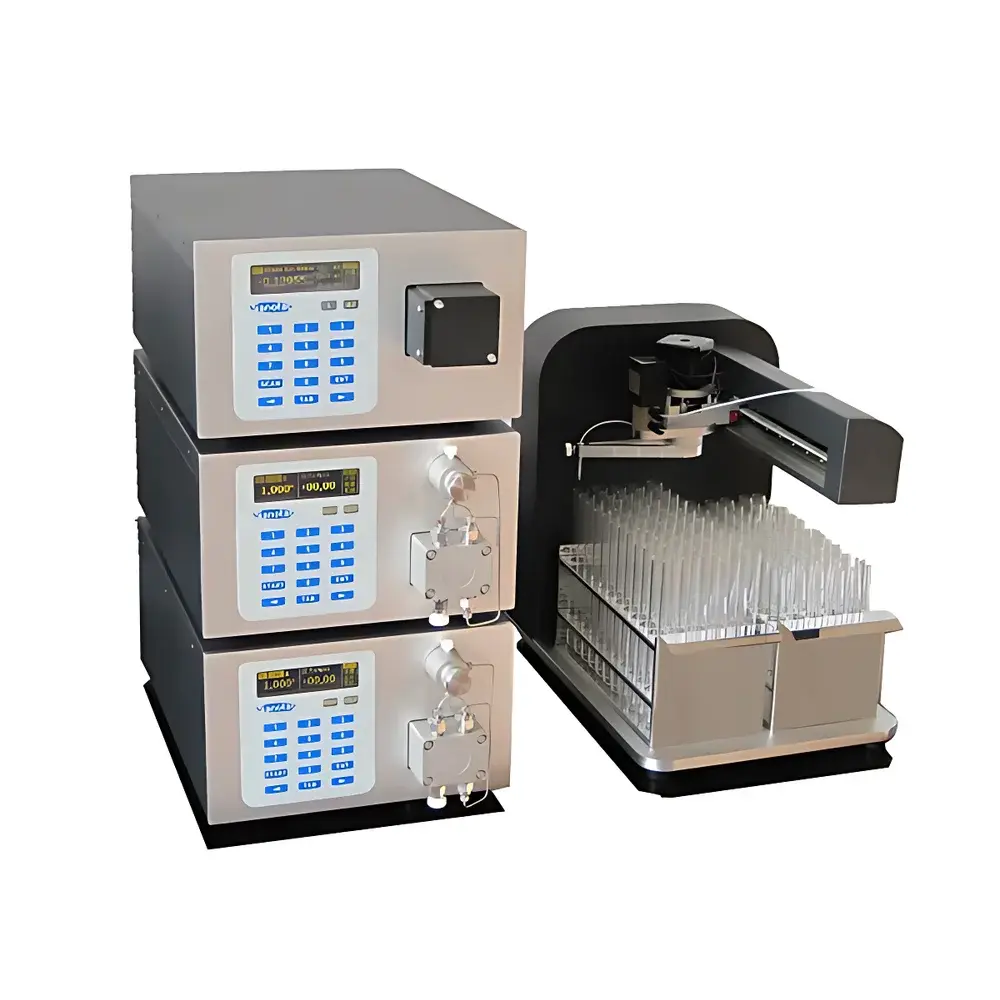
Sanotac Purifier 150 Medium-Pressure Preparative Liquid Chromatography System
| Brand | Sanotac |
|---|---|
| Origin | Shanghai, China |
| Manufacturer Type | Original Equipment Manufacturer (OEM) & Direct Producer |
| Instrument Class | Laboratory-Scale Medium-Pressure Preparative HPLC |
| Flow Rate Range | 0.01–150.00 mL/min |
| Flow Accuracy | ±1% |
| Flow Precision (RSD) | ≤0.5% |
| Maximum Pressure | 20 MPa |
| Wavelength Range | 190–800 nm |
| Wavelength Accuracy | ±1 nm |
| Wavelength Repeatability | 0.2 nm |
| Baseline Noise | ±0.75×10⁻⁵ AU (254 nm, TC = 1 s) |
| Data Acquisition Rate | 10 Hz |
Overview
The Sanotac Purifier 150 is a laboratory-grade medium-pressure preparative liquid chromatography (PLC) system engineered for high-fidelity isolation and purification of organic synthetic compounds, pharmaceutical intermediates, natural products, antibiotics, and biologically active molecules. Based on classical reversed-phase and normal-phase chromatographic principles—employing high-resolution separation via controlled solvent gradients and precise UV detection—the system delivers reproducible fractionation under scalable, non-destructive conditions. Its 20 MPa maximum pressure rating supports both silica- and polymer-based stationary phases (e.g., C18, amino, cyano, diol), enabling robust method transfer from analytical to preparative scale. Designed for R&D laboratories in pharmaceutical development, medicinal chemistry, and natural product research, the Purifier 150 operates within GLP-aligned workflows and integrates seamlessly into regulated environments requiring traceable instrument control and data integrity.
Key Features
- Microprocessor-controlled dual-piston parallel pump architecture with real-time chamber pressure feedback, dynamically compensating for solvent compressibility and refill-induced pulsation across the full flow range (0.01–150.00 mL/min).
- Cam-profile flow compensation technology minimizing pulsation-induced baseline noise—achieving baseline stability of ±0.75×10⁻⁵ AU at 254 nm (1 s time constant).
- Multi-point volumetric calibration curves applied across the entire flow spectrum, ensuring certified accuracy of ±1% and repeatability (RSD) ≤0.5%.
- Self-aligning floating plunger design extending seal service life under sustained medium-pressure operation (up to 20 MPa).
- 10 user-definable gradient and flow programs with on-the-fly modification capability—supporting complex multi-step elution schemes without interruption.
- Dual-wavelength UV/Vis detection (190–800 nm) with deuterium and tungsten lamp sources; simultaneous dual-channel monitoring enables co-elution discrimination of major analytes, by-products, and low-abundance impurities.
- Integrated auto-sampler valve (standard 10 mL loop) supporting both solid-phase loading (via slurry or dry-load techniques) and direct liquid injection—compatible with volatile and non-volatile samples.
Sample Compatibility & Compliance
The Purifier 150 accommodates diverse sample matrices including crude reaction mixtures, plant extracts, fermentation broths, and synthetic oligomers. Its chemically resistant 316L stainless steel and optional PEEK fluidic path ensures compatibility with aggressive solvents (e.g., THF, DCM, DMF, TFA) and pH-stable mobile phases (pH 1–12). The system meets fundamental requirements for ISO/IEC 17025-compliant laboratories and supports audit-ready documentation when operated with Sanochrom software configured for electronic signatures, user access levels, and 21 CFR Part 11–compliant audit trails (including event logging, parameter change history, and raw data immutability). All hardware components—including UV flow cell, pump heads, and collection tubing—are designed for easy cleaning, validation, and routine maintenance per GMP Annex 15 guidelines.
Software & Data Management
Controlled exclusively via Sanochrom Chromatography Workstation—a Windows 10–compatible native application—the system provides full graphical interface navigation for method building, real-time signal visualization (dual-wavelength overlay), and synchronized actuation of pump, detector, and fraction collector. Data acquisition occurs at 10 Hz with lossless binary storage (.raw format), supporting post-run re-integration, spectral library matching, and peak purity analysis. The software implements configurable delay volume compensation algorithms to align UV peak maxima with physical fraction collection—critical for isolating narrow peaks in fast-gradient separations. Export options include CSV, PDF reports, and AIA/ANDI-compliant formats for LIMS integration. Remote monitoring and method sharing are enabled via secure LAN deployment.
Applications
- Purification of novel small-molecule drug candidates following Suzuki, Heck, or amidation reactions.
- Isolation of bioactive alkaloids, flavonoids, and terpenoids from botanical extracts—particularly in traditional Chinese medicine (TCM) research.
- Desalting and buffer exchange of synthetic peptides prior to lyophilization or biological assay.
- Removal of residual catalysts (e.g., Pd, Ru) and ligands from transition-metal-catalyzed syntheses.
- Preparative chiral separations using immobilized polysaccharide columns (e.g., Chiralpak AD-H, IC) under isocratic or gradient conditions.
- Scalable method development bridging analytical UHPLC (e.g., 2.1 mm ID columns) to preparative PLC (10–30 mm ID columns) with linear velocity preservation.
FAQ
What is the maximum column inner diameter supported by the Purifier 150?
The system is optimized for columns ranging from 10 mm to 30 mm ID, with validated performance up to 50 mm ID when operated within specified pressure and flow constraints.
Can the UV detector perform spectral scanning during fraction collection?
Yes—the detector supports stop-flow spectral acquisition (190–800 nm) with 1 nm resolution, enabling post-run peak identification and purity assessment.
Is the system compatible with mass-directed fraction collection?
While the base configuration does not include an integrated MS interface, the Sanochrom software supports external trigger input from third-party mass spectrometers via TTL or analog signal, allowing synchronized collection based on m/z-selected events.
How is data integrity ensured during long-duration purification runs?
All detector signals, pump parameters, and collector position logs are timestamped and written continuously to non-volatile storage; file checksums and write-verification protocols prevent data corruption.
What regulatory documentation is provided with the instrument?
Each unit ships with Factory Acceptance Test (FAT) report, IQ/OQ protocol templates, and a complete set of CE-marked conformity declarations compliant with EU Machinery Directive 2006/42/EC and EMC Directive 2014/30/EU.



