
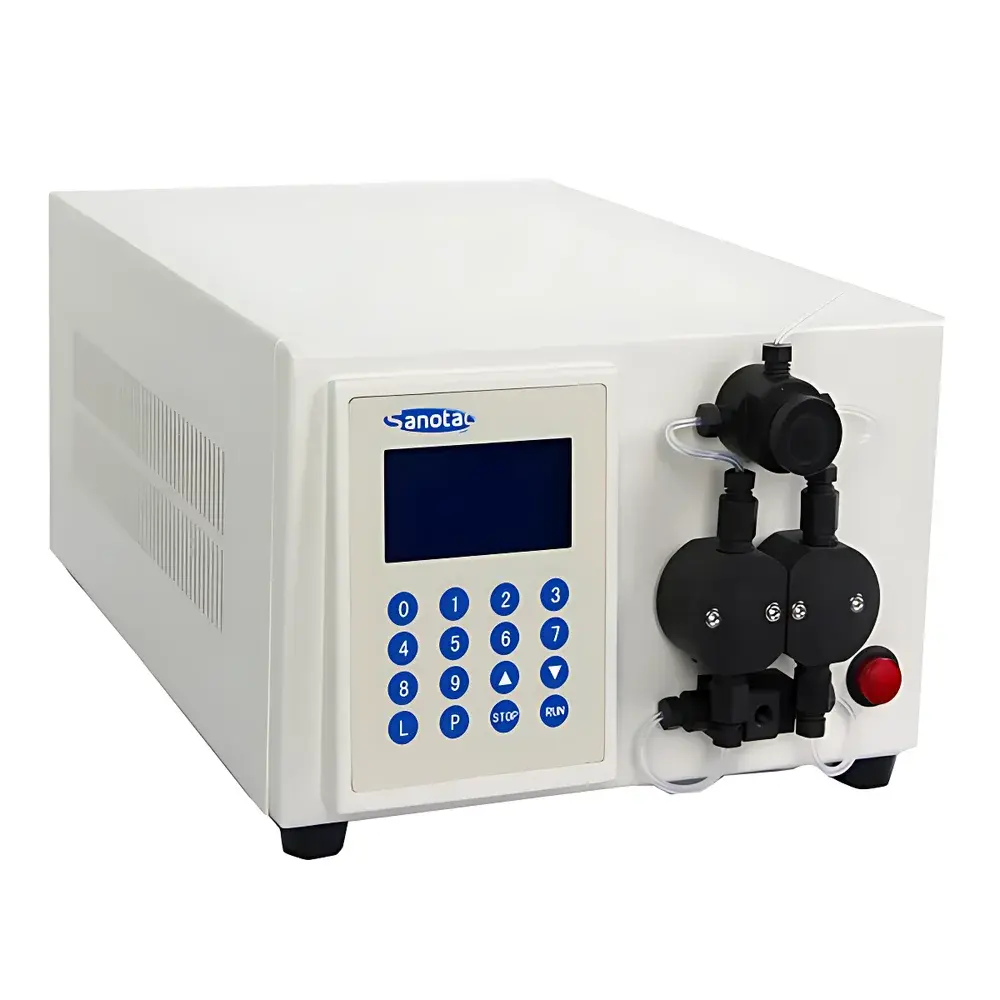
Sanotac QJ1002 High-Precision Alkali-Resistant Constant Flow Pump
| Brand | Sanotac |
|---|---|
| Origin | Shanghai, China |
| Manufacturer Type | Direct Manufacturer |
| Country of Origin | China |
| Model | QJ1002 |
| Flow Range | 0.1–100.0 mL/min |
| Flow Accuracy | ±1% |
| Flow Precision (RSD) | ≤1% |
| Maximum Pressure | 2 MPa |
| Pressure Pulsation | ≤0.2 MPa |
| Wetted Materials | PTFE, Ruby, Zirconia Ceramic |
| Control Modes | Front-panel Keypad + RS232/USB Computer Reverse Control (Open Protocol) |
| Power Supply | 85–264 VAC, 50 Hz |
| Power Consumption | 75 W |
| Weight | 12 kg |
Overview
The Sanotac QJ1002 is a high-precision, alkali-resistant constant flow pump engineered for reliable, low-pulse delivery of aggressive alkaline solutions in demanding laboratory and industrial process environments. Designed around a dual-piston parallel head architecture with microprocessor-based servo control, the pump employs solvent compressibility compensation and multi-point flow calibration to maintain exceptional volumetric accuracy across its full operational range (0.1–100.0 mL/min). Its core measurement principle relies on positive displacement via precision-machined PTFE-coated plungers and ceramic-ruby valving—ensuring minimal chemical interaction and long-term stability when handling concentrated hydroxides including KOH, NaOH, Ca(OH)₂, Mg(OH)₂, and Al(OH)₃. Unlike conventional stainless-steel or alloy-based pumps, the QJ1002’s fully fluoropolymer-wetted fluid path eliminates corrosion-induced drift, seal degradation, and metal ion leaching—critical for applications requiring strict chemical purity and regulatory compliance.
Key Features
- Alkali-Resistant Fluid Path: All wetted components—including pump heads, check valves, seals, and tubing interfaces—are constructed from chemically inert materials: PTFE (polytetrafluoroethylene), sapphire-grade ruby balls, and yttria-stabilized zirconia ceramics—certified for continuous exposure to pH >14 solutions at elevated temperatures.
- Low-Pressure Pulsation Design: Integrates cam-profile optimization and real-time electronic pulse suppression algorithms to limit pressure ripple to ≤0.2 MPa (RMS), ensuring baseline stability in downstream analytical systems such as IC, HPLC, and electrochemical cells.
- Wide Dynamic Flow Range: Achieves ±1% flow accuracy and ≤1% RSD from 0.1 mL/min up to 100.0 mL/min without hardware reconfiguration—enabled by adaptive piston stroke modulation and dynamic solvent compressibility modeling.
- Gradient Capability: Supports isocratic, linear, and step-gradient profiles through programmable time-segmented flow programming; compatible with external gradient mixers for multi-solvent elution schemes.
- Robust Mechanical Architecture: Floating plunger design minimizes lateral load on PTFE seals, extending service life beyond 10,000 operating hours; cam drive mechanism sourced from Swiss OEM suppliers ensures angular repeatability <0.05°.
- Open Communication Protocol: RS232 and USB interfaces support bidirectional command/response communication using ASCII-based SCPI-like syntax—fully compatible with LabVIEW, Python (PySerial), MATLAB, and third-party chromatography data systems (CDS).
Sample Compatibility & Compliance
The QJ1002 is validated for use with strongly alkaline aqueous media, including but not limited to 50% w/w NaOH, saturated Ca(OH)₂ slurries, and 30% KOH solutions at ambient to 60°C. It meets material compatibility requirements outlined in ASTM D1250 (liquid transfer equipment for caustic service) and ISO 15195:2018 (reference materials for pH metrology). While not certified for explosion-proof or intrinsically safe operation, its non-sparking PTFE/ceramic construction renders it suitable for Class I, Division 2 hazardous locations per NEC Article 500 when installed with appropriate enclosures. The pump supports GLP/GMP traceability via optional audit-log firmware modules that record all parameter changes, runtime events, and error codes with UTC timestamps.
Software & Data Management
The embedded controller features a 4.3-inch capacitive touchscreen interface with ten preconfigured user methods—each storing independent flow programs, gradient tables, pressure limits, and auto-shutdown thresholds. All settings are retained during power cycling. For integration into automated workflows, the open reverse-control protocol enables full remote operation—including real-time flow/pressure readback, event-triggered start/stop, and firmware update capability—without proprietary drivers. Data export supports CSV-formatted logs with millisecond-resolution timestamps, compliant with FDA 21 CFR Part 11 requirements when deployed with qualified electronic signature and audit trail configurations.
Applications
- Ion chromatography (IC) mobile phase delivery for anion analysis in wastewater, flue gas desulfurization effluents, and battery electrolyte recycling streams.
- In-line pH adjustment and reagent dosing in continuous-flow synthesis reactors handling organometallic catalysts sensitive to metal contamination.
- Calibration and validation of online pH and conductivity sensors in caustic scrubber loops and boiler feedwater treatment systems.
- Long-duration leaching studies (e.g., TCLP, SPLP) where consistent alkaline extractant delivery over 168+ hours is required.
- Electrochemical energy research, including solid-alkaline fuel cell testing and Ni–Fe battery electrolyte circulation under controlled stoichiometric flow.
FAQ
Is the QJ1002 suitable for pumping 45% NaOH at 50°C?
Yes—the PTFE/ruby/zirconia fluid path has been thermally and chemically validated for continuous operation with ≥45% NaOH up to 60°C.
Can the pump be integrated into a PLC-controlled pilot plant?
Yes—its RS232/USB interface supports Modbus RTU emulation and discrete I/O triggering via optional digital expansion module.
Does it comply with USP <1058> for analytical instrument qualification?
The base model supports IQ/OQ documentation; full PQ execution requires site-specific performance verification per USP <1058> Annex 2 protocols.
What maintenance intervals are recommended for continuous 24/7 operation?
Plunger seals require inspection every 3,000 hours; ruby check valves are rated for ≥8,000 hours under alkaline conditions.
Is remote firmware update supported over network connection?
Firmware updates are performed locally via USB stick; network-based OTA updates require optional Ethernet gateway add-on.



