
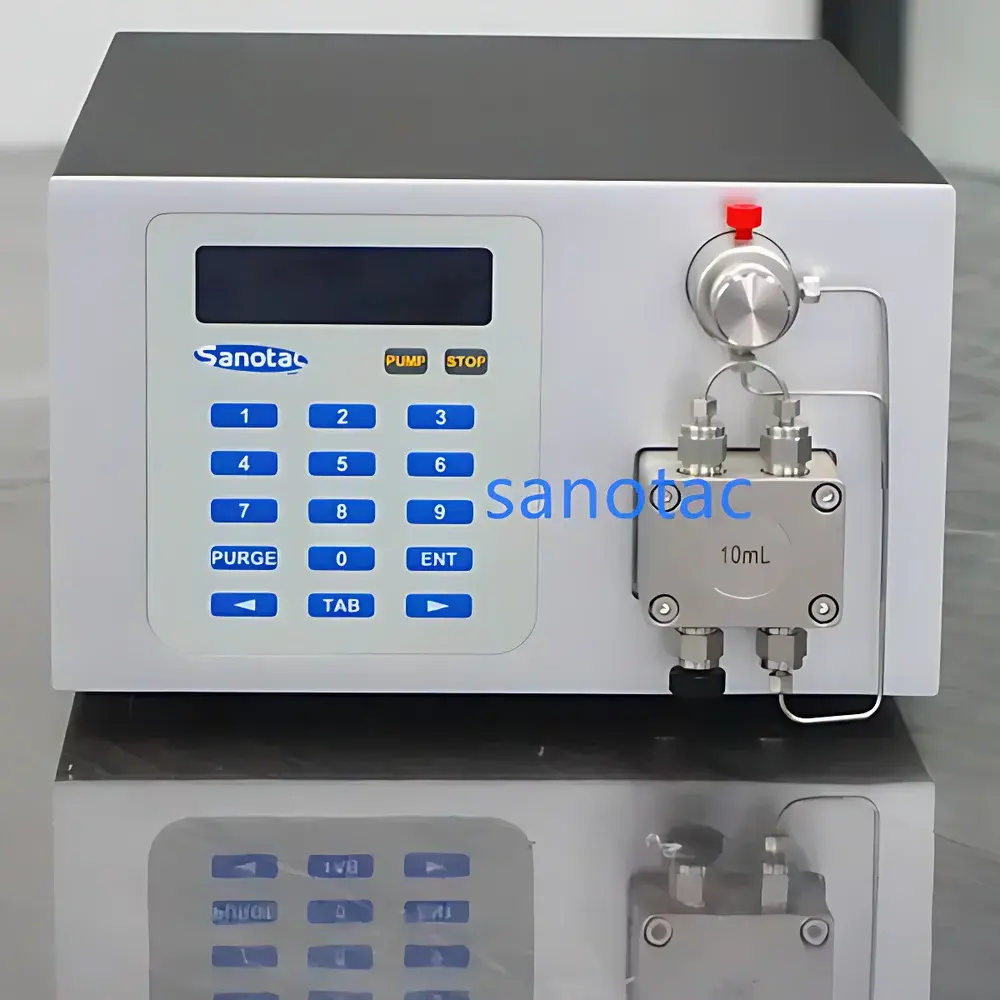
Sanotac S1040 High-Pressure Constant Flow Pump (Stainless Steel, 100 mL/min, 40 MPa)
| Brand | Sanotac |
|---|---|
| Model | S1040 |
| Flow Range | 0.01–100.00 mL/min |
| Accuracy | ±0.5% |
| Repeatability | ≤0.1% |
| Max Pressure | 40 MPa |
| Pressure Pulsation | ≤0.1 MPa |
| Wetted Materials | 316L Stainless Steel, Sapphire, PTFE, Ceramic |
| Communication | USB, RS232, RS485/422 (optional), Modbus RTU/ASCII |
| Power Supply | 85–264 VAC, 50 Hz |
| Power Consumption | 75 W |
| Dimensions | 370 × 240 × 152 mm |
| Weight | 8 kg |
Overview
The Sanotac S1040 High-Pressure Constant Flow Pump is an engineered precision fluid delivery system designed for demanding laboratory and pilot-scale applications requiring stable, pulse-free flow under extreme pressure conditions. Based on positive displacement piston technology with dual-cam synchronized drive architecture, the S1040 delivers consistent volumetric flow across its full operational range (0.01–100.00 mL/min) while maintaining pressure stability up to 40 MPa (5800 psi). Its core design adheres to fundamental principles of hydraulic compression compensation and dynamic flow pulsation suppression—critical for applications where pressure transients could compromise reaction kinetics, column integrity in chromatographic systems, or phase behavior in supercritical fluid processes. Unlike peristaltic or diaphragm-based alternatives, the S1040 employs a hardened sapphire-plunger and ceramic-seated check valve assembly within a 316L stainless steel fluid path, ensuring chemical compatibility with aggressive solvents, catalyst slurries, and high-salinity media commonly encountered in catalytic evaluation, hydrothermal synthesis, and electrochemical flow cells.
Key Features
- Multi-point volumetric flow calibration across the entire range (0.01–100.00 mL/min), enabling traceable accuracy of ±0.5% and repeatability ≤0.1%—validated per ISO 5725-2 guidelines for precision measurement.
- Active flow pulsation suppression via dual-stage compensation: mechanical cam-profile optimization combined with real-time electronic feedback control reduces pressure ripple to ≤0.1 MPa, minimizing disturbance in sensitive downstream instrumentation.
- Integrated plunger rear-wash function automatically flushes residual particulates from the sealing interface during idle cycles, significantly extending seal life and reducing maintenance frequency in abrasive or suspended-solid applications.
- Compression compensation algorithm dynamically adjusts stroke volume in response to fluid compressibility and backpressure—ensuring true volumetric delivery even at 40 MPa with low-viscosity solvents (e.g., CO₂, methanol, supercritical fluids).
- Modular communication architecture supports native RS232/USB for local configuration and optional RS485/422, Modbus RTU/ASCII, and industrial protocols (Modbus TCP, Profibus DP, Profinet) for seamless integration into SCADA, DCS, or PLC-controlled reactor systems.
- Robust mechanical construction includes vibration-damped chassis, IP20-rated enclosure, and thermally stabilized motor driver—designed for continuous 24/7 operation in controlled laboratory environments per IEC 61000-6-2 EMC immunity standards.
Sample Compatibility & Compliance
The S1040 accommodates a broad spectrum of process fluids including organic solvents (acetone, THF, DMF), aqueous electrolytes, catalyst suspensions (e.g., Pt/C, NiMo/Al₂O₃ slurries), supercritical CO₂, and ionic liquids. All wetted components conform to ASTM F899-22 (stainless steel) and USP Class VI (PTFE, ceramic), supporting use in GMP-aligned catalytic screening and API synthesis workflows. The pump meets CE marking requirements under the Machinery Directive 2006/42/EC and Low Voltage Directive 2014/35/EU. For regulated environments, audit-trail-capable firmware (optional) complies with FDA 21 CFR Part 11 requirements when paired with validated software modules, supporting GLP/GMP documentation of calibration history, method execution logs, and parameter change records.
Software & Data Management
The standard firmware provides real-time graphical display of flow rate vs. pressure curves, program progress indicators, and live status diagnostics (plunger position, temperature, fault codes). Data logging captures timestamped flow and pressure values at user-defined intervals (100 ms–10 s), exportable as CSV or XLSX with embedded metadata (method ID, operator, date/time stamp). Optional PC-based control software enables method sequencing—including stepwise, linear, and multi-segment gradient profiles—and supports method library management with version-controlled storage. Calibration routines allow user-defined point mapping against gravimetric or timed-collection reference standards, with automatic coefficient retention and factory-reset recovery. Remote monitoring is supported via Ethernet (wired/wireless) with TLS-secured HTTP API endpoints for integration into centralized lab informatics platforms.
Applications
- Catalytic reaction engineering: precise co-feeding of reactants and catalysts into fixed-bed or microchannel reactors under elevated pressure (e.g., Fischer–Tropsch, hydrodesulfurization, CO₂ hydrogenation).
- Supercritical fluid processing: metering of scCO₂ and co-solvents in extraction, particle formation (RESS, SAS), and impregnation systems.
- Advanced chromatography: auxiliary pumping for preparative HPLC, SFC, and multidimensional LC systems requiring >30 MPa backpressure tolerance.
- Energy materials research: electrolyte delivery in flow battery test stations, slurry injection for electrode coating lines, and pressurized gas–liquid mass transfer studies.
- Chemical process intensification: integration into automated microreactor platforms for residence time distribution analysis and kinetic modeling under isobaric conditions.
FAQ
What is the maximum allowable operating pressure for the S1040, and how is overpressure protection implemented?
The S1040 is rated for continuous operation up to 40 MPa. It incorporates dual-stage pressure safeguarding: hardware-based pressure relief valves (set at 42 MPa) and software-enforced pressure limits configurable via serial command or front-panel interface.
Can the S1040 handle abrasive or particulate-laden fluids without compromising accuracy?
Yes—when equipped with optional ceramic check valves and sapphire plungers, the pump maintains metrological performance with suspended solids up to 5 µm in diameter; routine plunger rear-wash cycles are recommended for slurries exceeding 0.5 wt% solids.
Is flow calibration traceable to national standards?
Calibration procedures follow ISO/IEC 17025 principles; users may perform gravimetric calibration using NIST-traceable analytical balances and certified volumetric glassware—the firmware stores calibration coefficients with timestamp and operator ID.
Does the pump support analog input for external flow setpoint modulation?
Yes—via optional 0–5 V or 4–20 mA analog input, enabling closed-loop control from external sensors (e.g., inline densitometer, pressure transducer) or programmable logic controllers.
What maintenance intervals are recommended for continuous 24/7 operation?
Under nominal conditions (clean solvents, <30 MPa), seal replacement is recommended every 6 months or 5000 hours; plunger polishing and valve inspection every 12 months—maintenance logs are auto-recorded in internal non-volatile memory.



