
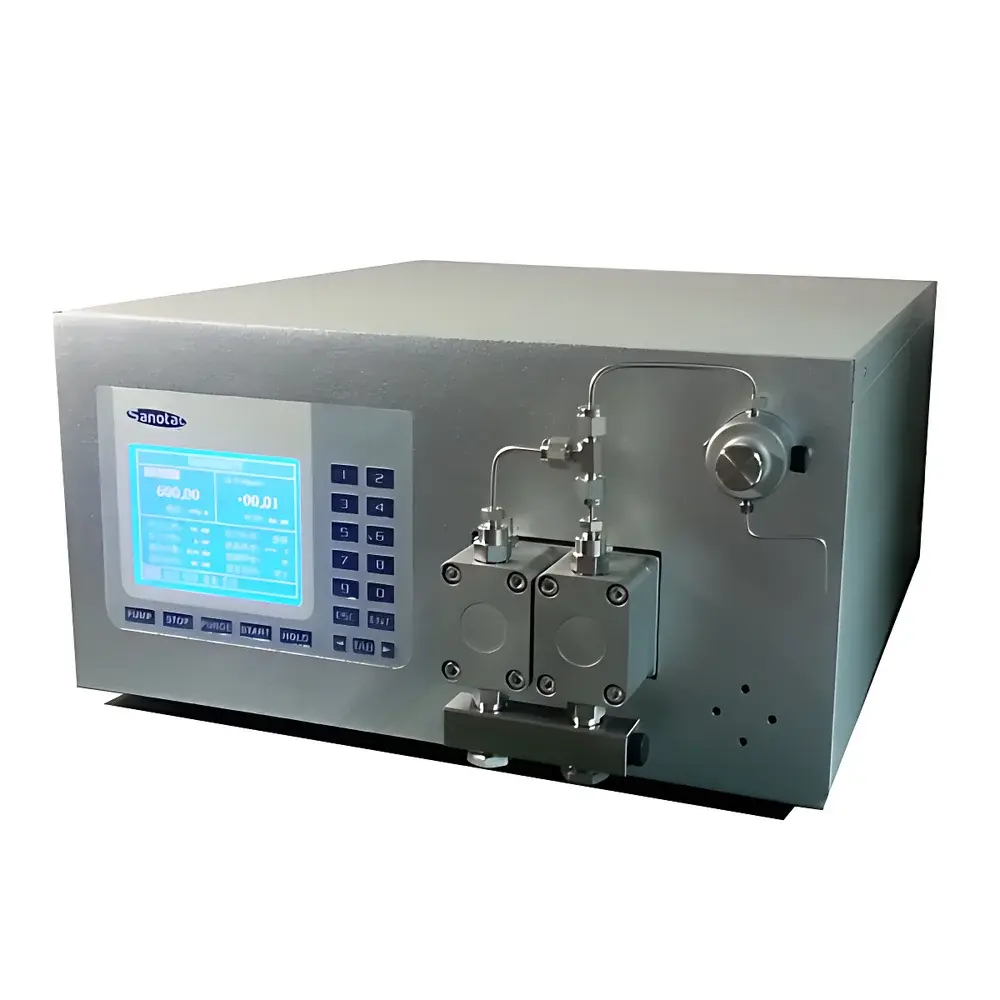
Sanotac TSP6005 Medium-Pressure Constant Flow Pump
| Brand | Sanotac |
|---|---|
| Origin | Shanghai, China |
| Manufacturer Type | Direct Manufacturer |
| Model | TSP6005 |
| Flow Rate Range | 10–10,000 mL/min |
| Pressure Range | 2–42 MPa |
| Pump Head Volume | 600 mL |
| Max. Pressure (Standard Configuration) | 5 MPa |
| Max. Pressure (High-Pressure Option) | 105 MPa |
| Construction Materials | Stainless Steel / Titanium / PTFE / PCTFE / Hastelloy / PEEK |
| Control Interface | Microprocessor-Based Dual-Piston Drive with Solvent Compressibility Compensation |
| Gradient Capability | Isocratic, Linear & Step Gradients |
| Flow Accuracy | High across full dynamic range |
| Pressure Pulsation | Minimized via Cam Profile Compensation & Electronic Flow Pulse Suppression |
| Seal Life | Extended via Floating Plunger Design |
| Check Valves | Swiss-sourced, High-Integrity |
| User Programs | 10 Predefined Methods |
| Communication Protocol | Open-Source PC Reverse Control (RS-232/RS-485 or optional Ethernet) |
Overview
The Sanotac TSP6005 Medium-Pressure Constant Flow Pump is an engineered precision fluid delivery system designed for demanding laboratory and pilot-scale applications requiring stable, reproducible volumetric flow under variable backpressure conditions. Based on dual-piston parallel drive architecture and microprocessor-controlled solvent compressibility compensation, the TSP6005 operates on positive displacement principles—ensuring consistent volumetric output independent of fluid viscosity, density, or system resistance within its specified pressure envelope (2–42 MPa standard; up to 105 MPa in high-pressure configuration). Its core function is to deliver chemically compatible solvents, reagents, catalysts, or supercritical fluids at precisely defined flow rates across a broad dynamic range—from 10 mL/min to 10,000 mL/min—making it suitable for integration into HPLC/UHPLC systems, continuous-flow reactors, catalytic screening platforms, SFC instrumentation, and extrusion-based material synthesis setups.
Key Features
- Dual-piston parallel drive mechanism with real-time solvent compressibility compensation ensures high flow accuracy (<±0.5% RSD typical) across the entire operational range.
- Multi-point flow calibration curves enable linearization of non-ideal pump behavior, supporting both low-flow analytical applications and high-throughput preparative workflows.
- Cam profile optimization combined with electronic flow pulse suppression reduces pressure pulsation to <0.5% peak-to-peak amplitude—critical for sensitive detection systems and stable reaction kinetics.
- Floating plunger design minimizes lateral stress on high-pressure seals, extending service life of PTFE, PEEK, or metal-faced sealing elements by up to 3× versus fixed-plunger alternatives.
- Swiss-manufactured check valves provide leak-tight operation up to 105 MPa, with validated chemical compatibility across aggressive solvents (e.g., HF, fuming nitric acid, supercritical CO₂).
- Open communication protocol (RS-232/RS-485, optional Ethernet) enables seamless integration with third-party chromatography data systems (CDS), LIMS, or custom LabVIEW/Python automation frameworks.
- Ten onboard user-programmable methods support complex gradient profiles—including hybrid isocratic/linear/step sequences—for method development without external software dependency.
Sample Compatibility & Compliance
The TSP6005 accommodates diverse fluid chemistries through configurable wetted-path materials: 316L stainless steel (standard), titanium (for chloride-rich or reducing environments), PTFE/PCTFE (for strong acids and oxidizers), Hastelloy C-276 (for hot alkaline or mixed-acid services), and PEEK (for high-purity aqueous or organic mobile phases). All configurations comply with ISO 9001:2015 manufacturing controls and meet mechanical safety requirements per EN 61000-6-2 (EMC immunity) and EN 61000-6-3 (EMC emission). When deployed in regulated environments (e.g., pharmaceutical QC labs), the pump supports audit-ready operation when paired with compliant CDS software enabling 21 CFR Part 11-compliant electronic signatures, user access control, and immutable audit trails.
Software & Data Management
The embedded firmware provides local control via intuitive membrane keypad and LCD interface, while remote operation is enabled through ASCII-based command sets documented in the publicly available communication protocol specification. No proprietary drivers are required—integration with Agilent ChemStation, Waters Empower, Thermo Chromeleon, or open-source tools (e.g., PySerial + Jupyter notebooks) is fully supported. Real-time flow/pressure telemetry is streamed at 10 Hz resolution, timestamped and buffered for post-run analysis. All method parameters—including gradient tables, flow ramps, and pressure limits—are stored with versioning and user attribution, facilitating GLP/GMP traceability when logged to networked storage.
Applications
- HPLC and preparative LC systems requiring stable flow delivery at 5–42 MPa for reversed-phase, HILIC, or ion-exchange separations.
- Catalytic reaction engineering: precise co-injection of catalyst precursors and substrates into continuous-flow microreactors or fixed-bed reactors.
- Supercritical fluid processing: metering of scCO₂ or scCHF₃ in extraction, impregnation, or particle formation (RESS, SAS).
- Electrochemical energy research: controlled electrolyte feed in flow batteries, PEM fuel cell test stations, or Li-ion electrode slurry dispensing.
- Polymer processing R&D: metering of monomers, initiators, and blowing agents in reactive extrusion or foam compounding lines.
- Geochemical simulation: high-pressure brine or CO₂ injection into core-flooding apparatuses under reservoir-relevant conditions (up to 105 MPa).
FAQ
What is the maximum allowable pressure for the standard TSP6005 configuration?
The base model is rated for continuous operation up to 42 MPa; a reinforced variant with hardened camshaft and ceramic-coated plungers supports intermittent duty at 105 MPa.
Can the TSP6005 be used with corrosive solvents such as hydrofluoric acid?
Yes—when configured with PTFE or PCTFE fluid paths and Hastelloy C-276 valve seats, it demonstrates full compatibility with HF concentrations ≤48% at temperatures ≤60°C.
Does the pump support gradient elution in HPLC applications?
Yes—its programmable gradient engine supports isocratic hold, linear ramp, step transitions, and composite profiles combining all three modes within a single method.
Is validation documentation available for GxP-regulated use?
IQ/OQ protocols, material certifications (EN 10204 3.1), and traceable calibration reports are provided upon request for qualified purchasers.
How is maintenance performed on the high-pressure seal assembly?
Seal replacement requires only standard hex tools; full procedure, torque specifications, and wear-limit inspection criteria are detailed in the bilingual (English/Chinese) service manual included with each unit.



