
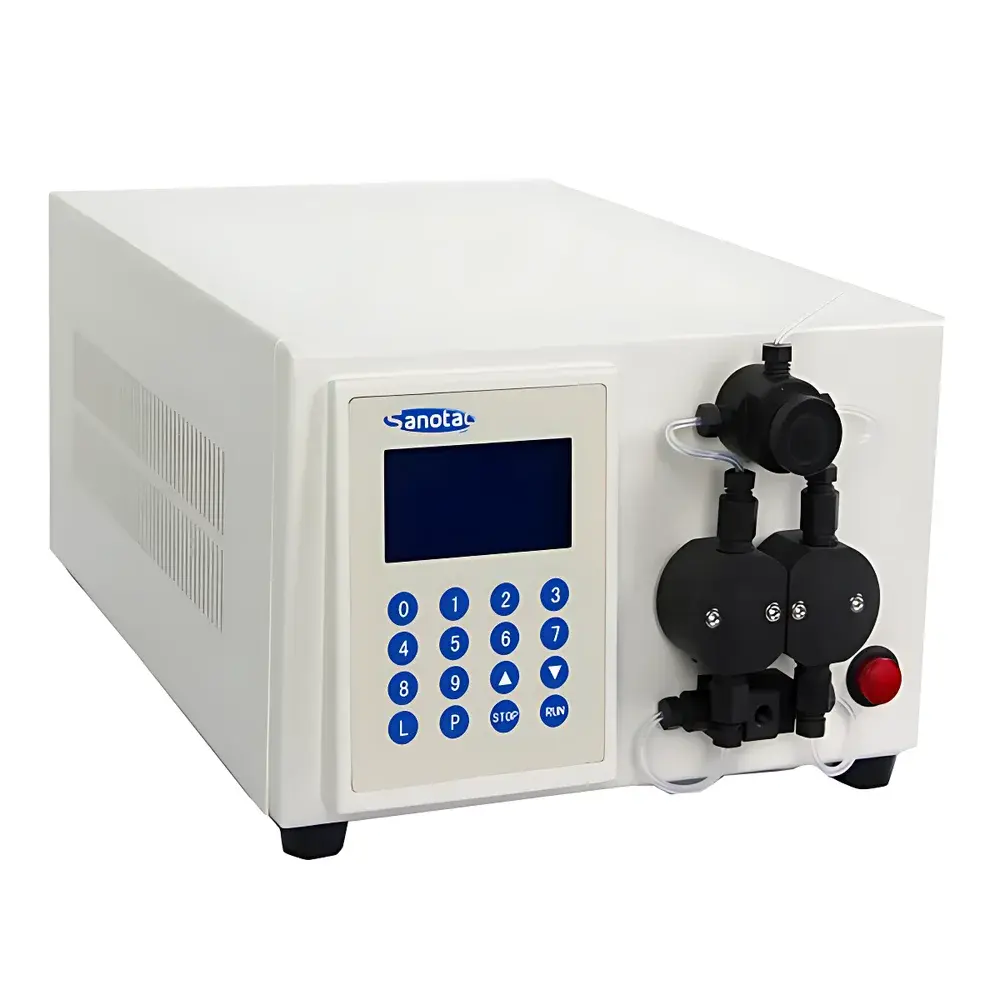
Sanotac VPF1002 PTFE-Lined High-Pressure Precision Metering Pump for Concentrated Sulfuric Acid and High-Viscosity Phosphoric Acid
| Brand | Sanotac |
|---|---|
| Model | VPF1002 |
| Flow Rate | 0.1–100.0 mL/min |
| Max Pressure | 2 MPa |
| Pressure Pulsation | ≤0.2 MPa |
| Flow Accuracy | ±1% |
| Flow Repeatability | ≤1% |
| Viscosity Range | 0–50 cP |
| Wetted Materials | PTFE, Sapphire, Zirconia Ceramic |
| Communication | RS232 (standard), RS485/422 (optional), Modbus RTU, Sanotac Proprietary Protocol |
| Power Supply | 85–264 VAC, 50 Hz |
| Power Consumption | 75 W |
| Weight | 12 kg |
Overview
The Sanotac VPF1002 is an engineered high-pressure precision metering pump designed specifically for handling aggressive, highly corrosive, and moderately viscous process fluids in laboratory and pilot-scale chemical synthesis environments. Its core operational principle relies on a positive displacement mechanism driven by a cam-actuated plunger system, coupled with electronic pulse suppression and real-time pressure feedback control. Unlike conventional stainless-steel or alloy-based metering pumps, the VPF1002 features a fully metal-free fluid path constructed entirely from chemically inert materials—polytetrafluoroethylene (PTFE) for tubing and seals, sapphire for check valve seats, and zirconia ceramic for plungers and valve components. This architecture ensures long-term integrity when dosing concentrated sulfuric acid (up to 98 wt%), phosphoric acid (including 85% orthophosphoric acid), hydrofluoric acid solutions, and other halogenated or oxidizing reagents where metallic leaching or passivation failure would compromise reaction fidelity or safety.
Key Features
- Metal-free wetted path compliant with ASTM D4522 and ISO 15142-2 for corrosion resistance in aggressive chemical environments
- Programmable pressure limit protection with adjustable upper threshold (0–2 MPa), preventing over-pressurization of downstream reactors or analytical flow cells
- Low-pressure pulsation design (<0.2 MPa) achieved via optimized cam profile compensation and active electronic flow stabilization—critical for stable residence time in continuous-flow microreactors
- Dual-unit flow output: selectable volumetric (mL/min) or gravimetric (g/min) delivery mode, enabling direct integration with mass-based reaction monitoring systems
- User-accessible calibration parameter zone for in-situ flow rate adjustment across varying fluid densities and viscosities (0–50 cP)
- Configurable operation modes: constant-flow mode for steady-state feed and gradient-flow mode for controlled ramped addition (e.g., catalyst titration or pH modulation)
- Real-time dual-curve visualization: synchronized pressure and flow rate trend plots accessible via front-panel display or remote interface
Sample Compatibility & Compliance
The VPF1002 is validated for use with concentrated mineral acids (H₂SO₄ ≥96%, H₃PO₄ ≥85%, HNO₃ up to fuming grades), organic solvents (e.g., chlorinated hydrocarbons, DMF, NMP), and viscous precatalyst slurries. Its PTFE/sapphire/zirconia construction meets USP Class VI biocompatibility requirements and complies with ISO 9001:2015 manufacturing controls. For regulated environments, the pump supports audit-ready operation through optional firmware-enabled event logging (start/stop, pressure fault, calibration update) aligned with GLP documentation standards. While not intrinsically rated for Zone 1 hazardous areas, it may be installed in ventilated enclosures meeting IEC 60079-14 guidelines when used with compatible explosion-proof controllers.
Software & Data Management
The pump supports native ASCII command protocol over RS232 (standard) and Modbus RTU over RS485 (optional), enabling seamless integration into industrial automation frameworks including Siemens S7 PLCs, Wonderware InTouch, Ignition SCADA, and LabVIEW-based custom acquisition platforms. All communication interfaces support full read/write access to operating parameters (target flow, pressure limit, run mode, calibration offsets) and real-time status registers (actual pressure, instantaneous flow, motor temperature, error codes). Firmware includes configurable data logging intervals (1–60 s) for time-stamped pressure and flow records exportable as CSV. Optional Ethernet module enables TCP/IP socket communication and HTTP REST API endpoints for cloud-connected lab infrastructure.
Applications
- Controlled reagent addition in continuous-flow sulfonation, nitration, and phosphorylation reactions
- Precise catalyst dosing (e.g., Pt/C, Pd(OAc)₂ suspensions) into high-pressure hydrogenation or oxidation reactors
- Supercritical CO₂ co-solvent delivery in extraction and particle formation systems
- Stoichiometric acid addition in automated titration modules for in-line pH control
- Feedstock metering in electrochemical flow cells and fuel cell membrane testing rigs
- Calibration fluid delivery for online conductivity and density analyzers in process analytical technology (PAT) workflows
FAQ
Does the VPF1002 require periodic recalibration under continuous operation?
Yes—users are advised to perform flow verification every 200 operating hours or after any change in fluid composition or temperature profile, using traceable gravimetric methods per ISO/IEC 17025-accredited procedures.
Can the pump handle particulate-laden slurries without clogging?
It supports suspended solids up to 5 µm in diameter at concentrations ≤0.5 wt%, provided the slurry exhibits Newtonian behavior and is pre-filtered through a 10 µm inline filter.
Is FDA 21 CFR Part 11 compliance available?
Electronic signature and audit trail functionality are available via optional firmware upgrade and validated software configuration package, supporting role-based access control and immutable record storage.
What is the maximum allowable inlet backpressure?
Inlet pressure must remain below 0.1 MPa (gauge) to ensure reliable check valve seating; higher inlet pressures require upstream pressure regulation.
How is thermal drift compensated during extended operation?
Internal temperature sensors monitor motor and drive housing conditions; flow compensation algorithms adjust pulse timing in real time to maintain volumetric accuracy within ±1% across ambient temperatures of 15–35°C.



