
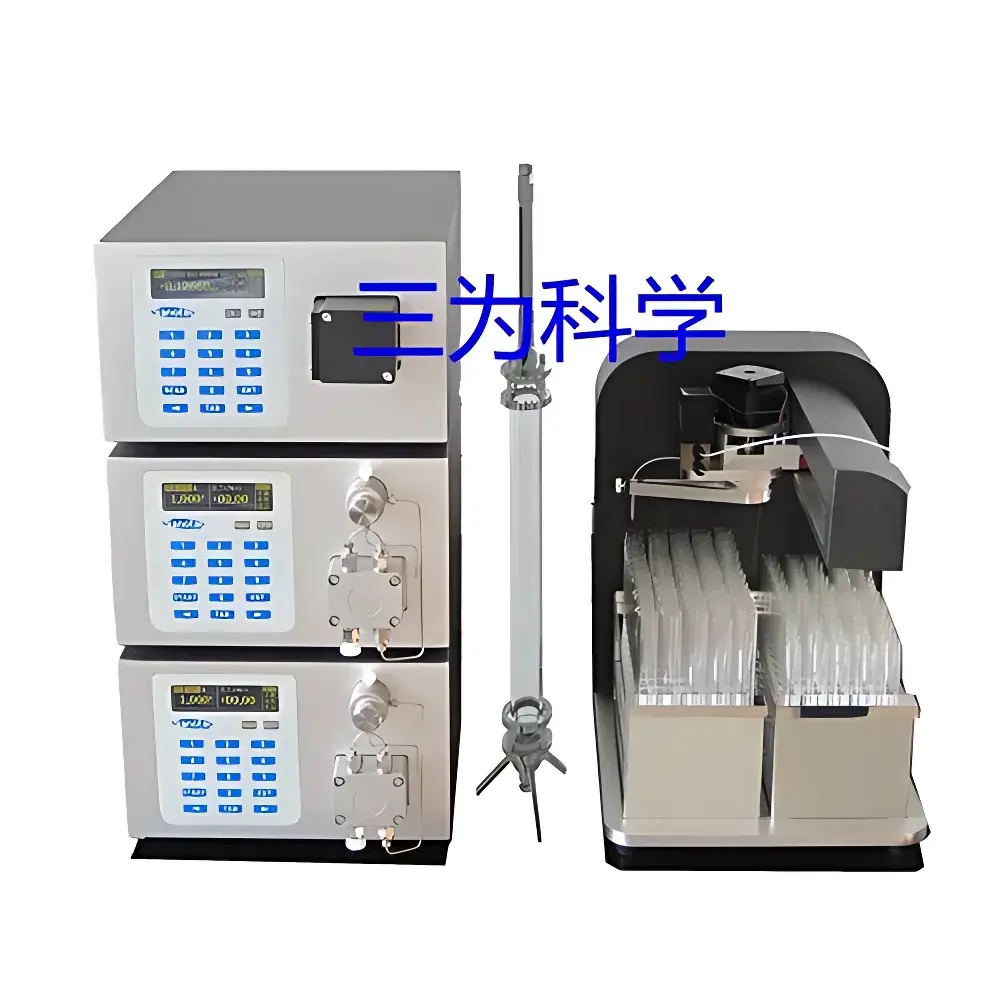
Sanotac ZD100 Preparative High-Performance Liquid Chromatography System
| Brand | Sanotac |
|---|---|
| Origin | Shanghai, China |
| Manufacturer Type | Original Equipment Manufacturer (OEM) |
| Product Category | Domestic |
| Model | ZD100 |
| Application Level | Laboratory-Scale |
| Instrument Type | High-Pressure Preparative Liquid Chromatograph |
| Flow Rate Range | 0.01–100.00 mL/min |
| Flow Accuracy | ±1% |
| Flow Precision (RSD) | ≤0.5% |
| Maximum Pressure | 20 MPa |
| Wavelength Range | 190–800 nm |
| Wavelength Accuracy | ±1 nm |
| Wavelength Reproducibility | 0.2 nm |
| Baseline Noise | ±0.75×10⁻⁵ AU (254 nm, TC = 1 s) |
| Data Acquisition Rate | 10 Hz |
Overview
The Sanotac ZD100 Preparative High-Performance Liquid Chromatography (Prep-HPLC) System is an engineered solution for the isolation and purification of reference standards from complex natural matrices—particularly Chinese herbal medicines (CHM), botanical extracts, and synthetic pharmaceutical impurities. Designed around a dual-piston, high-pressure reciprocating pump architecture with real-time chamber pressure feedback, the system delivers precise solvent delivery across a wide dynamic flow range (0.01–100.00 mL/min) while compensating for solvent compressibility and refill dynamics. Its operation adheres to the fundamental principles of reversed-phase and normal-phase liquid chromatography, enabling scalable separation of structurally diverse phytochemicals—including saponins, flavonoids, isoflavones, coumarins, chromones, alkaloids, phenolic acids, terpenoids, anthraquinones, and lignans—under reproducible, GxP-aligned conditions. The system operates at up to 20 MPa, supporting both analytical-scale method development and milligram-to-gram preparative fractionation in a single platform.
Key Features
- Microprocessor-controlled dual-piston pump with floating plunger design for extended seal life and consistent high-pressure performance.
- Advanced flow pulsation suppression via cam-profile compensation, achieving baseline noise as low as ±0.75×10⁻⁵ AU (254 nm, 1 s time constant).
- Multi-point flow calibration across the full range ensures ±1% flow accuracy and ≤0.5% RSD reproducibility.
- Dual-wavelength UV-Vis detector (190–800 nm) with deuterium and tungsten lamp auto-switching; wavelength accuracy ±1 nm, reproducibility 0.2 nm.
- Real-time dual-wavelength monitoring, wavelength programming, and stop-flow spectral scanning to minimize drift and maximize linear dynamic range (0–2 AU).
- Modular, field-upgradable architecture compatible with standard 10 mm ID–50 mm ID preparative columns from GE AKTA, Biotage®, ISCO®, Buchi®, and Bio-Rad® systems.
- 10 programmable user methods supporting gradient slope adjustment (minimum 1% increment), flow/gradient reprogramming during run, and multi-step elution profiles.
Sample Compatibility & Compliance
The ZD100 supports solid and liquid sample loading via a standard 10 mL loop preparative injection valve. It accommodates a broad polarity spectrum—from highly polar glycosides to non-polar diterpenes—through interchangeable stationary phases (C18, C8, silica, amino, cyano). All hardware interfaces and fluidic pathways are constructed from 316L stainless steel or PEEK (optional), ensuring chemical compatibility with aggressive solvents (e.g., DMSO, THF, chloroform, TFA-containing mobile phases). The system meets regulatory requirements for traceable, auditable workflows: Sanochrom™ control software is validated per CFDA GxP guidelines and fully compliant with FDA 21 CFR Part 11, including electronic signatures, audit trails, role-based access control, and data integrity safeguards required for GLP and GMP environments.
Software & Data Management
Sanochrom™ is a Windows-native (Windows 7/8/10) chromatography data system (CDS) that integrates pump, detector, and fraction collector control through USB and RS-232 interfaces. It enables simultaneous acquisition of up to four wavelength channels, customizable peak detection algorithms (threshold, slope, time-window), and automated fraction triggering based on time, volume, absorbance threshold, or derivative criteria. The software supports full audit trail logging—recording all parameter changes, method executions, user logins, and data exports—with immutable timestamps and operator attribution. Export formats include CSV, ASCII, and AIA (.cdf), facilitating integration with LIMS and third-party quantification tools. Electronic signature functionality complies with ALCOA+ principles (Attributable, Legible, Contemporaneous, Original, Accurate, Complete, Consistent, Enduring, Available).
Applications
The ZD100 is routinely deployed in natural product laboratories for the isolation of certified reference materials (CRMs) used in pharmacopoeial monographs (e.g., USP, ChP, EP). Key use cases include: purification of triterpenoid saponins from Astragalus membranaceus; isolation of quercetin glycosides and aglycones from Ginkgo biloba; resolution of stereoisomeric alkaloids from Corydalis yanhusuo; removal of genotoxic impurities from synthetic APIs; and recovery of oxidation-sensitive phenylpropanoids under inert atmosphere-compatible configurations. Its modular design allows seamless transition from scouting runs (5–10 mL/min) to production-scale purification (50–100 mL/min), reducing method transfer risk between R&D and QC labs.
FAQ
Is the ZD100 compatible with non-aqueous mobile phases such as hexane/isopropanol or chloroform/methanol?
Yes—the fluidic path uses chemically resistant 316L stainless steel and optional PEEK components, supporting full-range organic solvent compatibility.
Can the system be validated for use in a regulated pharmaceutical QC lab?
Yes—Sanochrom™ software includes 21 CFR Part 11-compliant features: electronic signatures, full audit trail, data encryption, and change control logs required for FDA and EMA submissions.
What is the minimum detectable mass for a typical flavonoid under standard Prep-HPLC conditions?
At 254 nm with 10 mm pathlength flow cell and 10 Hz sampling, LOD is typically 0.5–2 µg on-column for UV-absorbing compounds with ε > 10,000 L·mol⁻¹·cm⁻¹.
Does the fraction collector support custom tube rack geometries beyond 2×60 positions?
Yes—modular tray adapters accommodate 13 mm, 15 mm, and 20 mm diameter tubes; custom racks can be configured via software-defined coordinate mapping.
How is system suitability verified before a purification run?
Built-in diagnostics include pump priming verification, pressure decay test, baseline stability assessment (<1 hr), and wavelength accuracy check using holmium oxide filter.




