
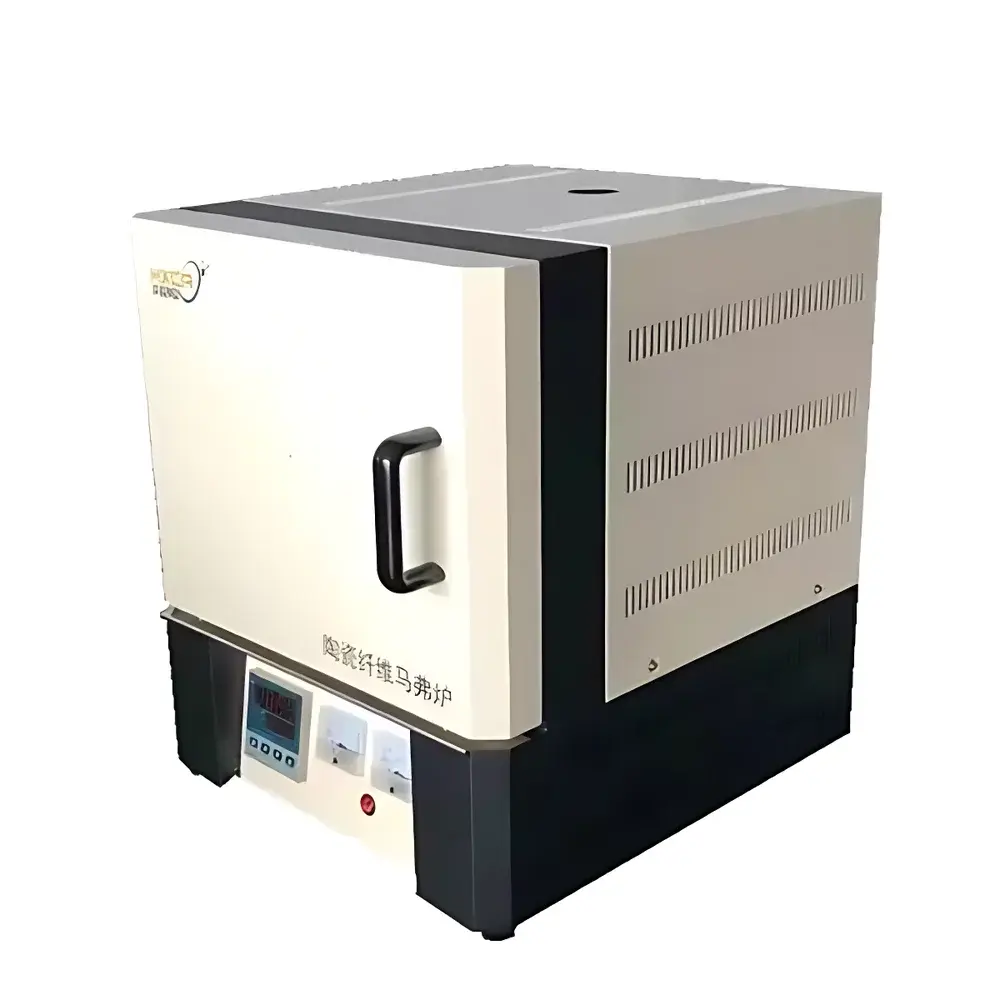
Sanpu CA-T Ceramic Fiber Muffle Furnace
| [Brand | Sanpu |
|---|---|
| Origin | Beijing, China |
| Manufacturer Type | Manufacturer |
| Model | CA-T |
| Temperature Range | Up to 1700 °C |
| Chamber Volume | 4–20 L |
| Heating Element | Kanthal A1 resistance wire (≤1400 °C) / Silicon molybdenum (MoSi₂) rods (1700 °C) |
| Control System | Programmable PID controller, up to 60 segments |
| Temperature Uniformity | ±5 °C (at setpoint) |
| Sensor | K-type (≤1200 °C), S-type (≤1400 °C), B-type (≤1700 °C) |
| Power Supply | AC 220 V / 50 Hz (≤9 L) |
| Weight | 55–120 kg (model-dependent) |
| Compliance | Designed for ISO/IEC 17025-compliant laboratories |
Overview
The Sanpu CA-T Ceramic Fiber Muffle Furnace is a high-performance, laboratory-grade thermal processing instrument engineered for precision ashing, calcination, heat treatment, and sample pre-digestion in analytical, pharmaceutical, environmental, and materials science applications. Unlike traditional brick-lined muffle furnaces, the CA-T series employs high-purity alumina-silica ceramic fiber insulation—offering exceptional thermal efficiency, rapid heating kinetics, and superior temperature stability. Its modular architecture supports operation across four maximum temperature classes: 1000 °C, 1200 °C, 1400 °C, and 1700 °C—each configured with thermocouple type, heating element, and power delivery optimized for thermal fidelity and long-term repeatability. The furnace operates on fundamental principles of resistive heating within a low-thermal-mass chamber, enabling controlled ramp-hold-cool cycles critical for standardized methods including ASTM D3174 (ash content), ASTM D3175 (volatile matter), ISO 1171 (determination of ash), and USP <281> (residue on ignition).
Key Features
- Programmable multi-segment PID control system supporting up to 60 customizable temperature ramps and holds, with user-defined rate limits (°C/min), dwell durations (min/h), and end-of-program actions (cool-down, hold, or shut-off)
- Ceramic fiber insulation (density: ~128 kg/m³) reduces thermal inertia—achieving 100–1000 °C in under 30 minutes (for ≤1400 °C models); 100–1200 °C in <80 minutes for 1700 °C variants
- Side-opening door with electromagnetic interlock: automatic power cutoff upon door actuation, compliant with IEC 61010-1 safety requirements for laboratory equipment
- Modular chamber design: interchangeable furnace bodies (4 L, 6 L, 9 L, 20 L) with standardized flange interfaces for optional gas purging, exhaust ducting, or oxygen enrichment ports
- Dual-zone thermal monitoring: primary control thermocouple (K/S/B-type) + independent verification sensor for redundancy and calibration traceability
- Energy-efficient power architecture: 4–9 L models operate on standard 220 V/16 A circuits; 20 L variant utilizes 380 V three-phase supply to maintain voltage stability under sustained load
- Robust heating elements: high-purity Kanthal A1 resistance wire (1000–1400 °C) or sintered silicon molybdenum (MoSi₂) rods (1700 °C), rated for >5,000 hours at nominal operating temperature
Sample Compatibility & Compliance
The CA-T furnace accommodates crucibles, boats, and trays made from alumina, quartz, platinum, and silicon carbide—compatible with aggressive matrices including coal, biomass, pharmaceutical excipients, catalysts, and geological samples. Its uniform temperature distribution (±5 °C across working volume per ISO 9001 validation protocol) ensures reproducible results for regulatory submissions. The instrument meets mechanical and electrical safety requirements per IEC 61010-1:2010 and supports quality management systems aligned with ISO/IEC 17025:2017. When integrated with optional RS485/Modbus or USB data loggers, it generates timestamped, tamper-evident temperature profiles compliant with FDA 21 CFR Part 11 for electronic records and signatures—enabling full audit readiness in GMP/GLP environments.
Software & Data Management
Standard configuration includes an embedded 4.3″ TFT touchscreen HMI with intuitive menu navigation, real-time graphing of setpoint vs. actual temperature, and event logging (door open/close, program start/end, overtemperature alarms). Optional PC software (Windows/Linux compatible) provides extended functionality: batch program import/export (.csv), automated report generation (PDF/Excel), trend analysis, and integration with LIMS via OPC UA. All logged data include metadata (operator ID, sample ID, method ID, instrument serial number) and are stored with SHA-256 hash integrity verification. Audit trail features record every parameter change—including who modified a program, when, and from which IP address—fulfilling ALCOA+ data integrity criteria.
Applications
- Coal & Energy Testing: ASTM D3172–D3176 (proximate analysis), ISO 5073 (ash fusion temperature), ASTM D5373 (elemental analysis by combustion)
- Environmental Analysis: EPA Method 2540C (total suspended solids ignition), ISO 11464 (pre-treatment of textile samples), DIN EN 13656 (waste incineration residue testing)
- Pharmaceutical QC: USP <281> (residue on ignition), Ph. Eur. 2.2.33 (loss on drying), ICH Q5C (protein stability studies requiring dry-heat exposure)
- Materials Research: Sintering of advanced ceramics (ZrO₂, SiC), thermal gravimetric pre-conditioning, catalyst activation/deactivation protocols, and metal oxide synthesis
- Food & Agriculture: AOAC 942.05 (crude ash determination), ISO 5984 (feed ash content), EN 15287-1 (biomass ash composition)
FAQ
What temperature uniformity can be expected across the working chamber?
Typical radial and axial uniformity is ±5 °C at steady-state operation within the central 60% of the chamber volume, verified per ISO 9001 thermal mapping procedure.
Is the furnace suitable for inert or reducing atmospheres?
Yes—optional flanged inlet/outlet ports support N₂, Ar, or forming gas (5% H₂/95% N₂) purging; quartz or alumina tube extensions available for semi-closed configurations.
Can the CA-T be validated for GxP use?
Absolutely—the system supports IQ/OQ/PQ documentation packages, including as-found/as-left calibration reports, alarm response testing, and worst-case thermal mapping protocols.
What maintenance is required for the heating elements?
Resistance wire elements require no routine servicing; MoSi₂ rods exhibit gradual resistance increase over time—calibration compensation is supported in firmware, and replacement intervals exceed 5,000 operational hours under proper loading conditions.
Does the controller support remote monitoring via Ethernet or Wi-Fi?
Standard units feature RS485 Modbus RTU; Ethernet/Wi-Fi gateway modules are available as accessories for SCADA or cloud-based fleet monitoring.





