
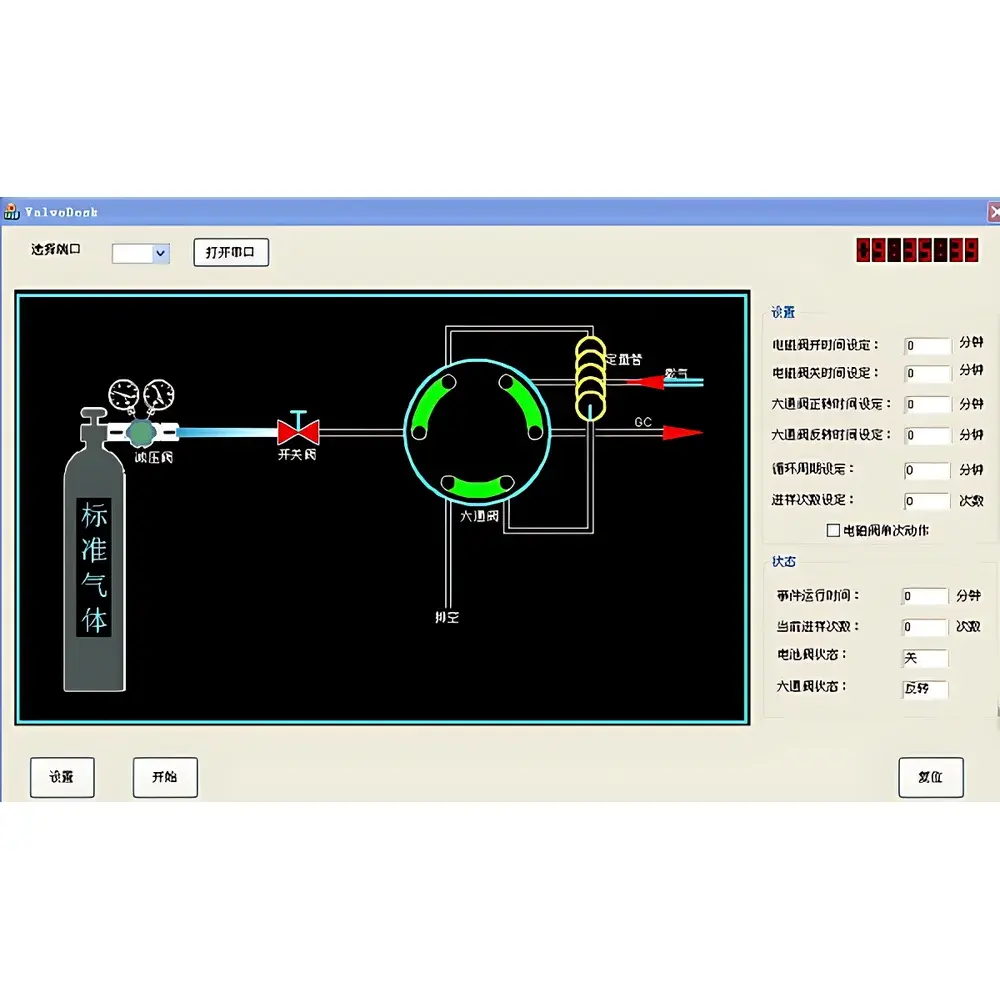
Sanpu ED-6 Automated Gas Autosampler
| Brand | Sanpu |
|---|---|
| Model | ED-6 |
| Origin | Beijing, China |
| Manufacturer Type | Direct Manufacturer |
| Instrument Type | Gas Chromatography Autosampler |
| Sample Format | Gaseous & Liquid (via gas-phase introduction) |
| Interface | USB to PC |
| Standard Injection Volume | 1 mL (0.5 / 2 / 3 / 5 mL optional) |
| Temperature-Controlled Zone | Ambient to 200 °C (±0.5 °C accuracy, optional) |
| Display | 12-inch TFT LCD touch screen (optional) |
| GC Synchronization | TTL/Relay trigger output for GC start |
| Duty Cycle | Continuous unattended operation (24/7) |
Overview
The Sanpu ED-6 Automated Gas Autosampler is a dedicated, programmable sample introduction system engineered for gas-phase analysis by gas chromatography (GC). It operates on the principle of precise pressurized gas displacement and valve-switched quantitative loop injection—compatible with standard 6-port or 10-port switching valves—and delivers reproducible, time-synchronized sample transfer directly into the GC inlet without occupying the primary injection port. Unlike manual syringe injection or fixed-loop valve systems, the ED-6 integrates real-time sequence control, thermal management of critical fluidic pathways, and hardware-level GC instrument synchronization. This architecture ensures minimal carryover, high inter-run repeatability (RSD < 1.5% for retention time and peak area under optimized conditions), and robust performance in both laboratory-based method development and continuous online process monitoring applications.
Key Features
- Programmable injection parameters: user-defined sampling time, injection time, number of injections per sequence, and delay intervals between runs
- Integrated GC triggering interface: TTL or relay output signal initiates GC acquisition simultaneously with valve actuation, eliminating timing drift between sample introduction and data capture
- Modular thermal management: heated valve manifold and sample loop zone (ambient to 200 °C, ±0.5 °C stability) prevents condensation of volatile organic compounds (VOCs) and ensures consistent vapor-phase composition delivery
- Non-invasive integration: installs externally to the GC; preserves native manual injection capability at the instrument’s front inlet
- Full PC-based configuration: USB 2.0 interface enables parameter setup, method storage, and firmware updates via Windows-compatible software—no embedded keypad dependency
- Continuous-duty design: rated for 24/7 unattended operation in ambient lab environments (15–35 °C, <80% RH non-condensing)
- Flexible volume support: standard 1 mL quantitative loop; optional loops of 0.5, 2, 3, or 5 mL available; custom loop volumes accommodated upon request
- Optional human-machine interface: 12-inch capacitive touchscreen display with graphical workflow navigation and real-time status monitoring
Sample Compatibility & Compliance
The ED-6 supports gaseous samples delivered via pressurized cylinders, gas bags, or process stream manifolds, as well as liquid samples introduced via headspace or purge-and-trap interfaces (when coupled with appropriate upstream modules). It complies with fundamental requirements for analytical instrumentation used in regulated environments: all firmware logs timestamped method changes and injection events; USB communication supports audit trail export in CSV format; thermal control subsystem meets IEC 61000-6-2/6-3 immunity and emission standards. While not pre-certified to FDA 21 CFR Part 11, the system architecture permits integration into Part 11–compliant workflows when deployed with validated LIMS or chromatography data systems (CDS) that enforce electronic signatures, role-based access, and immutable audit trails.
Software & Data Management
Control software runs natively on Windows 10/11 (64-bit) and provides a hierarchical method editor supporting multi-sequence scheduling, conditional logic (e.g., “inject only if pressure > 0.8 bar”), and automatic calibration curve generation from bracketing standards. All acquisition metadata—including loop temperature, valve cycle count, GC trigger latency, and USB handshake status—is embedded in exported .csv result files. Software updates are distributed as signed installers; version history and changelogs are maintained in accordance with ISO/IEC 17025 clause 5.9.3 for software validation traceability. No cloud connectivity or remote telemetry is implemented—data residency remains fully local unless explicitly routed through customer-controlled network infrastructure.
Applications
- Continuous emissions monitoring (CEM) of stack gases (e.g., SO₂, NOₓ, CO, CH₄) per EPA Methods 18 and 25A
- Refinery and petrochemical process stream analysis (C₁–C₅ hydrocarbons, H₂S, mercaptans)
- Indoor air quality (IAQ) and workplace exposure assessment per ISO 16000-6 and OSHA Method 05
- Pharmaceutical residual solvent testing (ICH Q3C) using headspace-GC configurations
- Biogas composition profiling (CH₄, CO₂, H₂, H₂S) in anaerobic digestion facilities
- Calibration gas verification and cylinder certification laboratories requiring NIST-traceable repeatability
FAQ
Is the ED-6 compatible with Agilent, Thermo Fisher, and Shimadzu GC systems?
Yes—its TTL/relay trigger output and pressure-tolerant pneumatic interface are vendor-agnostic and have been verified with all major GC platforms, including Agilent 7890/8890, Thermo ISQ EC, and Shimadzu GC-2030.
Can the ED-6 be integrated into an existing SCADA or DCS environment?
It does not feature native Modbus TCP or OPC UA; however, its USB-controlled operation allows integration via middleware (e.g., LabVIEW, Ignition SCADA) using provided DLL libraries and documented command protocol.
What maintenance intervals are recommended for long-term reliability?
Valve seals and loop tubing should be inspected every 6 months or after 10,000 cycles; heating element calibration is advised annually using a NIST-traceable RTD probe.
Does the system support internal standard addition during injection?
No—the ED-6 performs pure sample transfer only; internal standard spiking must be implemented upstream (e.g., via T-piece mixing before the loop) or via GC method programming with post-column reagent addition.
Is firmware source code or SDK documentation available for custom integration?
A complete binary firmware update toolkit and C/C++ API reference guide (including USB HID command structure and error code definitions) are supplied under NDA to qualified OEM and system integrator partners.



