
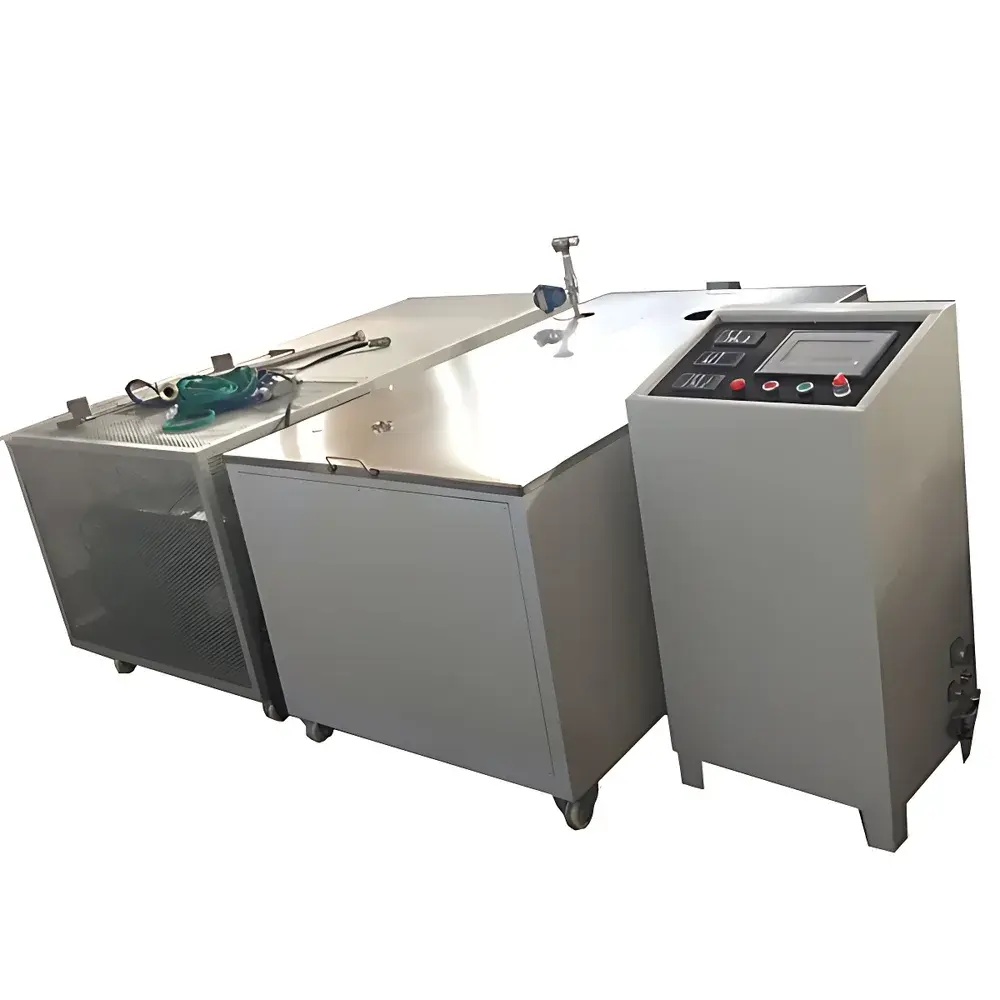
Sanqi SQ005B Sanitary Ceramics Thermal Shock Tester
| Origin | Hunan, China |
|---|---|
| Manufacturer Type | Authorized Distributor |
| Origin Category | Domestic (China) |
| Model | SQ005B |
| Pricing | Available Upon Request |
| Cold Water Pressure Range | 0.05–0.5 MPa (Accuracy Class 1.0) |
| Hot Water Pressure Range | 0.05–0.5 MPa (Accuracy Class 1.0) |
| Flow Rate Measurement Range | 0.05–0.6 L/s (Accuracy Class 1.0) |
| Power Supply | 380 VAC, 36 kW |
| Cold Water Temperature Control | Ambient to 10 ± 1 °C |
| Hot Water Temperature Control | Ambient to 90 ± 1 °C |
| Cold Water Tank Capacity | 300 L |
| Hot Water Tank Capacity | 350 L |
| Compliant Standards | AS 3588:1996, EN 14688:2015, EN 14516:2006, EN 13310:2015 |
Overview
The Sanqi SQ005B Sanitary Ceramics Thermal Shock Tester is a purpose-engineered physical property testing system designed to evaluate the structural integrity and thermal fatigue resistance of vitreous china sanitary ware—including toilets, basins, bidets, and urinals—under rapid, cyclic temperature transitions. It operates on the principle of controlled, alternating immersion or pressurized water exposure between independently regulated cold and hot reservoirs, simulating real-world service conditions that induce thermally driven stress gradients in ceramic bodies. Unlike generic environmental chambers, this tester delivers precise hydraulic pressure coupling alongside temperature ramping, enabling standardized simulation of thermal shock as defined by international ceramic testing protocols. Its architecture supports deterministic pass/fail assessment of glaze crazing, body microcracking, and joint delamination following prescribed thermal cycling sequences.
Key Features
- Integrated dual-temperature fluid circulation system with independent 300 L cold-water (10 ± 1 °C) and 350 L hot-water (90 ± 1 °C) tanks, each equipped with PID-controlled heating/cooling modules and level-sensing feedback loops
- High-reproducibility hydraulic delivery: dual precision pumps delivering calibrated static pressures from 0.05 to 0.5 MPa (Class 1.0 accuracy per ISO 4064) for both cold and hot circuits
- Real-time flow monitoring via calibrated electromagnetic flow meters (0.05–0.6 L/s range, Class 1.0 accuracy), synchronized with thermal cycle timing logic
- 7-inch industrial-grade capacitive touchscreen HMI with preloaded test templates aligned to AS 3588:1996, EN 14688:2015, EN 14516:2006, and EN 13310:2015
- Fail-safe interlocks including overtemperature cutoff, low-fluid-level shutdown, pressure relief valves, and door-position sensors compliant with IEC 61000-6-2 EMC immunity requirements
- Modular test chamber design accommodating full-size WC pans (up to 800 × 400 × 750 mm) with adjustable mounting fixtures and non-contact thermal mapping ports
Sample Compatibility & Compliance
The SQ005B accommodates standard and oversized sanitary ceramic specimens up to 75 kg mass and 0.8 m height, with fixture adaptability for wall-hung, floor-standing, and concealed cistern configurations. All operational parameters—including dwell time at extreme temperatures, transition rate between thermal phases, pressure application sequence, and total cycle count—are programmable to satisfy clause-specific requirements across referenced standards. The system’s metrological traceability is maintained through factory calibration certificates for pressure transducers (EN 837-1), temperature sensors (IEC 60751 Class B), and flow meters (ISO 4064-1). It supports GLP-compliant documentation generation required for CE marking submissions and third-party certification audits under EN 14688 Annex A.
Software & Data Management
Embedded firmware provides ISO/IEC 17025-aligned data integrity features: timestamped raw parameter logging (pressure, temperature, flow, cycle count) at 1 Hz resolution; automatic report generation in PDF and CSV formats; user-access-level controls (operator, technician, administrator); and audit trail functionality recording all configuration changes, manual overrides, and calibration events. Optional Ethernet/IP connectivity enables integration into centralized LIMS environments and supports remote diagnostics via TLS-secured SSH sessions. All data files include embedded digital signatures conforming to FDA 21 CFR Part 11 electronic record requirements when paired with validated user authentication workflows.
Applications
- Pre-production validation of glaze-body thermal expansion coefficient matching in vitreous china formulations
- Quality conformance testing for ISO 13006-compliant sanitary ware prior to export to EU, Australia, and ASEAN markets
- Root-cause analysis of field failures linked to thermal cycling-induced cracking in installed bathroom suites
- Material development support for low-expansion frit systems and reinforced porcelain bodies
- Third-party certification testing per EN 14516 Annex C (thermal shock resistance of ceramic fittings)
- Supplier qualification audits requiring documented repeatability (RSD ≤ 3.2% across n = 10 replicate cycles on identical specimens)
FAQ
What standards does the SQ005B explicitly support?
AS 3588:1996, EN 14688:2015, EN 14516:2006, and EN 13310:2015 — with test templates preconfigured for thermal dwell times, pressure hold durations, and cycle repetition counts specified in each.
Is external calibration required before first use?
Yes. Initial verification must be performed using NIST-traceable pressure calibrators (e.g., Fluke 729), PT100 reference thermometers (±0.1 °C), and volumetric flow standards per ISO 4064-3 prior to IQ/OQ execution.
Can the system operate continuously for extended durability testing?
It is rated for uninterrupted operation up to 72 hours under nominal load (36 kW supply, ambient ≤ 30 °C, relative humidity ≤ 75%), with thermal management ensuring stable tank temperatures and pump motor winding temperatures within Class F insulation limits.
Does the controller support custom test profiles beyond the built-in standards?
Yes. Advanced mode allows user-defined multi-step sequences with variable ramp rates, conditional branching based on real-time sensor thresholds, and external trigger inputs for synchronized auxiliary equipment (e.g., image capture systems).



